The Anthropic AI Safety Bill: What It Would Actually Change
Anthropic shared a draft federal AI safety bill with Congress. As reported, it routes all blocking power through one judge, shutting out every other agency.
Anthropic has shared a confidential discussion draft of federal legislation with a small number of congressional offices, a draft that would let the government stop an AI model posing a risk of mass harm. The Anthropic AI safety bill, reported under the title AEGIS Act, has no bill number, no sponsor who has introduced it, and no vote scheduled. What it does have, according to press reports of the text, is a narrow mechanism that would hand all federal blocking power to a single judge, and expressly lock every other agency out of the decision. That design detail matters more than the bill’s current odds of passing, because it reveals how an AI lab wants safety regulation to actually work.
What the draft legislation actually proposes
If the name sounds familiar from our look at how Anthropic handled pulling one of its own models offline, this is a different kind of move: the company shaping policy rather than managing its own product. The text, first reported by Politico on October 16 and detailed further by TechCrunch and The Next Web, would let the federal government block the release of an AI model, but only under a narrow set of conditions. A model could be stopped only if it poses a foreseeable, imminent risk of killing or seriously injuring more than 50 people, or causing more than $1 billion in damages, and only if that risk comes from one of three named scenarios: the creation or release of a biological weapon, a model evading its developer’s controls, or a cyberattack. Nothing outside those three categories would qualify, no matter how large the damage.
The process to get there is just as specific. The Department of Commerce, the federal agency that already oversees export controls and technology policy, would have to bring evidence of one of those three risks before a federal judge, specifically at the US District Court for the District of Columbia. That judge, not a technical regulator or a scientific panel, decides whether the model gets blocked. The risk assessment behind that evidence would come from independent evaluators registered with Commerce, who could be paid by the AI labs themselves, as long as, in the wording Politico reported and TechCrunch relayed, the payment is “not contingent on the evaluations’ results.”
Read in isolation, each piece sounds like reasonable due process. Put together, they describe a single, narrow gate, not a safety net.
Why routing everything through one judge changes the stakes
A federal judge handling an AI safety case is not the same as a technical regulator handling one. A judge is trained to weigh evidence and apply law, not to assess whether a model’s behavior under adversarial testing crosses a line that a machine learning researcher would recognize as dangerous. Press coverage of the draft mentions no requirement that the judge have any technical background, and no standing panel of AI specialists built into the process to advise them. Expert testimony can be brought in, as in any trial, but the decision itself sits with one person who may be seeing model evaluation evidence for the first time.
Court proceedings also take time, and the draft frames its trigger as a “foreseeable, imminent risk.” Whether a district court can move at the speed an imminent-harm claim requires is an open question that, as reported, the draft does not resolve.
The part of the mechanism that carries the most weight, though, is not the judge’s qualifications. It is what the bill leaves out. According to press reports, the draft text expressly states that no other federal department, agency, or office could suspend a model’s development, deployment, or internal use. This one courtroom path is not one option among several. As reported, it is the only path, by design.
How this compares to the law Anthropic already backs
Anthropic is not new to AI safety legislation. The company has publicly endorsed California’s SB 53, a state law in effect since January 1, 2026 that requires large frontier AI developers to publish a safety framework. SB 53 and the federal draft solve two different problems. SB 53 is a transparency law. It gives no power to block a model or to approve it before release. It requires large developers to publish a safety framework, to follow it, and to report serious incidents, with civil penalties of up to $1 million per violation enforced by California’s Attorney General.
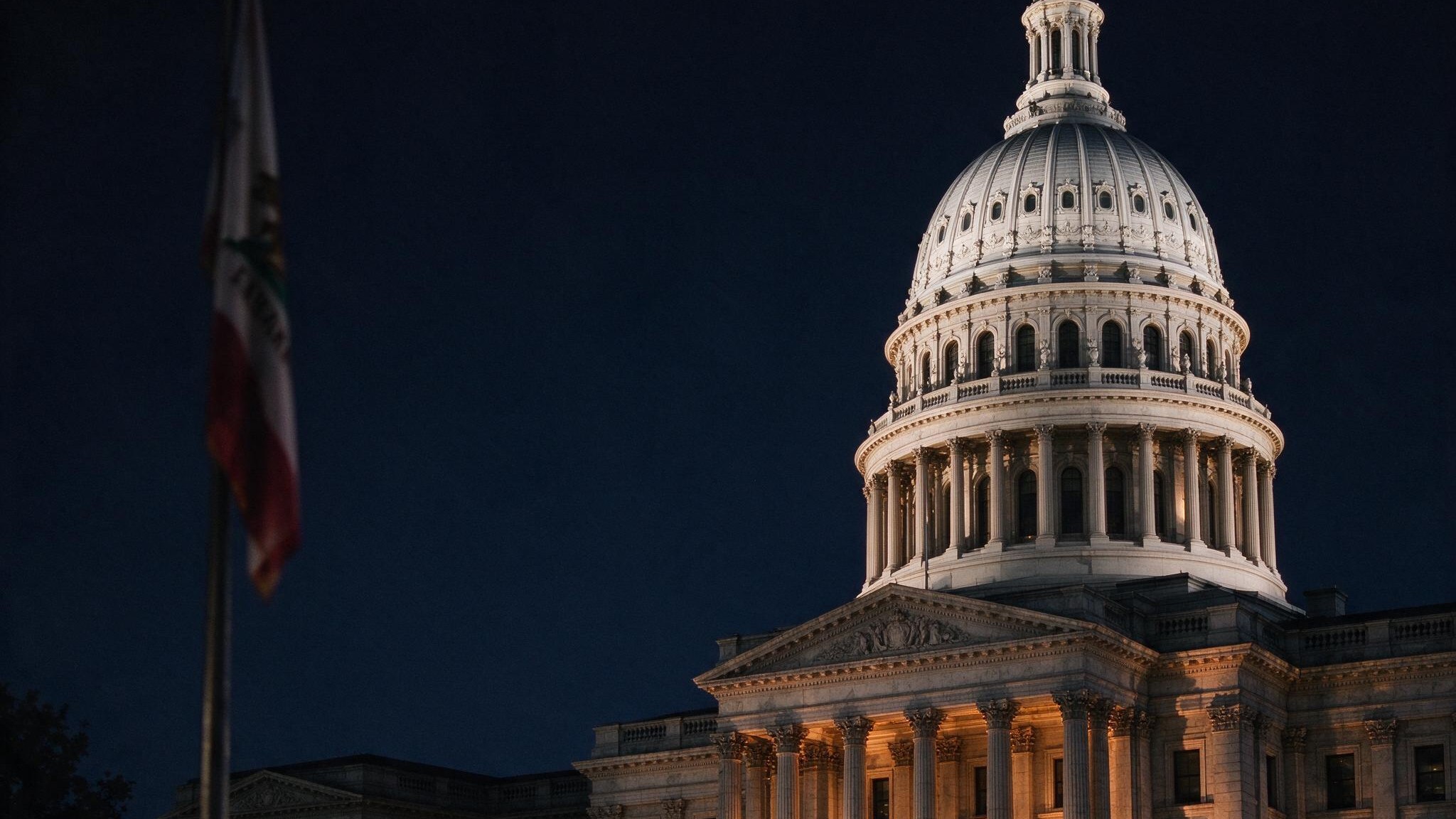 The California State Capitol in Sacramento. Governor Newsom signed SB 53 on September 29, 2025, the transparency law Anthropic endorsed that month.
The federal draft is the opposite kind of tool: it does carry blocking power, routed through a court. Anthropic’s own voluntary safety commitments, its Responsible Scaling Policy, are a third, separate thing again: a policy the company sets for itself. For SB 53, Anthropic uses a different document, its Frontier Compliance Framework.
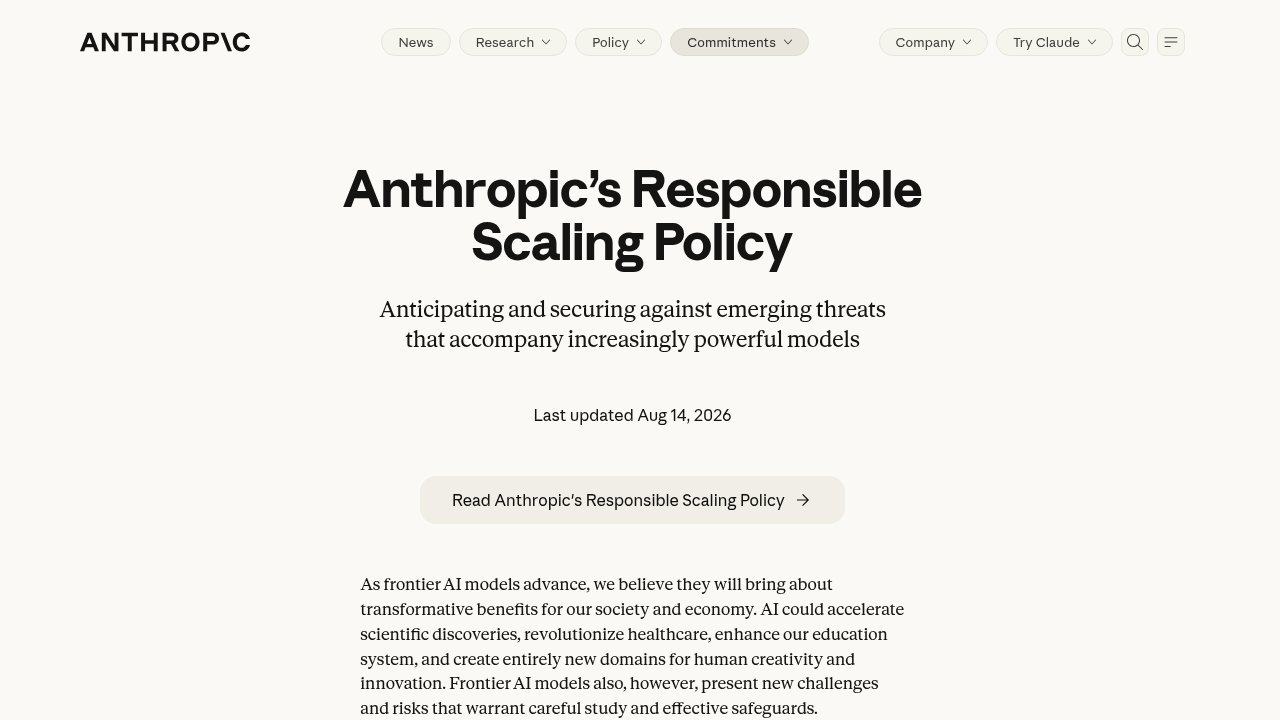 Anthropic’s Responsible Scaling Policy, the company’s own voluntary safety policy, which sits alongside SB 53 and the federal draft in this comparison.
Lining the three up side by side shows the gap plainly. A transparency law that Anthropic endorsed, and says it complies with, asks for disclosure rather than restraint. A federal bill that creates real blocking power, but funnels it through exactly one courtroom and shuts out every other regulator, asks for predictability in exchange. Supporting a disclosure law while writing a blocking law yourself is not a contradiction. It is a coherent position, just not the one the safety framing suggests on its own.
Where the draft actually stands right now
As of October 27, 2026, the text has not been formally introduced in Congress. No representative or senator has publicly confirmed sponsoring it, and it has no bill number. Anthropic’s own newsroom, where the company announced its support for SB 53, does not list the text. A company spokesperson did confirm it to the press, describing it as following the proposals in Anthropic’s Advanced AI Framework, and Anthropic’s head of federal affairs said on October 18 that the company plans to update the language on preemption and may revisit the risk thresholds. The figures in this article are those of the October 16 draft.
That status is not a technicality. A bill without a sponsor is a position paper, not a proposal moving through a legislature. Congress works through committees, markups, and floor votes, and none of that has started here. What exists today is a document Anthropic is showing to a small number of congressional offices, and that reached the press, making the case for a specific shape of regulation before anyone has agreed to carry it forward. It could be introduced tomorrow with a sponsor’s name attached, or it could sit as a talking point for years. Readers searching for what the bill requires today should know they are reading a pitch, not a law on the books, and nothing in it binds anyone yet.
What the draft says about how AI labs want to be regulated
Step back from the specific numbers and the single courtroom, and a pattern becomes visible that will outlast this particular draft. An AI lab writing its own proposed safety law is a predictable move once a technology reaches the size where regulation becomes inevitable: the company with the most at stake wants to shape the rules before someone else does. The question worth sitting with is not whether Anthropic is acting in bad faith. It is what kind of oversight a lab-authored bill tends to produce when nobody else is in the room.
A bill that funnels all federal blocking power through one court, and forecloses every other agency from acting in parallel, is a bill that favors predictability over broad intervention capacity. A company operating under that regime knows exactly which door regulators can walk through, and knows every other door is sealed by statute. That is valuable to a company planning years of model releases, and it is a different kind of value than the safety framing implies, easy to blur together if you only read the press release.
None of this makes the three risk scenarios in the bill, bioweapons, loss of control, large-scale cyberattacks, unreasonable things to worry about. The durable point is narrower and more useful: when a law arrives framed as a safety measure, the part worth reading closely is not the headline threat it names, but the access it grants and the access it removes. A single gate is easier to defend in a courtroom, and easier to predict as a business, than an open field where any regulator could act.

Frequently asked questions
Is the Anthropic AI safety bill an actual law right now?
No. The Anthropic AI safety bill is a confidential discussion draft the company has shared with a small number of congressional offices, not a bill that has been formally introduced. It has no bill number, no congressional sponsor, and no scheduled vote, so nothing in it currently has legal force.
What would trigger a model being blocked under the draft bill?
Under the text as reported, a model could only be blocked if it posed a foreseeable, imminent risk of killing or seriously injuring more than 50 people, or of causing more than $1 billion in damages, and only if that risk came from a biological weapon, a model evading its developer’s controls, or a cyberattack. No other type of harm would qualify under the draft.
Who would decide whether to block an AI model under this proposal?
A single federal judge at the US District Court for the District of Columbia would decide, after the Department of Commerce presents evidence of one of the three named risk scenarios. Press coverage mentions no technical AI background requirement for that judge, and no other federal agency would have the power to act instead.
How is this different from California’s SB 53, which Anthropic supports?
SB 53 is already in effect and requires large frontier developers to publish and follow a safety framework and to report serious incidents, with civil penalties, but it carries no power to block a model from shipping. The federal draft does carry blocking power, but as reported it routes it through one court and excludes every other federal agency from acting, a fundamentally different kind of law than SB 53.
Could other federal agencies step in if this bill becomes law?
According to press reports, no. The draft expressly states that no other federal department, agency, or office could suspend a model’s development, deployment, or internal use once this mechanism is in place. The single court path would be the only route available, not one option among several.