The AI Developer Productivity Survey Everyone Will Misread
Atlassian's 2026 AI developer productivity survey shows a startling drop in reported time saved. Here is what actually changed, and what did not.
A new survey of 1,560 software developers and engineering leaders found that the share reporting they save 10 or more hours a week thanks to AI coding tools dropped from 68% to 25% in a single year. That number is about to travel fast, and most of the coverage repeating it will frame it as proof that AI coding assistants are disappointing people. The survey itself tells a different story: 87% of the same respondents still say AI helps them ship faster than before. Adoption has not slipped. What changed is where the time AI frees up actually goes, a question that sits close to how teams organize their internal developer platforms and the workflows built on top of them.
The survey is Atlassian’s annual State of Developer Experience report for 2026, published October 20 on the company’s own blog and covered a week later by the trade outlet InfoQ. Atlassian is best known for Jira and other software used to plan and track engineering work, which is also why it runs this kind of survey: better data on how developers actually work helps sell more of that software. That commercial interest does not make the numbers wrong, but it is worth knowing who is asking the question.
What this survey actually measured, and what it did not
Atlassian polled 1,155 individual contributor developers and 405 engineering leaders in 2026 and asked them how AI tools affect their work. The report is explicit about what kind of data this is: it reflects self-reported experience and perception, not system-level telemetry. Nobody measured actual commits, build times, or deployment frequency. Every figure in the report is a person’s own estimate of how AI is going, filtered through memory, mood, and whatever happened that week.
That distinction matters more than it sounds. A developer who says they save “10+ hours a week” is reporting a feeling, not a stopwatch reading. People are notoriously bad at estimating their own time use, and the number can shift for reasons that have nothing to do with the tool itself, such as a harder sprint, a new project, or simply a more honest mood when filling out the form.
It also matters that the 2025 and 2026 figures come from two separate annual samples, not the same group of people followed over time. Nobody can say for certain that a given developer’s number dropped. What the survey shows is that the population answering the question in 2026 reported a very different average experience than the population that answered it in 2025. That is a real and useful signal about the industry, but it is not a before-and-after story about identical people.
The number everyone will misread
Here is the headline figure, stated plainly: in 2025, 68% of developers told Atlassian that AI saved them 10 or more hours a week. A year later, only 25% said the same. (Atlassian’s own blog post states this figure as 25%; InfoQ’s recap of the same report cites 26% instead. This piece uses the number from Atlassian’s original post.) That is a drop of more than 40 percentage points, and on its own it looks like a collapse.
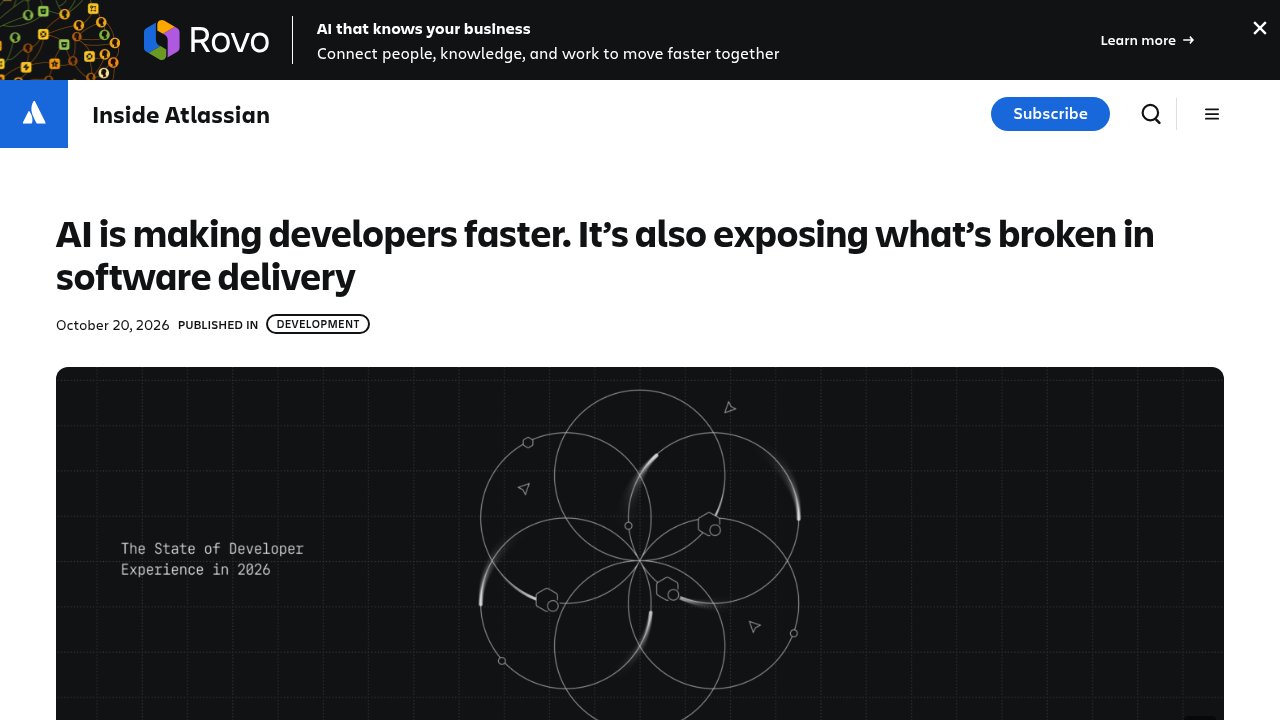
Atlassian — the company’s own write-up of its 2026 State of Developer Experience survey, the source of the figures in this piece.
But the same survey asked a separate question: does AI help you ship work faster? 87% of developers answered yes, essentially unchanged from the enthusiasm Atlassian measured the year before. If AI coding assistants had genuinely gotten worse, or if developers had lost faith in them, that second number should have fallen too. It did not. People still think the tools help. They just do not think the tools save as much net time as they did a year ago.
That gap, between still-helps and no-longer-saves-as-much, is the actual story. It means something downstream of the AI’s output is eating into the benefit. The report points at exactly where.
Where the saved time actually went
Atlassian found that 72% of developers report the same amount of friction in their work as before AI, or more, with only about 28% saying friction has meaningfully gone down. Friction, in this context, means the everyday drag of getting work done: context switching, waiting on reviews, chasing down why something broke. AI was supposed to cut that drag. For most respondents, it has not.
Part of the answer is time spent managing the tools themselves rather than writing code. 49% of individual contributor developers and 57% of engineering leaders now spend four or more hours a week managing AI tools, a category that covers choosing which assistant to use for which task, configuring it, and keeping up with how it changes. Leaders report even more of this overhead than the developers actually writing code, which suggests the coordination cost sits as much at the team level as at the keyboard.
The other part is cleanup work. 65% of developers say they regularly spend time correcting output that AI generated. Code that an assistant writes quickly can still be wrong, outdated, or simply not what the task needed, and someone has to catch that before it ships. Taroon Mandhana, Atlassian’s Chief Technology Officer for AI and Teamwork, put it this way in comments reported by InfoQ: “the bottleneck has moved to managing AI’s work.” The AI is not slow anymore. Managing what it produces is.
The one thing that cuts the overhead in half
The report’s most useful finding is not about the tools at all. It is about how organizations deploy them. Only 17% of developers and 23% of engineering leaders say their organization has an AI strategy that is clearly communicated and actively implemented across the development lifecycle, meaning most teams are left to figure out AI usage case by case rather than following any agreed approach.
Atlassian — the report’s official landing page, summarizing its core finding.
The developers who do work inside a clear strategy fare noticeably better. Developers at organizations with a clearly communicated AI strategy are twice as likely to report reduced friction than those without one. Same tools, same general technology, very different experience, and the difference is organizational rather than technical.
Without that structure, something else tends to fill the gap. 60% of developers say AI usage is treated internally as a signal of productivity, something leadership notices and perhaps rewards, whether or not it reflects real output. 41% admit to using AI more than the task actually needs because they feel it is expected of them. Atlassian’s report calls this performative usage: effort spent satisfying an unwritten expectation rather than solving the problem in front of them. That kind of pressure adds exactly the sort of busywork a clear strategy would otherwise remove, which is probably a large part of why the gap between the two groups is so wide.
What this means if you are rolling out AI tools now
None of this is a reason to pull back on AI coding assistants. The 87% figure is the one to hold onto: developers overwhelmingly still find the tools useful for shipping work faster. The practical lesson is narrower and more useful than “AI is disappointing”: the payoff depends less on which assistant you pick and more on whether the organization around it has decided how the tool is actually supposed to be used.
Concretely, that means agreeing, in writing, on what AI-generated code needs before it merges, who reviews it, and how much of a developer’s week is reasonably spent managing or correcting AI output versus writing it. It also means not treating raw AI usage as a performance metric, since that is precisely the pressure that produces the performative, time-costing over-use the survey documents. A team that writes down its approach and holds to it is, according to this survey, twice as likely to actually feel the benefit instead of absorbing it as overhead.

FAQ
Is the Atlassian AI developer productivity survey a real measurement of coding speed?
No, the Atlassian State of Developer Experience 2026 survey is a self-reported perception survey, not a technical benchmark. It asked developers and engineering leaders how they feel AI affects their work. It does not track commits, build times, or any system-level metric, so treat its figures as sentiment, not a stopwatch reading.
Did AI coding tools get worse between 2025 and 2026?
Nothing in the survey supports that conclusion. The report contains no AI model benchmark, and 87% of developers still say AI helps them ship work faster, essentially unchanged from the year before. What dropped is the share reporting large net time savings, which points to rising management and correction overhead, not declining AI capability.
Why did the share of developers reporting 10+ hours saved per week drop so much?
The drop happened because the 2025 and 2026 figures come from two different annual survey samples, not the same tracked group, and because the time AI frees up is increasingly spent managing tools and correcting their output. Roughly half of developers now spend four or more hours weekly on that management alone.
Does having an AI strategy actually reduce friction for developers?
Yes, according to Atlassian’s survey. Developers at organizations with a clearly communicated and actively implemented AI strategy are twice as likely to report reduced friction than developers without one, even though only 17 to 23% of organizations currently have that kind of strategy in place.
What is “performative” AI usage and why does it matter?
Performative AI usage is using an AI coding tool more than a task requires because of a perceived expectation from leadership, rather than because the tool is genuinely the best way to do the work. The Atlassian survey found 41% of developers admit to this, and it adds exactly the kind of unnecessary overhead a clear AI policy would otherwise remove.