Docker Sandboxes and AI Agents: What 'Official' Really Means
Docker certified a startup's multi-agent kit as official for Docker Sandboxes. Here's what that label buys you, and what it quietly requires.
On October 21, 2026, Docker published a blog post introducing what it called the “official BAND AI kit for Docker Sandboxes.” The headline sounds like Docker shipped a new capability: multiple AI agents working together, safely contained, built into the platform millions of developers already use. What actually happened is narrower and more interesting. Docker picked a year-and-a-half-old startup’s product, wrapped it in a free container image, and let the word “official” do a lot of work it hasn’t earned yet.
What Docker Sandboxes actually is
Docker Sandboxes is a feature that lets a developer run an AI agent, a piece of software that can read files, run commands and make decisions on its own, inside an isolated environment on their machine. The isolation comes from a microVM, a stripped-down virtual machine that starts in under a second and shares Docker’s own virtualization engine (Docker VMM). The idea is straightforward: an AI agent with access to your terminal can do real damage if it goes wrong, so you let it operate inside a sealed box instead of directly on your laptop. You create one with a command like sbx create, and run it with sbx run.
As of this writing, Docker Sandboxes is not yet a finished, fully general product. Docker’s own release notes point to full general availability, meaning the point where a company stops calling something a preview, arriving in late October 2026, when Docker VMM becomes the default engine inside Docker Desktop. The two most recent version bumps, v0.48.0 on October 13 and v0.49.1 on October 20, were both still actively reshaping how the CLI reports output and talks to the cloud. The Band announcement landed the day after that second update. Docker was tuning the plumbing of its own sandbox feature the same week it told the world a third party’s product was “official” inside it.
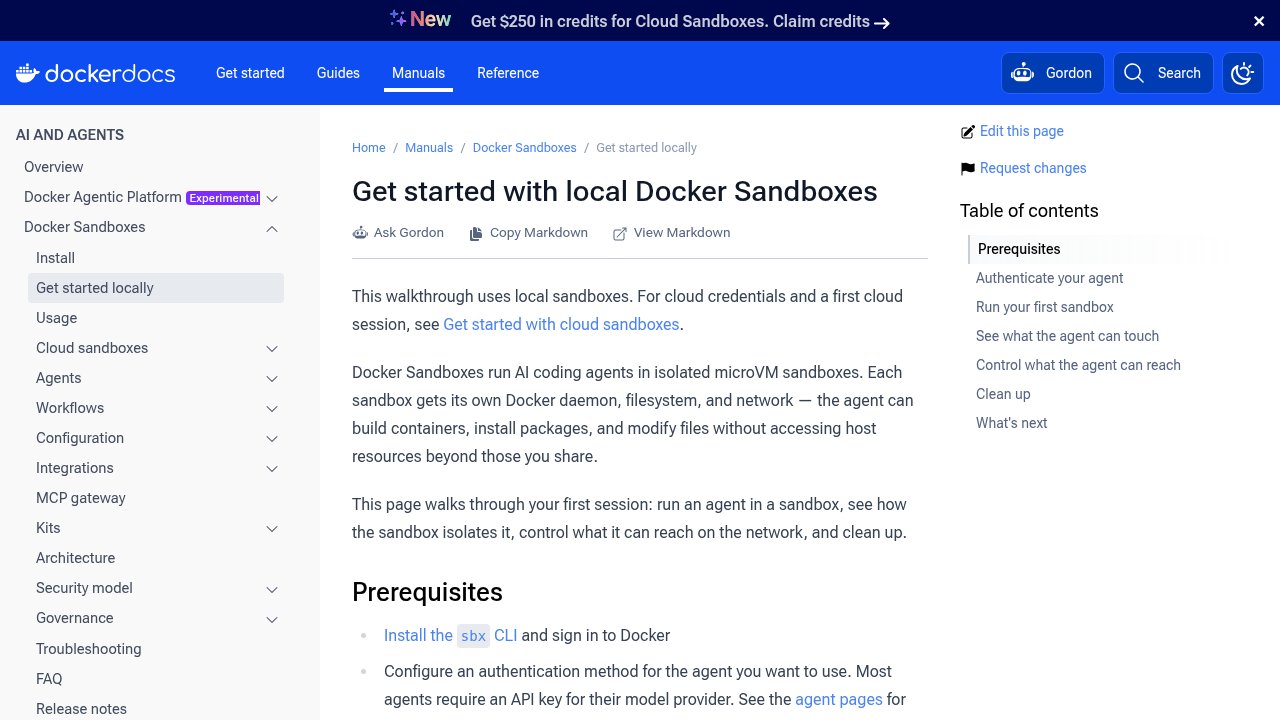
Docker Sandboxes docs — the official get-started guide, showing the sbx CLI commands referenced above.
Band is not a Docker product
Here is the distinction that the word “official” tends to blur: Band is a separate company with its own funding, its own age, and its own business model. Band AI, known as band.ai and listed as bandhq on Docker Hub and band-ai on GitHub, is an Israeli startup based in Kokhav Yair with a second office in San Francisco. It was founded in mid-2025 by CEO Arick Goomanovsky, a serial entrepreneur who previously co-founded Sygnia (acquired by Temasek for $250 million) and Ermetic (acquired by Tenable for roughly $265 million), alongside CTO Vlad Luzin. Band came out of stealth mode, the period when a startup operates privately before publicizing its product, in April 2026 with a $17 million seed round from Sierra Ventures, Hetz Ventures and Team8.
Band’s product is a communication and coordination layer for AI agents, something the company itself has described as a kind of Slack for agents: a shared space where multiple AI processes can post messages, read each other’s output, and hand off tasks. That is genuinely useful if you’re running several agents on a complex job, say one agent reviewing code while another writes tests. But it is Band’s layer, running on Band’s platform, governed by Band’s terms. Docker did not build multi-agent coordination. It hosts and certifies Band’s install kit in its registry and documentation, the same way an app store can feature a third-party app without having written a line of its code.
This matters because “official” is Docker’s own word, used in Docker’s own announcement, to describe a partner integration. DecodeStack is reporting that framing, not endorsing it, and the word is no evidence that the underlying coordination technology has been vetted, owned, or hardened by Docker itself.
The free image hides two paid dependencies
The kit itself, bandhq/band-python-kit, is public on Docker Hub and free to download. A demo repository is posted at github.com/dockersamples/band-ai-sbx-demo, and Band publishes its own software development kit, a set of code libraries for building on a platform, at github.com/band-ai/band-sdk-python. Anyone can pull the image today.
But pulling an image is not the same as running a working system. To actually use the official kit, a developer needs three things: the free Docker image, a Band account on Band’s commercial platform (not an open-source project, a paid SaaS product), and an Anthropic API key loaded with credits, since the demo runs on Claude as the underlying language model. Two of those three pieces cost money and belong to companies other than Docker. The free image is the visible ten percent of an iceberg; the paid accounts behind it are what actually make the thing function.
This is the core trade-off worth sitting with. When a platform calls a third-party integration “official,” a reader can reasonably assume it means tested, supported, and safe to build on. What it more precisely means here is that Docker has placed a bet on one external vendor’s protocol, a vendor that is eighteen months old, privately funded, and could change its pricing, shut down, or get acquired like its founder’s two previous companies did. Anyone adopting the “official” path is quietly adopting that vendor’s risk profile too, whether or not they read the fine print.
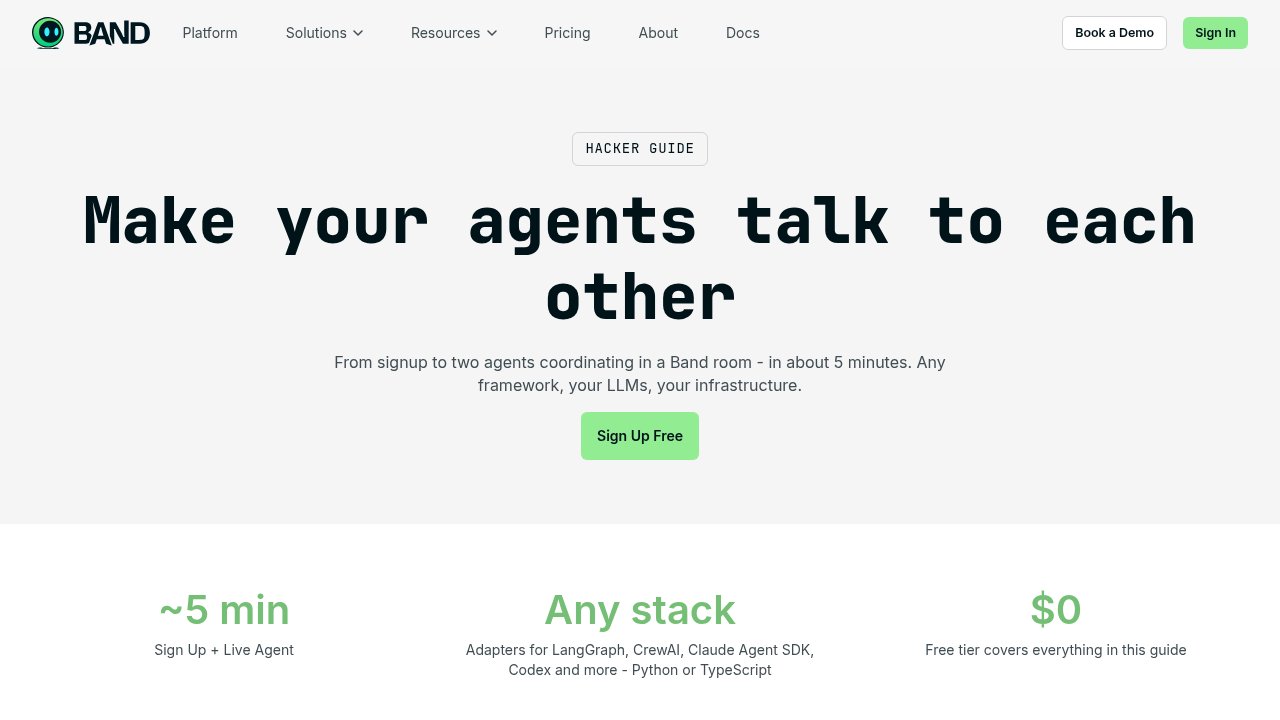
Band AI — Hacker Guide — Band’s own developer docs for the coordination layer Docker’s kit connects to.
How the pieces actually talk to each other
Stripped of marketing language, the architecture Docker describes in its own post is fairly plain. Each agent runs inside its own isolated Docker Sandbox microVM. The agent opens a WebSocket, a persistent two-way connection that lets a program send and receive messages continuously rather than asking and waiting each time, to Band’s platform, and posts its replies back through Band’s API, a defined way for one piece of software to request something from another. Docker’s own wording is specific here: connectivity is outbound-only, so “nothing needs to reach into the sandbox.” The sandbox calls out; nothing calls in.
Band’s platform, which can run in the cloud or be self-hosted, sits in the middle, relaying messages between agents and giving a human a window into the conversation through Band’s desktop app. A real setup command from Docker’s post illustrates the shape of this: sbx policy allow network --sandbox band-repo-doctor api.anthropic.com explicitly opens a single outbound path to Anthropic’s servers, and nothing else, for that one sandboxed agent.
It is worth being precise about what this is not. This is not a new form of collective machine intelligence. It is several instances of a language model, each boxed into its own microVM for safety, posting text messages into a shared chat room run by a third party, the same conversational back-and-forth a Slack channel enables between people, just with language models typing instead of humans. The isolation is a genuine and useful safety property. The coordination on top of it is a messaging protocol, not a breakthrough in how the agents think.
Why this happened right before GA
The timing lines up with something else Band did a week earlier. On October 16, 2026, trade outlet SiliconANGLE covered Band’s launch of “Band for Developers,” a desktop application for driving several coding agents at once. The Docker Sandboxes kit reads as the natural next step for that product: once you have a tool for orchestrating multiple coding agents, you need somewhere safe to actually run them. Docker Sandboxes, itself mid-rollout toward general availability, offered exactly that missing execution layer, and certifying Band’s kit gave Docker a concrete, demoable use case for a feature that was still finding its footing.
Neither company is doing anything unusual here. Platforms frequently court early partners to give a new feature a visible flagship use case before launch, and funded startups frequently seek platform distribution before their own product has broad name recognition. The useful move for a reader is simply not to read “official” as “built, owned, or warrantied by Docker.” It means Docker picked a partner and pointed a spotlight at it.

FAQ
What is Docker Sandboxes used for?
Docker Sandboxes lets a developer run an AI agent, software that can execute commands and modify files on its own, inside an isolated virtual environment instead of directly on their computer. If the agent does something destructive or unexpected, the damage stays contained inside the sandbox rather than reaching the host machine.
Is Band AI part of Docker?
No. Band AI is an independent Israeli startup, founded in mid-2025 by Arick Goomanovsky and Vlad Luzin, that raised a $17 million seed round in April 2026. Docker hosts and certifies Band’s installation kit in its registry, but Band builds, owns, and operates its own separate coordination platform.
Do I need to pay to use the official Band kit for Docker Sandboxes?
Yes, in practice. The Docker image itself is free to download, but running it requires a paid Band account for the coordination platform and a funded Anthropic API key for the underlying language model, since the demo setup runs on Claude. Neither of those two accounts is included with the free image.
Does Docker Sandboxes require a special network setup to use with Band?
Yes. Docker Sandboxes connects outbound only, meaning the sandboxed agent opens a connection out to Band’s platform and to the language model’s API, but nothing from outside can reach into the sandbox itself. A developer must explicitly allow each outbound destination, such as Anthropic’s API, through a sandbox network policy before the agent can use it.
Is multiple AI agents talking to each other a new technology?
Not in the sense of new machine intelligence. What Docker and Band describe is several instances of a language model, each running safely isolated in its own microVM, exchanging text messages through a shared coordination platform, conceptually similar to people messaging each other in a group chat. The isolation and the messaging layer are useful engineering, not a new way for the models themselves to think.