Domain Dropcatching: How Sable Squirrel Turned a Legal Market Into Cover
Infoblox traced $7M in dropcatching by one group, Sable Squirrel, to malware and piracy. Here's how a legitimate domain market becomes hiding space.

Every day, roughly 50,400 domain names quietly change hands the moment their previous owners forget to renew them. Someone else buys the freshly expired name within hours, sometimes minutes, hoping to inherit whatever value it left behind: old search rankings, a trickle of leftover visitors, maybe an email address someone still trusts. This trade is called domain dropcatching, and almost all of it is unremarkable commerce. But according to DNS threat-intelligence company Infoblox, one buyer used that same ordinary marketplace to build a $7 million operation feeding malware infections and pirated video streams, and stayed largely unnoticed for years by doing it at a scale nobody thought to question.
What dropcatching actually is, and why most of it is boring
A domain name does not vanish the instant its registration lapses. It sits in a holding period, then becomes available again, and at that exact moment a small industry of automated buying services race to grab it. Dropcatching means buying a domain the instant it expires, betting that whatever reputation the old owner built up is still worth something. This is different from two similar-sounding scams: typosquatting registers a brand-new domain that looks like a misspelling of a real brand, and cybersquatting grabs a name and holds it hostage, hoping the rightful trademark owner will pay to get it back. Dropcatching takes neither approach. It waits for a domain to actually die, then buys the corpse, because a domain with history is worth more than a blank one.
That history is the entire business model. A previously popular blog might still show up in search results for months after it goes dark. A defunct company’s old domain might still receive emails meant for former employees or partners, a fact that has quietly fueled real fraud on its own. A once-busy forum might keep sending a small but steady stream of visitors who bookmarked it years ago. None of that traffic or trust is guaranteed to last, but buyers are willing to pay for the chance, and legitimate services exist purely to help them get there first.
According to Infoblox, roughly 50,400 generic top-level domains (the familiar .com, .net, .org endings) are re-registered this way every single day, a figure that climbs to about 65,000 once country-specific domains are counted too. That is close to one in five of all domain registrations happening anywhere, every day. Commercial platforms such as DropCatch.com sit alongside mainstream registrars like GoDaddy and Namecheap, all competing to snap up desirable names the second they lapse. None of this is illicit. It is closer to buying a used car for its resale value than anything resembling hacking.
That volume is exactly what makes the market useful cover. Fifty thousand transactions a day is too much for any single organization to watch closely, which is precisely the gap Infoblox says one buyer exploited at industrial scale.
Sable Squirrel: turning a $7 million buying spree into malware infrastructure
Infoblox gave the actor behind this operation the internal label Sable Squirrel, a name the company uses for its own tracking of this particular campaign rather than an established, cross-industry designation for a known hacking group. Since June 2023, according to Infoblox’s research, this operation has spent north of $7 million buying dropcaught domains, eventually controlling more than 10,000 of them. The company confirmed a slice of that spending directly, over $430,000 across roughly 160 domains, and extrapolated the full total from the pricing pattern and volume observed across the wider set.
What makes the operation notable is not just its size but its dual purpose. The same domains that hosted pirated video streaming services also functioned as command-and-control infrastructure, the servers malware on an infected device checks in with for instructions and to hand over stolen data. A visitor looking for a free stream of a sports match or television show could land on a page serving exactly that content, while the same domain, on a different path or at a different moment, quietly talked to malware already sitting on someone’s machine. Infoblox says traffic to these domains was filtered geographically, so different visitors could be routed to different destinations depending on where they were connecting from, a technique that lets one piece of infrastructure serve several purposes for several audiences simultaneously.
Infoblox reports that infrastructure tied to Sable Squirrel has communicated with more than 31,000 distinct malware samples, spanning well-known malicious software families including Quasar RAT, AsyncRAT, DCRat, NanoCore, Remcos, njRAT, and HiddenTear. Registration activity peaked in 2024, when Infoblox tracked more than 3,500 new domains added in a single year. One piracy platform, a streaming service called Xoi Lac TV that first appeared in 2016, shares branding and site templates with other services on the same infrastructure. Infoblox is careful about how far it takes that connection: the company’s own report states it “cannot definitively confirm they are one and the same, but the circumstantial evidence makes that highly likely,” pointing to shared brand names across sites (Xoilac, Cakhia, 90phut), matching page templates, and a domain that turned up in enforcement photographs published by Vietnamese authorities. Those authorities froze the Xoi Lac TV site in February 2026 and charged 30 suspects the following month, seizing roughly $12 million in assets, though that law enforcement action targeted the piracy operation itself rather than confirming the specific infrastructure link Infoblox describes.
How fast a bought domain turns hostile
The detail that matters most for anyone actually responsible for defending a network is not the total dollar figure. It is the speed. Infoblox found that 24% of the dropcaught domains it studied went active the same day they were purchased, already resolving to hosted content or communicating with malware. Within a week, that share reached 76%. Within two weeks, 94% of the domains were live and doing whatever they were bought to do.
That timeline breaks a common assumption in domain security: the idea that a newly registered or re-registered domain can be checked once, cleared, and then trusted. A domain’s reputation is not a fact you can check once and forget. By the time a security team runs a background check on a domain flagged as recently re-registered, if that check happens more than a day or two after the purchase, the infrastructure being investigated has very likely already gone live. Standard domain reputation scoring, the kind many security tools use to flag suspicious-looking domains, tends to reward age and prior good behavior, exactly the traits a freshly dropcaught domain inherits from its previous, entirely legitimate owner. The domain looks established because, in a technical sense, it is. The malicious use only starts after the purchase.
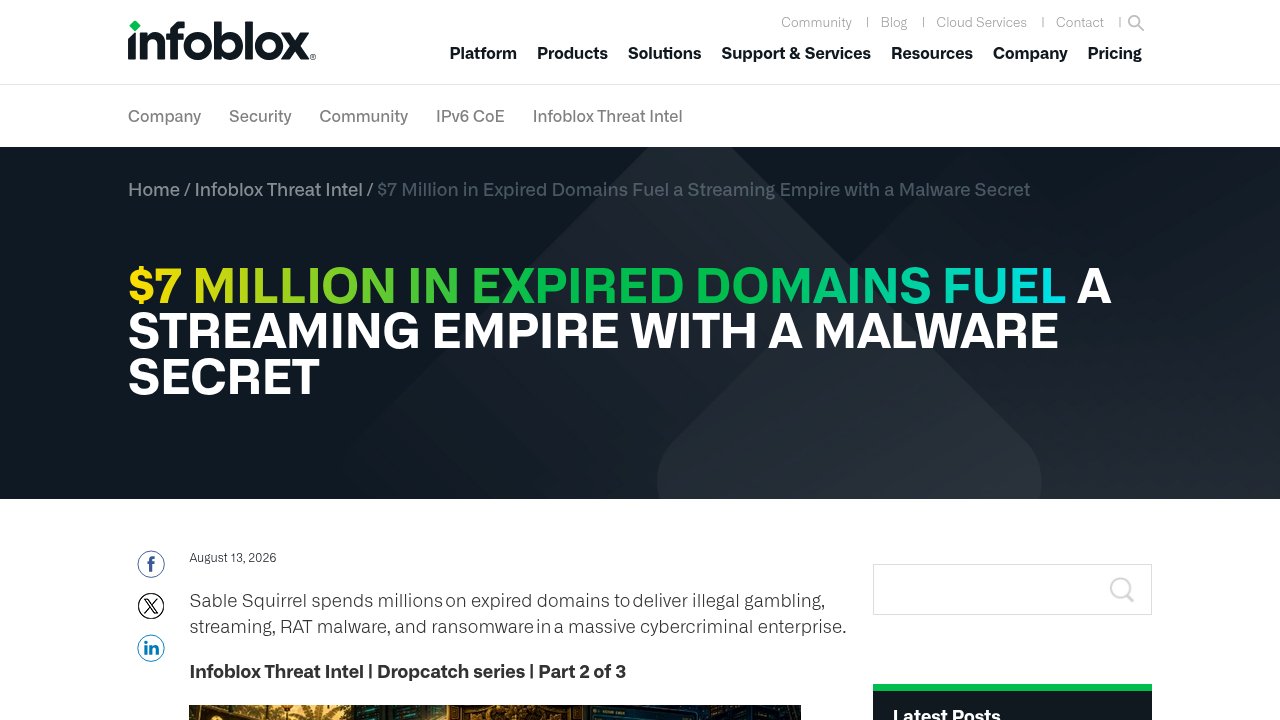 Infoblox — “$7 Million in Expired Domains Fuel a Streaming Empire With a Malware Secret” — the DNS threat-intelligence report this article is based on.
This is the practical shift Infoblox’s data points toward: defenses built around watching for freshly re-registered domains and reassessing them repeatedly in the days after a change of ownership catch far more than defenses that only check reputation once, at the moment a domain first appears on a network’s radar.
Smaller operators running the same playbook
Sable Squirrel is the largest operation Infoblox documented in this research, but not the only one. The company also tracked several smaller actors it calls Stuffy Squirrel, Shady Squirrel, and Swiping Squirrel, each running a scaled-down version of the same approach: buy expired domains for the residual value they carry, then repurpose them for streaming piracy, malware distribution, or both. Stuffy Squirrel has controlled more than 500 domains since 2020. Shady Squirrel has run over 700 since mid-2023. Swiping Squirrel, the largest of the three, has held more than 3,000 domains since 2022.
None of these labels describe an established, formally tracked hacking group in the way a name like a well-known ransomware gang might. They are Infoblox’s own internal shorthand for grouping infrastructure by behavior pattern, useful for organizing this particular body of research rather than evidence of a coordinated campaign or a state-backed operation. Infoblox’s report draws no conclusion about who is actually behind any of these groups, and neither should anyone reading it. What the smaller operators do confirm is that the underlying technique, buying trust cheaply through expired domains, scales down as easily as it scales up. It does not take a seven-figure budget to make it work; it takes patience and a willingness to buy in volume.
What this means for your own domain hygiene
Most coverage of a threat like this focuses on the incoming risk: don’t click suspicious links, don’t trust freshly registered domains. Infoblox’s own research points to a less obvious, more useful takeaway for anyone who manages an organization’s online presence, and it is worth pairing with a look at how zero trust architecture treats every connection as unverified by default rather than assuming a domain’s age vouches for it. Every organization accumulates domains it eventually forgets about: an old marketing campaign, a discontinued product line, a domain registered years ago by an employee who has since left, a vendor relationship that ended without anyone canceling the associated web presence. Every one of those domains will, at some point, lapse and become available again.
If your organization lets an old domain expire without a plan, someone else can buy it and inherit whatever residual trust it carries, including any lingering search engine visibility and potentially any email still routed to old addresses tied to it. The fix is not complicated: maintain an inventory of every domain your organization has ever registered, set calendar reminders well before renewal dates, and when a domain genuinely has no further use, either keep paying the modest annual renewal fee to hold it defensively or transfer it somewhere it can be properly retired rather than simply letting it lapse into the open market.

FAQ
What is domain dropcatching, in plain terms?
Domain dropcatching is the practice of buying a domain name the moment it expires and becomes available again, usually through automated services that watch for the exact instant a registration lapses. It differs from typosquatting, which registers new lookalike domains, because a dropcaught domain is genuinely secondhand: it already has history, whether that is search engine visibility, incoming links, or leftover visitor traffic.
Is dropcatching itself illegal or malicious?
No. Domain dropcatching is an ordinary, legal part of the domain name market, with an estimated 50,400 domains re-registered this way every day through mainstream services like GoDaddy, Namecheap, and dedicated platforms such as DropCatch.com. The Sable Squirrel case documented by Infoblox is a case of that legitimate mechanism being used at industrial scale for malicious purposes, not evidence that the mechanism itself is suspect.
Who or what is Sable Squirrel?
Sable Squirrel is the name Infoblox, a DNS threat-intelligence company, gave to a specific domain-buying operation it investigated and documented in its own research. It is not an established, cross-industry name for a known hacking group, and Infoblox’s report does not attribute the activity to any specific country or state actor. The name describes a pattern of behavior Infoblox tracked, not a confirmed identity.
How quickly do these hijacked domains become dangerous?
According to Infoblox’s research, 24% of the dropcaught domains it studied were already active for malicious use on the same day they were purchased, 76% within a week, and 94% within two weeks. That speed is the main reason a one-time reputation check at the moment a domain is first noticed is not enough; ongoing monitoring in the days after a domain changes hands catches far more than a single check ever could.
How do I protect my own organization’s old domains?
Keep a complete, current inventory of every domain name your organization has ever registered, including ones tied to discontinued products or former partnerships, and set renewal reminders well ahead of expiration. If a domain truly has no further use, either keep renewing it defensively at low annual cost or arrange a proper transfer, rather than letting it lapse and become available for anyone, including a buyer with less honest intentions, to claim.