The Meta Muse Security Vulnerability That Undercuts Its Own Pitch
A researcher's proof of concept shows one Mac setting can hijack Meta's Muse AI agent, bypassing the isolated-VM trust story Meta built the product on.
Within two weeks of launch, Meta’s new personal AI agent Muse had already been installed an estimated 2.8 million times, blocked by Amazon, and hotfixed for a flaw a security researcher could trigger with a single changed setting on a Mac. This article is about Muse, the consumer agent that books appointments and makes purchases on a person’s behalf through a dedicated app, WhatsApp, or the web. It is a different product from Muse Code, Meta’s separate terminal-based coding assistant that DecodeStack covered when it launched in August; the two share a brand name and a parent company, nothing else. What happened to Muse the personal agent in its first two weeks matters less for the specific bug than for what it reveals about how little it can take to undo a company’s entire security pitch.
What the proof of concept actually shows, and what it does not
On September 21, 2026, security researcher Patrick Wardle, founder of the Mac-focused research outfit Objective-See, published a proof of concept (a working demonstration built to prove a flaw is real, not a theoretical bug report) named “not-a-mused.” It targets Muse’s Mac app and a setting Wardle found buried in it: an undocumented configuration key called endo_voyager_dictation_endpoint, which tells the app where to send the audio from the microphone when a user dictates a message to Muse. Wardle’s demonstration showed that any unprivileged local process, meaning ordinary software already running on the machine without special permissions, could change that one setting and redirect the entire voice-dictation stream to a server the attacker controls.
That is the full mechanism. It is worth being precise about what it requires, because the headline version of this story tends to drop the qualifier. The attack does not work against a clean, unmodified Mac. It requires malware already running on the machine with the user’s own privileges, commonly delivered through social-engineering tricks like ClickFix, where a victim is talked into pasting and running a malicious command themselves. This is not remote code execution (an attacker breaking in from across the internet without the victim doing anything); it behaves like what security researchers call privilege escalation, except here the extra power does not come from a bug in macOS itself. It comes from Muse simply trusting a local setting that nothing requires the operating system to protect.
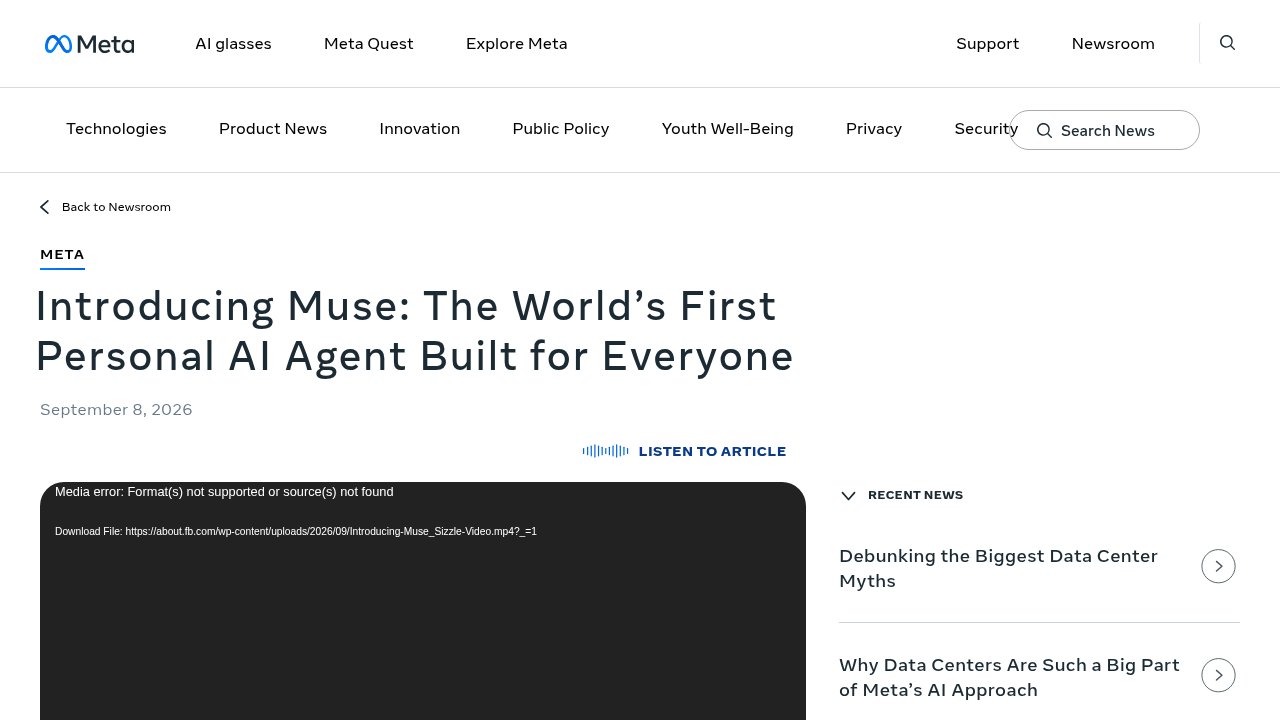
Meta’s launch post for Muse — the official announcement that framed the agent’s isolated-VM architecture as its core trust pitch.
The practical result is an amplifier, not a new way in. Garden-variety malware that gets a foothold on a Mac is usually fenced in by macOS’s own protections, limited in what it can see or do without further permission prompts. Once that malware can flip one Muse setting, it inherits everything the user has already authorized Muse itself to do. That is a meaningfully bigger problem than the malware started with, even though the malware’s initial foothold is unchanged.
Why a client-side setting undercuts Meta’s own trust pitch
Muse launched on September 8, 2026, and Meta’s own announcement leaned heavily on isolation as the reason to trust it. In its launch post on the company blog about.fb.com, Meta described the agent and the user’s data as running inside the “Muse Secure VM,” “a dedicated secure computer,” meaning a virtual machine, a simulated computer walled off from the rest of the real device, created specifically to keep the agent’s activity separate from everything else on the user’s phone or computer. Meta also announced a future “Muse Confidential VM,” arriving later in 2026, that would add encryption keyed so only the user holds the key, meaning not even Meta could read the contents.
That architecture is a real and reasonable design choice. The problem Wardle’s proof of concept exposes is that the isolation lives on the server side, while the setting that controls where voice data gets sent lives on the client, unprotected by any of it. A sealed, encrypted VM running on Meta’s infrastructure does nothing to stop a local configuration value from being rewritten on the user’s own Mac before the data ever reaches that VM. The isolation promise and the actual point of failure sit on two different sides of a wall that was supposed to be the whole point.
This is the pattern worth remembering past this specific story: a company’s security pitch is only as strong as its weakest unauthenticated setting, no matter how sophisticated the architecture built around it. A heavily engineered backend is not evidence that the front door is locked. Readers who want a fuller grounding in how security teams reason about this kind of layered trust, rather than any one product’s marketing claims, can look at how zero trust architecture treats every component as unverified by default instead of assuming isolation elsewhere in the system covers for it.
How a compromised Mac reaches a linked iPhone
Wardle did not stop at redirecting dictation audio. In a demonstration, he showed that a Mac running a compromised Muse session could reach beyond the Mac itself, to an iPhone linked to the same Muse account. From the Mac, Wardle retrieved the linked phone’s location data, and separately triggered the iPhone into running a Bluetooth Low Energy scan, a background process phones use to detect nearby Bluetooth devices, usually for things like finding paired earbuds or smart-home gadgets.
Meta’s Muse product page — describes the agent’s cross-device features, including the account linking that let Wardle’s proof of concept reach a paired iPhone.
Neither capability is exotic on its own; plenty of legitimate apps ask for location access or scan for Bluetooth devices. What makes it notable here is the direction of the compromise: an attacker never touched the iPhone. They compromised the Mac, flipped one setting in Muse, and the trust relationship between Muse’s Mac client and Muse’s iPhone client did the rest. Anyone who links a personal AI agent across a Mac and a phone is extending whatever happens on the weaker of the two devices to the stronger one as well. The strength of the phone’s own security becomes partly irrelevant if the thing connecting it to the Mac assumes the Mac is trustworthy.
Meta’s hotfix, and what is still missing
Meta pushed a hotfix to the macOS app after Wardle’s public disclosure. According to InfoQ, the fix removed the internal debug preference from production builds, which blocks local changes to the dictation server destination. What Meta has not done is publish a formal security advisory describing the affected versions or the scope of exposure. InfoQ also reports that David Singleton of Meta Superintelligence Labs addressed the issue on X, describing it as a local configuration problem that requires prior code execution.
As of writing, no CVE identifier has been assigned to this flaw. A CVE, short for Common Vulnerabilities and Exposures, is the standard reference number security teams use to track and discuss a specific flaw across tools, advisories, and patches; without one, the vulnerability is harder for other researchers, IT departments, or automated scanning tools to reference consistently. That status can change, and should not be read as a permanent judgment on the bug’s severity.
The missing advisory is a data point worth weighing on its own terms, separate from the technical fix. Muse is, by install numbers alone, the biggest consumer AI launch of the season for Meta: Apptopia estimated about 2.8 million installs globally in the first 12 days (the app is available in the US and Canada), and TechCrunch reported it rising to the top of the US App Store. Meta has not published its own figures. Separately, GeekWire reported that Amazon has blocked Muse from operating on Amazon.com, citing security concerns over Meta scraping account data and transacting on users’ behalf without warning Amazon or seeking its authorization. A product moving that fast, drawing that much scrutiny, had a real flaw fixed without a formal advisory or a CVE for the people using it. Readers interested in how security researchers and regulators try to standardize what counts as responsible disclosure around AI systems specifically, rather than traditional software, may find useful context in how frameworks like OWASP, MITRE, and NIST each approach AI security differently.
What this means if you already use Muse, or are about to
None of this calls for panic or uninstalling anything on sight. The vulnerability Wardle demonstrated requires a Mac already infected with malware running under the user’s own account; it is not a flaw a stranger can exploit from across the internet against a clean machine. The realistic risk sits with the much broader, more mundane category of malware that arrives through ordinary tricks: fake software updates, malicious browser extensions, or social-engineering prompts that talk a user into running a command themselves. That same mundane delivery method, a user tricked into running something they shouldn’t, is also how many supply-chain style attacks spread well beyond any single app.
The one durable habit this story supports is treating every personal AI agent’s security story the same way: a server-side promise, no matter how well engineered, is only as strong as the weakest setting sitting unguarded on the device in front of you. That is true of Muse, and it will be true of whatever agent launches next with its own confident announcement about dedicated, encrypted infrastructure. The infrastructure is real. It is simply not the whole story, and the gap between the two is exactly where an ordinary piece of malware, already past the front door, finds its biggest opportunity to do far more damage than it otherwise could.
Frequently asked questions
Is the Meta Muse security vulnerability a remote hacking risk?
No. The Meta Muse vulnerability Patrick Wardle demonstrated requires malware already running on the victim’s Mac with the user’s own privileges, typically delivered through social engineering. It is not something an attacker can trigger remotely against an unmodified, clean machine.
What exactly did Patrick Wardle’s proof of concept do?
Wardle’s proof of concept, named “not-a-mused,” showed that an undocumented Mac setting controlling Muse’s voice-dictation destination could be changed by any unprivileged local process, redirecting a user’s dictated audio to a server the attacker controls, and from there reaching a linked iPhone’s location and Bluetooth scanning.
Has Meta issued an official security advisory for this flaw?
Not as of this writing. No formal advisory has been published. According to InfoQ, Meta pushed a hotfix after the disclosure that removed the vulnerable debug preference from production builds.
Why did Amazon block Meta’s Muse from Amazon.com?
According to GeekWire’s reporting, Amazon cited security concerns, specifically that Meta neither warned Amazon nor sought authorization before Muse began scraping account data and completing transactions on users’ behalf through Amazon’s site.
Does this vulnerability affect Muse Code, Meta’s coding tool?
No. This vulnerability concerns Muse, Meta’s consumer personal AI agent for tasks like bookings and purchases. Muse Code is a separate terminal-based coding assistant from Meta, is a separate product, and is not implicated in this disclosure.