Free Ransomware Decryptors: Why Some Victims Are Left Out
The FBI holds 7,000+ LockBit decryption keys, yet some victims still can't decrypt. The technical reason why, and what to do about it.
Free Ransomware Decryptors: Why Some Victims Are Left Out
In June 2024, FBI Cyber Assistant Director Bryan Vorndran told a room of security professionals at the Boston Conference on Cyber Security that the bureau now holds more than 7,000 decryption keys for LockBit ransomware victims. For thousands of organizations still sitting on encrypted backups years after an attack, that announcement raised an obvious question: when a ransomware decryptor doesn’t work, even for a well-known family, why not? As DecodeStack’s look at hospital ransomware incident response found, recovery rarely hinges on a single dramatic fix, and decryptors are no exception. The answer is a technical distinction most victims never hear explained, and it decides who gets their files back for free and who doesn’t.
What the FBI’s 7,000 LockBit Keys Actually Mean
Operation Cronos, the international takedown led by the UK’s National Crime Agency, seized 34 LockBit servers in February 2024. That seizure alone yielded more than 1,000 decryption keys. By the time Vorndran spoke in June, ongoing FBI work against the group had pushed the total past 7,000. The bureau’s advice to victims is simple: contact the Internet Crime Complaint Center (IC3) and find out whether your specific attack is covered.
That word, “specific,” is doing a lot of work. Having thousands of keys doesn’t mean LockBit itself is broken open. It means law enforcement recovered thousands of individual keys, each one tied to a particular set of victims. If your incident isn’t among them, the seizure changes nothing for you today, even though you were hit by the same ransomware family as someone who just got their files back for free. Recovery, in other words, hinges on what was prepared and archived beforehand more than on any single announcement.
Why a Decryptor Can Fail Even on the Right Ransomware Family
No More Ransom, the project run by Europol alongside Kaspersky, McAfee, and dozens of other security vendors, catalogs free decryption tools for hundreds of ransomware families, listed alphabetically from 777 Ransom through TargetCompany and beyond. Picking the correct tool for the correct family is step one. It is not the whole story.
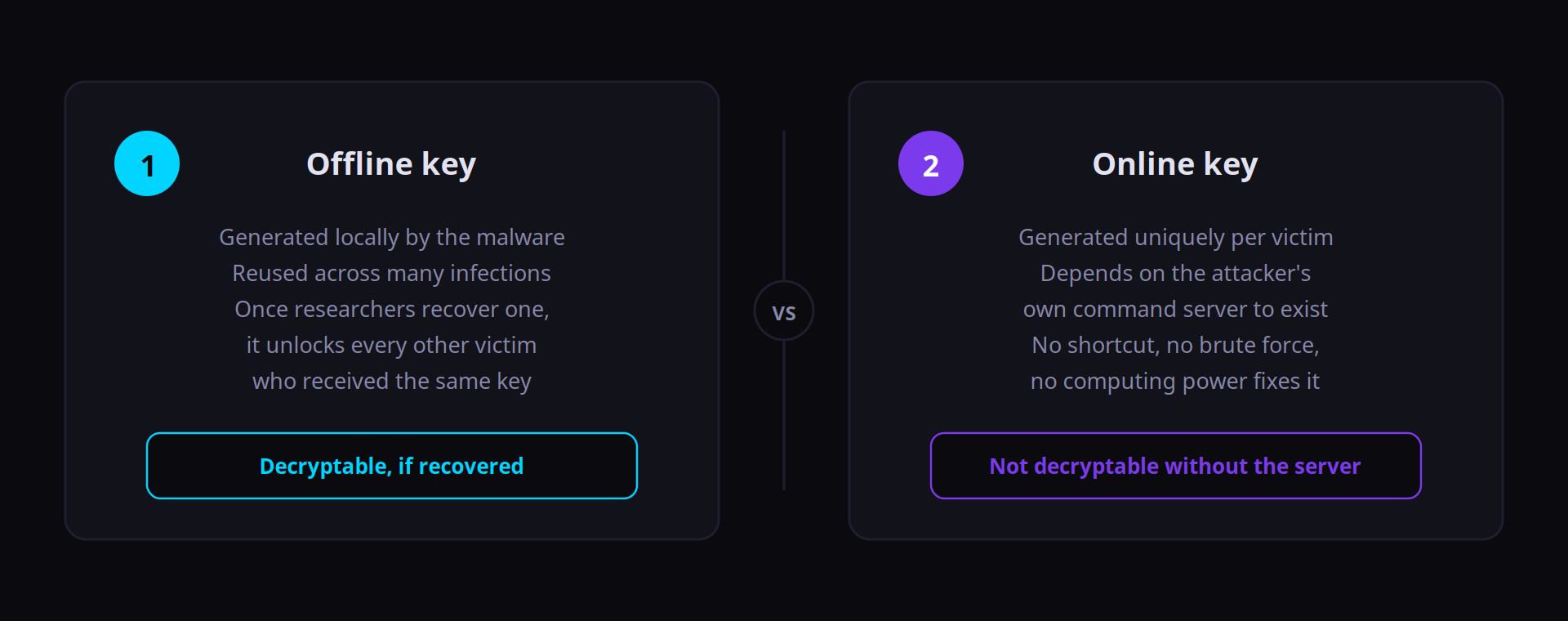
Emsisoft’s own documentation for its STOP/Djvu decryptor, one of the most requested tools on the platform because STOP/Djvu has hit an enormous number of individual victims, spells out the real dividing line: “For all versions of STOP Djvu, files can be successfully decrypted if they were encrypted by an offline key that we have.” An offline key is generated locally by the malware and reused across many infections, which means once security researchers recover one, that same key unlocks every other victim who was hit with it. An online key is different by design: it’s generated uniquely for each individual victim and depends on the attacker’s own command server to exist at all. Nobody, including Emsisoft, can reverse that math without access to the criminal infrastructure itself.
So two people can be hit by the exact same ransomware family, run the exact same official decryptor, and get opposite results, not because one victim did something wrong, but because their attacker’s malware happened to assign an offline key to one of them and an online key to the other. Modern ransomware typically generates that per-victim key locally, then encrypts the key itself with the attacker’s own public key before sending it home, a standard hybrid-encryption design borrowed straight from legitimate cryptography. Without the attacker’s matching private key, sitting on a server researchers may never reach, there’s no shortcut, no brute-force path, and no amount of computing power that fixes it. That distinction almost never appears in ransom notes or victim-facing guidance, which is why “I tried the official decryptor and it didn’t work” so often gets mistaken for “this ransomware simply has no decryptor.”
The Pattern Repeats: Phobos and the Multi-Year Tail of Takedowns
LockBit isn’t an isolated case. Phobos, an affiliate-run ransomware operation active since 2019, was tied by US prosecutors to roughly $16 million in ransom payments from about 1,000 victims worldwide. A coordinated international operation involving the FBI, Germany, Japan, and other agencies took down more than 100 servers linked to the Phobos and 8Base schemes. On July 18, 2025, Japan’s National Police Agency released a free decryptor for Phobos and 8Base victims, which Europol and the FBI then helped distribute further.
The gap between the earliest Phobos attacks in 2019 and that July 2025 decryptor ran into years, not weeks. That timeline matters more than any single announcement: every law enforcement operation against a ransomware group is a reminder that “no decryptor exists yet” and “no decryptor will ever exist” are not the same statement, and the difference between them is usually measured in server seizures, not software updates. The same logic applies well beyond LockBit and Phobos, and the partial-coverage problem shows up even in decryptors that already exist. The Black Basta Buster tool published by SRLabs, for instance, only decrypts files from Black Basta infections between November 2022 and December 2023, a window tied to a specific flaw in that version of the malware (the ransomware reused the same 64-byte keystream segment instead of advancing it correctly, a bug fixed by the operators in December 2023); victims hit before or after it are out of luck with that tool. A “decryptor available” headline is rarely the full picture, and checking the fine print on version and date coverage matters as much as checking the family name.
What to Actually Do If Your Decryptor Doesn’t Work Today
The practical response splits into what to do immediately and what to do while waiting.
Immediately, isolate affected systems rather than trying to work around the infection. CISA’s ransomware response guidance recommends taking the network offline at the switch level where possible, or powering down individual machines if disconnecting them from the network isn’t an option. Don’t reinstall over the encrypted files, and don’t assume a failed decryptor means starting from zero: incident response firm Coveware recommends moving encrypted files and any ransom note onto a high-capacity external drive, disconnecting that drive, and never modifying or reusing it for anything else, with a cloud copy as a second safeguard. Coveware’s own framing of the payoff is blunt: “properly archiving your encrypted files will hopefully result in them being restored for free at a later date.” The Phobos and LockBit takedowns are exactly the kind of later date that advice is written for.
In France, data recovery specialists have covered the same ground: Chronodisk published a guide on what to do when a ransomware decryptor turns out to be ineffective, a useful complement to the US-focused recommendations cited above.
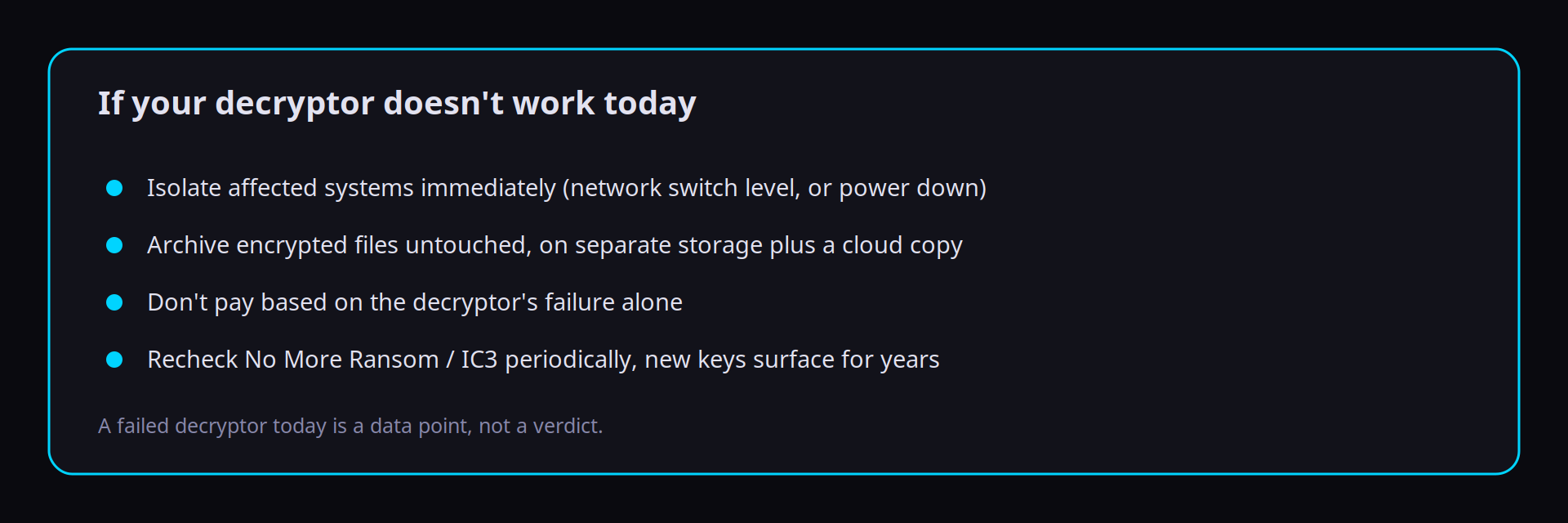
Don’t treat a failed decryptor as a reason to pay. No More Ransom’s official position remains that paying doesn’t guarantee a working key, and it directly funds the next attack. And check back periodically: No More Ransom’s tool catalog and IC3’s LockBit key database both get updated as new law enforcement operations recover more keys, so a family with no coverage today can have coverage next year without any action needed from the victim beyond checking again.
Frequently Asked Questions
How do I find out if my ransomware family has a free decryptor?
Identify the exact ransomware family first, usually from the ransom note or file extension added to encrypted files, then search that name on No More Ransom’s decryption tools catalog or the relevant vendor’s own decryptor page (Emsisoft and Kaspersky both maintain extensive libraries).
If a decryptor exists for my ransomware family, does that guarantee it will work?
No. As the STOP/Djvu case shows, a decryptor listed for a family can still fail on a specific infection if that infection used a unique, victim-specific (“online”) key rather than a key security researchers have already recovered.
Should I pay the ransom if no decryptor works?
No More Ransom and law enforcement agencies consistently advise against it. Payment doesn’t guarantee you receive a working key, and it funds further attacks against other victims.
How long should I keep encrypted files archived if decryption fails today?
Indefinitely, if storage allows. The LockBit and Phobos cases show law enforcement can recover keys years after an attack, and archived files properly kept in their encrypted state remain usable once a matching key surfaces.
The Takeaway
A decryptor that fails today is a data point, not a verdict. It usually means the malware assigned a victim-unique key rather than a shared one, and the fix isn’t a better tool, it’s time and a properly archived copy of what got encrypted. Check IC3 or No More Ransom periodically, keep the files untouched on separate storage, and treat every new takedown headline as a prompt to look again rather than just news to read. None of this replaces the harder work of not getting hit twice, which is where DecodeStack’s explainer on zero trust architecture picks up.