Cloudflare Bought the Startup Behind Vite. Astro 7 Is the First Release Built on What It Bought.
Cloudflare now owns Astro and Vite, the toolchain that builds it. Astro 7's Rust rewrite is the first real proof of what that ownership buys developers.
Cloudflare, the company whose network carries a large share of the web’s traffic, spent the first half of 2026 buying the tools that build a large share of the web’s front end. In January, it bought the team behind Astro, a framework developers use to build fast, content-heavy websites: blogs, marketing pages, documentation. In June, it bought VoidZero, the startup behind Vite, the tool that most modern JavaScript frameworks, Astro included, use to preview a site while it’s being built and then pack it into the files a browser actually loads. Eighteen days after that second deal closed, Astro shipped its seventh major version, rebuilt on the technology VoidZero brought with it. Astro 7 is the first shipped proof of what Cloudflare’s buying spree actually delivers: real speed gains, one properly awkward breaking change, and a bigger question about who controls the pipes the modern web runs on.
A five-month buying spree, in order
Astro’s team joined Cloudflare on January 16. Cloudflare’s CEO, Matthew Prince, framed the deal as a bet on speed: Astro was already known for shipping very little code to the visitor’s browser by default, and Cloudflare wanted the team building it working inside the company that hosts a lot of Astro sites. Astro’s own leadership promised the framework would stay open source (meaning anyone can read, use, and modify the code for free, rather than it belonging to one company) and stay deployable anywhere, not only on Cloudflare.
Five months later, on June 4, Cloudflare made a second, related purchase: VoidZero, founded by Evan You, the developer who created Vue, a widely used framework, and, more relevant here, Vite. Vite is not a framework itself. It is the workshop tool sitting underneath several of them: Vue, Nuxt, SvelteKit, Astro, and SolidStart all rely on it. Cloudflare made the same open-source promise it made with Astro: Vite, its testing tool Vitest, and two newer Rust-based tools, Rolldown and Oxc, would stay open and usable outside Cloudflare’s own products. It also added something the Astro deal didn’t include: an independent $1 million fund, run by Vite’s own core team rather than by Cloudflare or VoidZero, to pay community contributors who are not on either company’s payroll.
Then, on June 22, Astro 7 shipped: the first release built entirely on what VoidZero brought with it.
What actually changed for anyone running an Astro site
Two changes matter more than the version number. The first is that Astro’s compiler, the program that turns .astro files into plain code a browser can run, was rewritten in Rust, a programming language known for speed and for refusing to guess when code is ambiguous. The old compiler, written in Go, used to quietly fix small mistakes in a page’s markup: an unclosed tag, a stray attribute. The new one refuses to guess and stops the build with an error instead. For most sites that is a non-event. For a site with years of accumulated content and a few sloppy corners, an upgrade that used to be routine can suddenly fail, and the fix is to clean up the markup, not to fight the compiler.
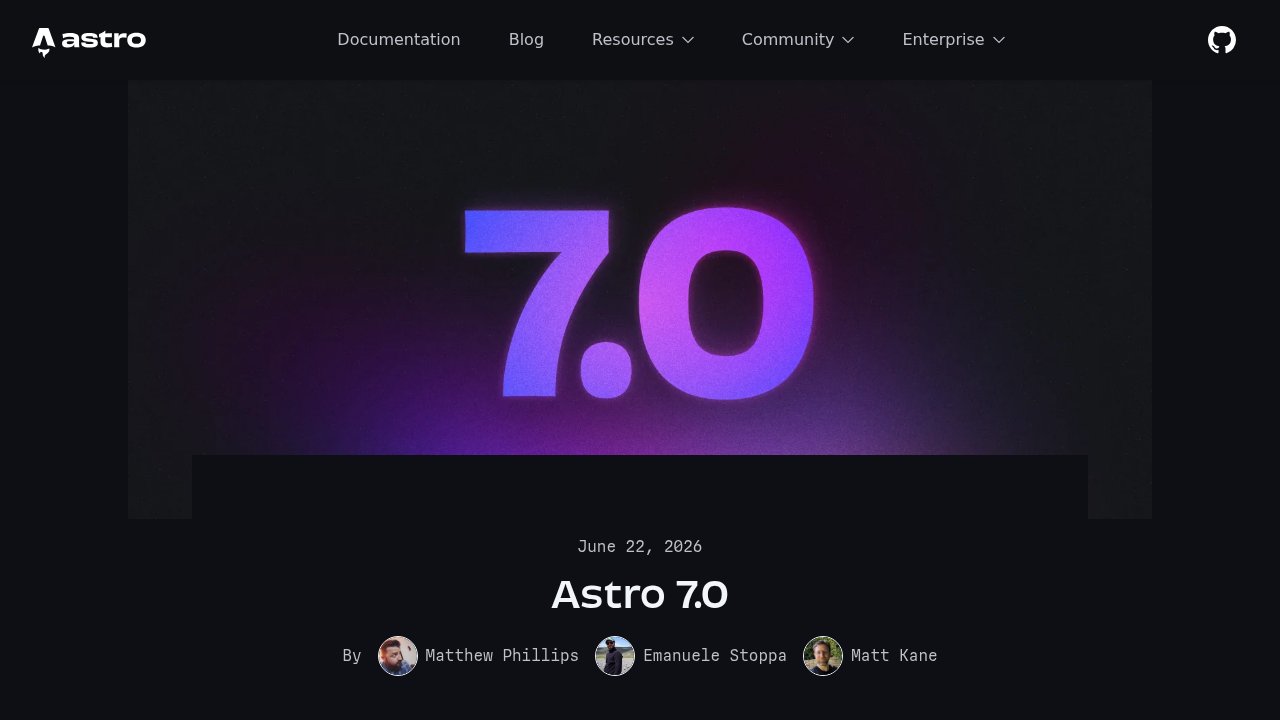
Astro’s official release announcement, detailing the Rust compiler rewrite and the performance benchmarks below.
The second change is the bundler, the part of the toolchain that packs a site’s code into the compact files a browser downloads. Astro 7 ships on Vite 8, which replaces its previous bundling tools with Rolldown, VoidZero’s Rust-based bundler that packages code roughly ten to thirty times faster than the tool it replaces, according to Astro’s own benchmarks. Testing the change on real, uncontrolled sites, Astro’s team measured its own documentation site (over 6,000 pages) building 36% faster, Cloudflare’s developer docs (more than 8,000 pages) building 32% faster, and Astro’s own marketing site building 61% faster. Those numbers come from Astro’s team measuring its own product, so treat them as a real order of magnitude, not a guarantee your project will see the same gain.
A couple of smaller changes round out the release. Page rendering now defaults to a faster internal process, roughly 2.4 times quicker in Astro’s own tests, that was optional in the previous version. A new file, fetch.ts, gives developers full control over how a site handles incoming requests, useful for anyone wiring up login flows or routing some requests to a different backend. Neither is the headline change, but both point the same direction as the bigger one: less waiting, more control, at the cost of a stricter tool that assumes you know what you are doing.
The bigger question: who controls the pipes
The performance story is the easy part. The harder question is what it means that one company, in the space of five months, came to own both a widely used website framework and the tool underneath several of its rivals. VoidZero’s Vite does not only power Astro. It also powers Vue and Nuxt, which are Astro’s direct competitors in the same market, and neither belongs to Cloudflare.
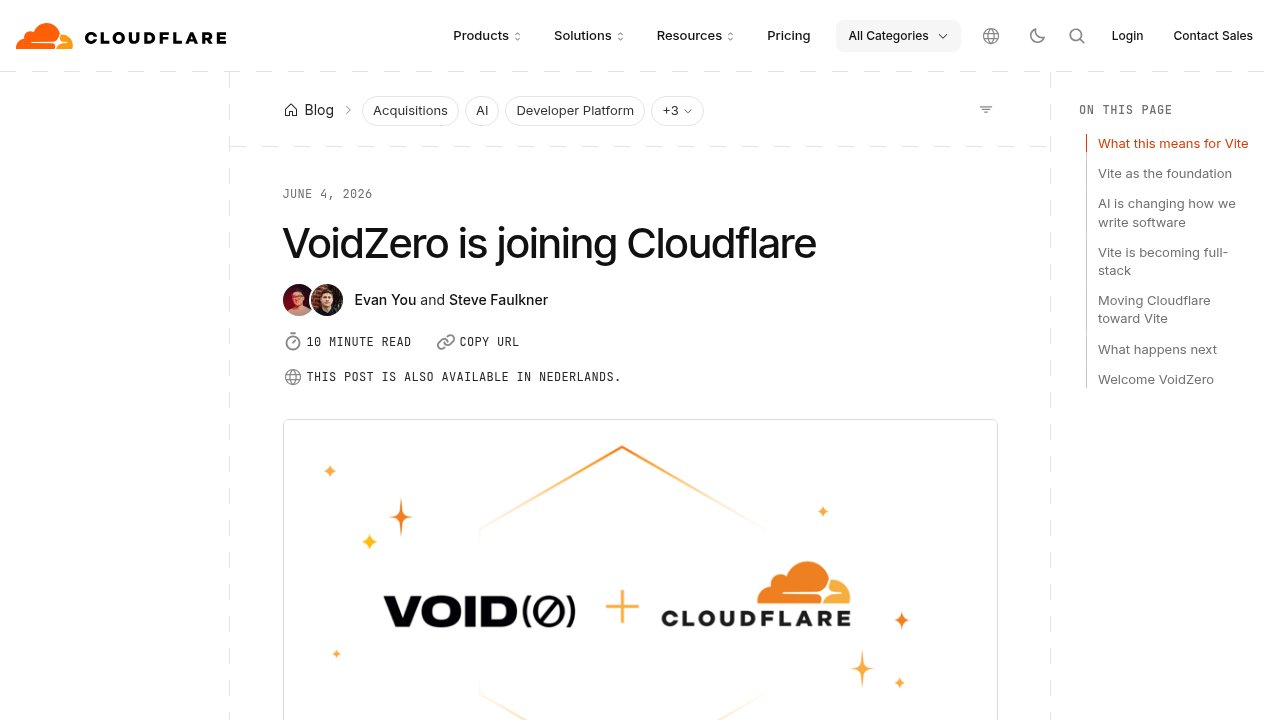 Cloudflare’s announcement of the VoidZero acquisition, including the open-source commitment and the independent Vite Ecosystem Fund.
Cloudflare’s answer, so far, is the open-source pledge and the independent fund described above: the code stays free to use and fork, and the fund exists specifically so community maintainers are not financially dependent on the company that now employs the tool’s creator. That commitment is checkable rather than just a press-release line, because anyone can watch whether Vite’s license changes or whether the fund actually pays out to contributors outside both companies. It is not a guarantee, though. A company can keep a license open while still shaping a project’s direction through who gets hired, what gets built first, and which platform a new feature is tuned for.
None of this is a reason to panic if you already run a site on Astro or on any Vite-based framework. The tools did not change ownership again while you were reading this; that happened months ago, and the code you can already read stays exactly as open as it was. It is a reason to notice the pattern the way you would notice one company suddenly owning your electricity, your internet, and your water: each purchase is defensible on its own, and the sum is still worth tracking.
Where this leaves you
Astro 7 itself is safe to plan for, not something to rush. The one item worth doing before any upgrade is checking older content for the kind of malformed HTML the previous compiler used to fix silently, since that is the change most likely to bite a site that skips it. The ownership question is the one worth actually watching: not because Cloudflare has done anything wrong yet, but because an open-source pledge is tested every day after the announcement, once the news cycle has moved on and nobody outside the project is checking anymore.
FAQ
Does upgrading to Astro 7 break existing sites?
Not automatically, but check your content first. The main risk is markdown or HTML with small errors, like an unclosed tag, that the old Go-based compiler used to fix without telling you. Astro 7’s Rust compiler stops the build instead. Run a build against a copy of your site before upgrading production.
Is Vite still free and open source now that Cloudflare owns VoidZero?
Yes, as of this release. Cloudflare has committed to keeping Vite, Vitest, Rolldown, and Oxc open source and usable outside its own products, and it funds an independent $1 million pool for outside contributors. That commitment is a promise, not a law, so it is worth rechecking periodically rather than assumed to hold forever.
What is Rolldown, and do I need to configure it myself?
Rolldown is the new Rust-based tool, built by VoidZero, that packs a site’s JavaScript into the files a browser downloads. It replaces two older tools, esbuild and Rollup, at once. Vite 8 includes a compatibility layer that converts most existing configuration automatically, so most projects need no manual changes.
Does this affect frameworks other than Astro, like Vue or SvelteKit?
Yes, indirectly. Those frameworks also rely on Vite, so they benefit from the same underlying speed gains as VoidZero’s tools mature, on whatever release schedule their own maintainers choose. They are not owned by Cloudflare and are not required to adopt Astro’s specific choices.
When should I actually upgrade?
There is no deadline forcing an upgrade. Astro 6 keeps working. The sensible order is: check your content for malformed markup, test the upgrade on a staging copy of your site, then move production over once the build is clean.