AI Agent Persistent Memory Problems: Why Remembering You Can Backfire
AI agents that remember you promise less repeating yourself. The catch is who checks what gets written down, and what happens when nobody does.

An AI agent that remembers your preferences, your projects, and the last ten conversations you had with it sounds like a straightforward upgrade over one that forgets everything the moment you close the tab. The promise of persistent memory is simple: stop repeating yourself. The catch is quieter, and it has nothing to do with how much an agent can store. It has to do with who checks what gets written into that memory in the first place, and what happens when the answer is nobody.
What “an agent that remembers you” is supposed to fix, and the quiet catch in how it does it
Every AI assistant without memory has the same annoying habit: it starts from zero every session. You explain your job, your stack, your preferences, again and again. Persistent memory exists to end that. The agent keeps notes between conversations, the same way a human assistant would, and pulls up the relevant ones later instead of making you repeat context.
That part works, and it genuinely helps. The problem shows up in how those notes get written. In most current systems, the agent itself decides what is worth remembering and writes it down, with nobody reviewing the entry before it becomes part of the agent’s permanent understanding of you. That design choice, not any particular product, is the thing worth examining: a memory system that writes to itself without a checkpoint has a built-in way to go wrong, and it is not a one-off glitch. It compounds.
A useful comparison is how AI coding agents decide what to learn on their own: self-directed learning in software agents raises the exact same question, does the agent’s own judgment about what it has learned get checked by anything outside itself, or does it just get trusted and built on.
How one wrong guess becomes a pattern of wrong guesses
The mechanism is easiest to see with a concrete example. Eliott, a knowledge-management creator with several years covering this space and the author of a book on organizing information, walked through this failure mode using Hermes Agent, an open-source AI agent framework built by NousResearch. Hermes is worth naming here because, unlike a tool such as Claude Code (which only runs Anthropic’s own models), it is model-agnostic: you can point it at different AI providers, and you can reach it through a desktop app, a web interface, or messaging apps like Telegram, WhatsApp, and Discord.
Hermes ships with its own built-in memory: two plain text files, one tracking facts about the user and one tracking general context, both rewritten by the agent itself as conversations happen, plus a searchable log of past sessions. According to Eliott’s account, the problem starts small. Say you ask the agent a hypothetical question, something like “what would you suggest if I were switching careers to design.” The agent, inferring rather than asking for confirmation, writes down that you are switching careers to design, as if you had stated it as fact. Nobody corrects this, because nothing in the loop is built to catch it. The next time you talk to the agent, that invented fact is sitting in memory as settled information. The agent references it. It makes new suggestions based on it. Those new suggestions get written back into memory too, now stacked on top of the original wrong guess.
This is the structural problem, and it differs from an agent simply hallucinating once in a single response. A single wrong answer in a conversation disappears when the conversation ends. A wrong fact written into persistent memory does not disappear. It becomes the foundation the agent reasons from in every future conversation, and each new inference built on that foundation has no mechanism to question it, because the agent treats its own earlier memory as settled ground truth rather than as a guess that was never checked.
 Hermes Agent — the open-source, model-agnostic AI agent from NousResearch used as the worked example above.
Why a smarter memory store doesn’t fix the actual problem
The natural next move, once you notice an agent’s native memory is thin or error-prone, is to bolt on something more sophisticated. Hermes supports exactly this: its documentation lists nine external memory providers you can plug in instead of, or alongside, the built-in files (the native memory stays active either way, since the two are additive, not a swap). Providers like Mem0 and Supermemory use vector search, which stores information as mathematical representations of meaning so the agent can later pull up anything semantically related to a query rather than needing an exact keyword match; this is the same underlying idea behind vector databases used in retrieval systems more broadly. Others, like Hindsight and OpenViking, organize memory as a structured hierarchy or a knowledge graph: a web of labeled connections between pieces of information rather than a flat list.
A smaller category, sometimes called a temporal graph, goes further still: it links facts, decisions, and preferences with typed relationships (this preference contradicts that one, this decision followed from that fact), and assigns each link a relevance score that fades over time rather than staying permanently weighted. One provider reportedly defaults to decaying that relevance by roughly one percent a day, though this figure comes from Eliott’s video rather than a confirmed published default, so treat it as illustrative rather than exact.
Here is the part that matters more than any of those technical details. None of these approaches change who validates the fact before it enters memory. A vector database can store a wrong guess just as efficiently as a right one, and retrieve it with the same confidence. A knowledge graph can connect a false fact to five other facts just as neatly as a true one. A temporal graph can let a bad guess decay gracefully over three weeks, which is a nicer failure than Hermes’ flat files, but it is still built on the same unchecked inference. Sophistication in how memory is stored and retrieved is a different axis entirely from whether the thing being stored was ever verified. Upgrading the database does not add a human, or any other check, to the step where the agent decided your hypothetical question was a statement of fact.
What the Markdown convergence actually tells you, and what it doesn’t
Around the same period Eliott’s video was circulating, two developments pointed in the same direction, and the connection between them is worth getting right rather than treating as a coincidence.
In April 2026, Andrej Karpathy, a co-founder of OpenAI who joined Anthropic’s pretraining team the following month, posted about an idea for keeping an AI’s working context current: an approach where an AI compiles raw material (notes, documents, transcripts) into a structured Markdown wiki that stays current over time rather than being re-derived from scratch at every use, with a periodic “lint” pass in which the LLM health-checks the wiki for contradictions, outdated claims and orphan pages. About two months later, in June 2026, Google formalized a vendor-neutral version of the same pattern as an Open Knowledge Format, a standard for packaging an organization’s internal knowledge as plain Markdown text with structured metadata, so that any AI agent can read it directly rather than needing a proprietary connector or account.
Neither development claims to solve agent memory specifically. One way to read this convergence, one idea for structured Markdown context catching on quickly enough that a major platform standardized it within about ten weeks, is as a signal worth paying attention to: a human-reviewed or deliberately structured text file keeps beating an opaque, auto-generated memory store, even as that store gets more technically elaborate. That is a reasonable read of the pattern. It is a different claim from saying any specific benchmark proved two Markdown files beat nine memory providers head to head, which is not something a primary source confirms.
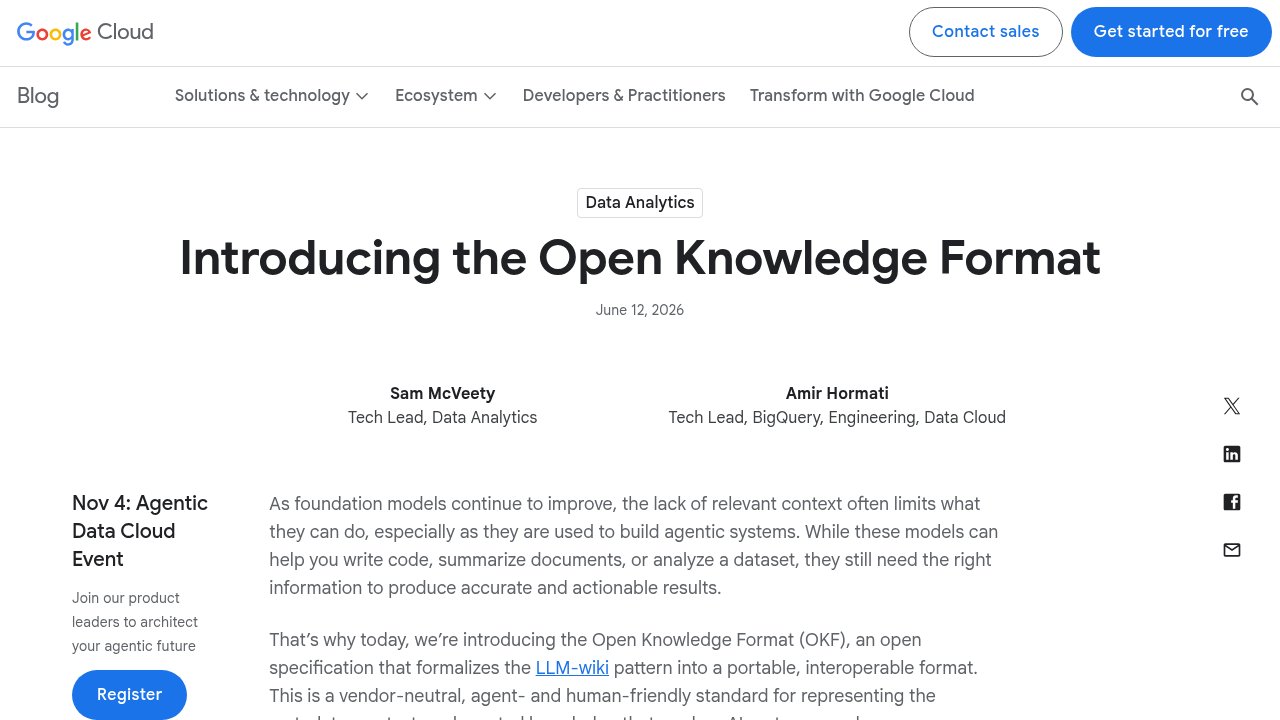 Open Knowledge Format — Google’s vendor-neutral spec for packaging knowledge as plain Markdown that any AI agent can read.
The detail that matters most here, and the one easiest to miss, is that Karpathy’s proposal includes a periodic lint step that health-checks the wiki, which puts it structurally closer to checked memory than to Hermes’ self-writing files. The approach reportedly drew some pushback in the following weeks over concerns about the AI’s judgment drifting from what users actually wanted, though this specific criticism could not be independently confirmed, so it is worth holding loosely rather than repeating as settled fact.
What holds up in practice: context you write on purpose, not memory the agent invents
Pull the mechanism and the convergence together and the trade-off becomes concrete rather than abstract. An agent’s memory layer is reliable in proportion to how much a human, or some other outside check, gets a look at what goes into it before it becomes permanent. A file you write yourself, or a wiki that gets checked regularly, has a built-in brake on compounding errors: a wrong entry stays a single wrong entry, because nothing downstream was forced to trust it as settled. An agent’s self-written memory has no such brake. Every inference it makes gets treated as fact by every inference that follows, and nothing in that chain was ever asked to double-check the first link.
None of this makes agent memory systems broken or not worth using. For a curious person experimenting with a tool like Hermes on a side project, unsupervised memory that occasionally drifts is a minor annoyance, easily corrected by just telling the agent it got something wrong. For a workflow you actually depend on, where a wrong assumption compounding silently over weeks has real cost, the current generation of self-writing agent memory is not yet something to build on without a way to review what it has decided is true about you.

FAQ
What is AI agent persistent memory, and how is it different from a longer context window?
AI agent persistent memory is a system that lets an agent save information between separate conversations, rather than starting fresh every time. A longer context window only extends how much an agent can hold within a single ongoing conversation; persistent memory survives after that conversation ends and gets pulled into entirely new ones.
Why does an agent’s self-written memory go wrong over time?
Self-written agent memory goes wrong because the agent, not a human, decides what counts as a verified fact worth saving. If it misreads a hypothetical or a passing comment as a statement about you, that guess gets saved as settled information, and every later conversation builds new inferences on top of it without anything checking the original guess.
Does a more advanced memory system, like a knowledge graph, fix this problem?
A knowledge graph or vector-based memory system does not fix this problem on its own, because it changes how information is stored and retrieved, not whether that information was verified before being saved. A more sophisticated store can hold, connect, and recall a bad entry just as efficiently as a correct one.
Should I turn off persistent memory in agents like Hermes or ChatGPT?
Turning off persistent memory in an AI agent is a reasonable choice if you want predictable, stateless answers and don’t want the agent forming assumptions about you over time. If you keep memory on, periodically reviewing what the agent has saved and correcting wrong entries reduces the risk of small errors compounding into a distorted picture.
Is a plain Markdown file actually better than a dedicated memory database for AI agents?
A plain, human-reviewed Markdown file isn’t inherently smarter than a dedicated memory database, but it tends to hold up better in practice because someone looked at it before it became the agent’s source of truth. The advantage comes from the review step, not from the file format itself.