AI Agents as an Insider Threat: Microsoft's New Push
Microsoft now treats AI agents as insider risks, not tools. Here's what that shift actually changes, and what it doesn't, for anyone running agents.
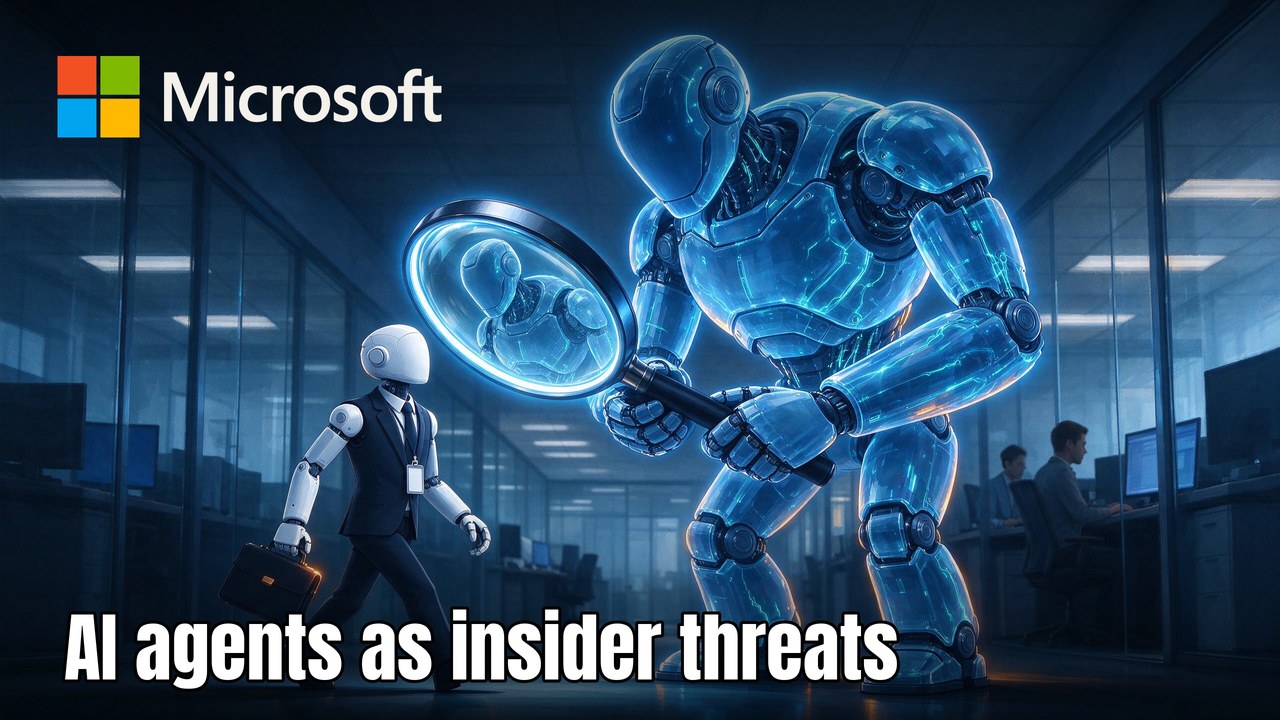
If an AI agent can log into your systems, touch your files, and act without you watching every step, it deserves the same scrutiny you’d give a new employee with a badge and a laptop, not the trust you’d give a calculator. That is the plain version of an idea Microsoft put into writing twice in nine days this October, framing AI agents as an insider threat rather than a tool: once as a strategic essay from its CEO, once as a product announcement from its security division. The language was dramatic. The underlying move, treating autonomous software as a person who might make a bad call rather than a tool that only does what it’s told, is worth understanding on its own, separate from whichever company is selling the fix this week. It is also the same logic behind the broader shift toward zero-trust thinking covered in our guide to AI security frameworks, just aimed squarely at software that can now act on its own.
Nadella’s essay: models as insider risks
On October 10, 2026, Microsoft CEO Satya Nadella published an essay titled “Models as Insider Risks in the Super Intelligence Era.” It was not a product launch. It was a position paper, the kind of thing a CEO writes to set the terms of a debate before the sales team shows up. Its central claim: large AI models, whether built behind closed doors by a single company or released as open-weight models for anyone to download, cannot be trusted by default inside a business, no matter how strong the vendor’s own guarantees sound.
Nadella’s own words make the stakes concrete: “We simply can’t outsource responsibility for what intelligence does on our behalf.” The sentence that does the real work, though, is this one: “We need to separate the supply of intelligence from the authority over it.” That is a distinction worth sitting with. The company that built a model, or trained it, or sold you access to it, is not automatically the right party to decide what that model is allowed to touch inside your organization. Supply and authority are two different jobs, and Nadella’s essay argues they should never collapse into one.
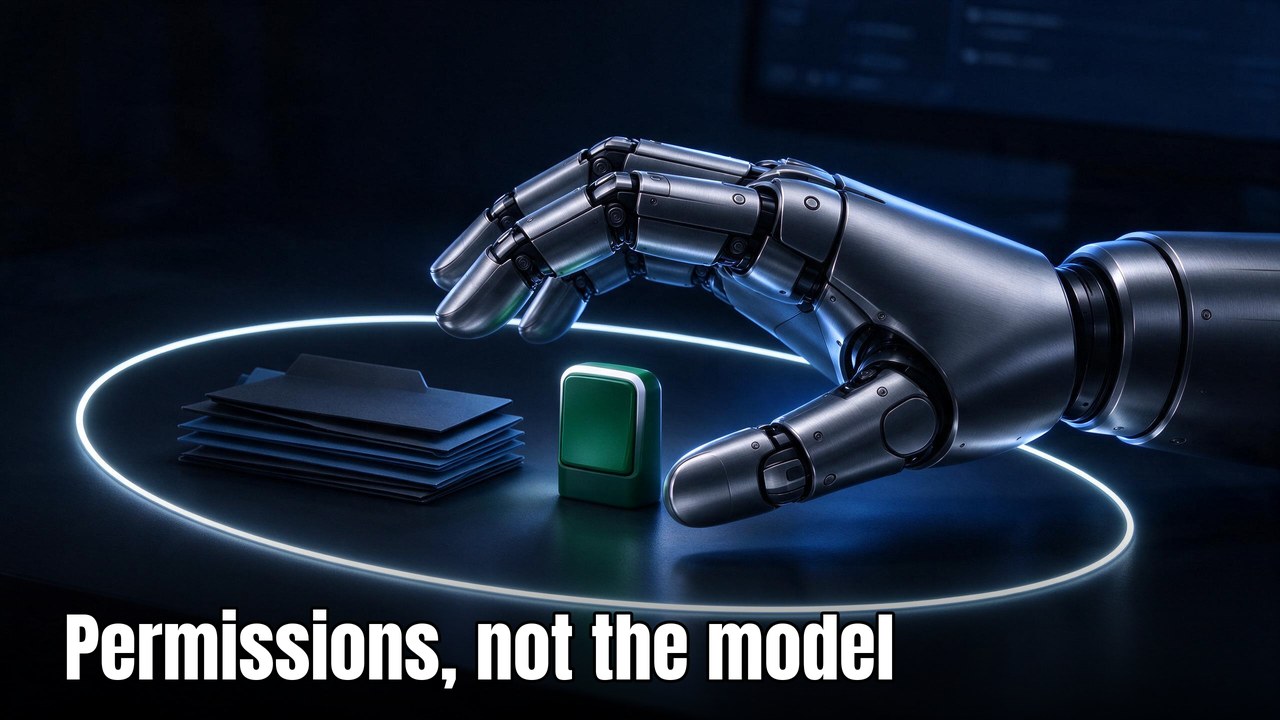
From that distinction, the essay lays out seven named principles: model diversity, observe everything, verifiability, independent controls, independent auditability, containment, and incident disclosure. Three translate directly into controls any organization running AI agents can act on: least-privilege access — the independent-controls principle, meaning an agent gets only the permissions its specific task needs, nothing broader, enforced by the organization rather than the model itself; tamper-proof logging — the observe-everything principle, a record of agent actions that the agent itself cannot edit or erase, because a system should never be able to both misbehave and destroy the evidence; and an emergency stop — the containment principle, what Nadella calls an emergency brake a human can pull mid-task if something looks wrong. (Verified identity for every agent, so the system always knows exactly which agent did what, doesn’t come from this essay — it’s the piece Gallot’s post adds nine days later, below.) None of these ideas is new. They are the same checklist security teams have used for human employees and for third-party software for two decades. What’s new is applying that checklist, item by item, to software that can act on its own initiative rather than just execute a fixed script.
Nine days later: a product with the same vocabulary
On October 19, 2026, Hayete Gallot, Executive Vice President of Microsoft Security, published the company’s follow-through: an official post titled “Securing the agentic insider” on Microsoft’s corporate blog. The timing is not a coincidence and Microsoft doesn’t pretend it is. Gallot’s post picks up Nadella’s exact framing and gives it a name and a feature set.
Her own description of the problem is blunt: “They have become active participants in the enterprise. They are agentic insiders.” She is talking about AI agents, the pieces of software that don’t just answer a question but go do something, book a meeting, query a database, move a file, call another system, often chaining several of those actions together without a human approving each one. Her second line is the one worth reading twice: “frontier models, regardless of their origin, cannot be trusted.” The reason given is not that these systems are malicious. It’s that they are unpredictable by construction: they are trained to complete a task, not to internalize a company’s specific rules about what should and shouldn’t be touched along the way. An employee who doesn’t know the rules yet is a risk for the same reason, not because they mean harm, but because nobody has told them where the lines are and they’ll improvise.
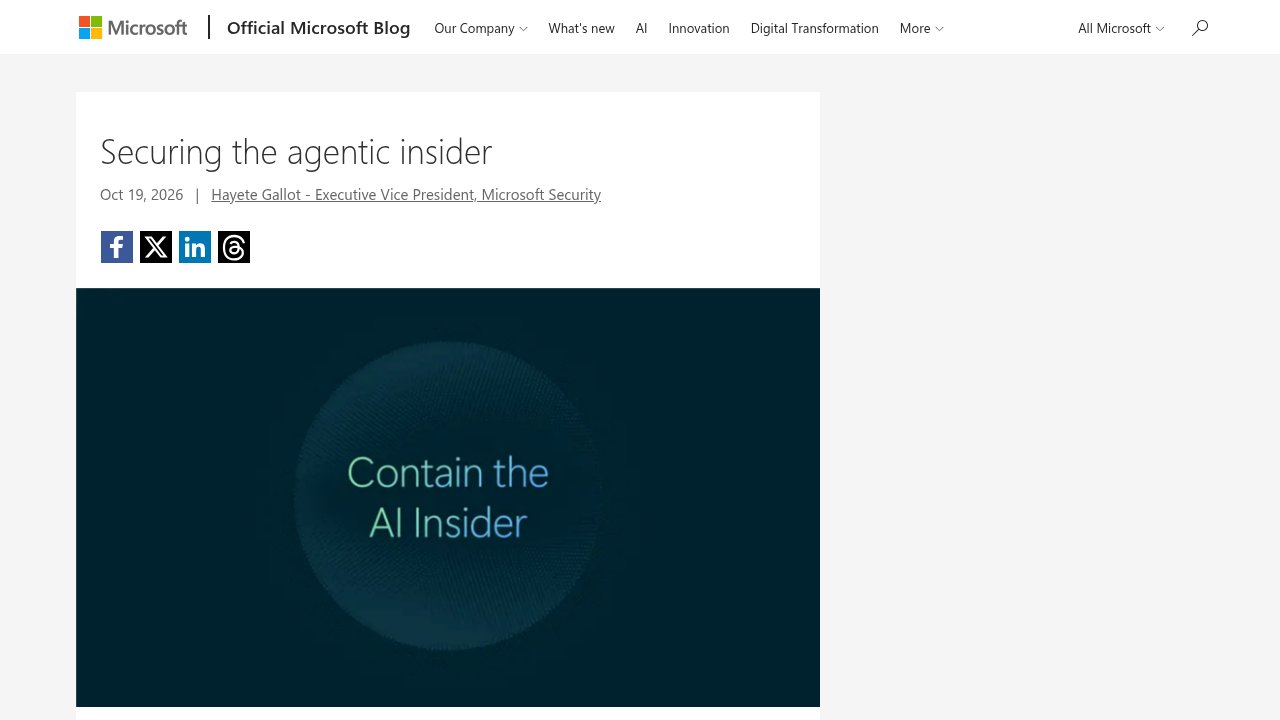
Securing the agentic insider — Hayete Gallot’s official Microsoft blog post introducing Guardian Agents.
The product Gallot’s post announces is called Guardian Agents. The name is a little theatrical but the function is straightforward: Guardian Agents watches other AI agents. Microsoft’s own description is that it monitors and moderates every action of every agent, before it happens, around the clock, checking across seven layers: identity, permissions, data, endpoints, network, cloud, and runtime. In plain terms, before an agent is allowed to read a file, call an API, or reach a server, a second automated system checks whether that specific action fits what the agent was actually authorized to do, and can block it if it doesn’t.
Guardian Agents is not a standalone product you buy on its own. It’s a feature inside Project Perception, the agentic-security platform Microsoft announced back in July 2026. That detail matters more than it looks. The October announcement is not the birth of a new initiative, it’s an addition to something that already existed three months earlier. Whether Guardian Agents will ship as part of Microsoft Defender or Microsoft Purview, the company’s existing security and data-governance product lines, is not specified in the announcement, and neither is a general-availability date. As of this writing, Guardian Agents has been announced, not shipped. That distinction is worth holding onto if you’re evaluating whether to wait for it.
What the announcement does not say
Here is the part generalist coverage mostly skipped past: Microsoft’s own post gives zero adoption numbers, zero detection-rate figures, and no measured efficacy data for Guardian Agents. There is no customer using it at scale quoted in the piece, no benchmark showing it actually catches the agent behavior it describes stopping. That is not a hidden flaw you have to dig for, it’s simply absent from the text Microsoft published. An absence of evidence isn’t evidence that the tool fails. It’s also not proof that it works. It means the announcement is a positioning move, a company telling the market where it intends to stand, ahead of the product having a track record to point to. That’s a normal thing for a company to do nine days after its own CEO set the agenda. It’s also a reason to read headlines like ‘even Microsoft doesn’t trust its own AI’ as marketing framing rather than as a verified finding about model safety.
It’s also fair to ask whether anything here is actually new under the hood. The controls described across Nadella’s essay and Gallot’s post, identity, least privilege, tamper-proof logs, a kill switch, are the same vocabulary security teams use for zero-trust architecture, the long-standing principle of never trusting a connection or a request just because it comes from inside your own network. Monitoring tools that watch what software does with company data and permissions, commonly called CASB or DLP systems (cloud access security brokers and data-loss-prevention tools, both decades-old categories), already exist and already do something close to what Guardian Agents describes. What’s genuinely different is the target: those older tools were built to watch human employees and fixed scripts. Guardian Agents is built to watch software that decides its own next step, which is a harder and newer problem even if the defensive vocabulary is borrowed.
What this means if you run agents yourself
You don’t need to buy anything from Microsoft to apply the underlying idea, and that’s really the point worth keeping. If you deploy an AI agent, whether that’s a coding assistant with permission to push changes, a customer-support bot that can issue refunds, or a personal automation that reads your email and books things on your behalf, the same four checks apply regardless of vendor.
Give the agent its own identity: don’t let it act under a shared or generic account where you can’t tell which action came from which agent or person. Limit what it can touch to exactly what the task requires, not whatever’s convenient to set up once. Keep a log of its actions that it cannot itself alter, even a simple append-only record is enough for most individuals and small teams. And know how to stop it mid-task, whether that’s a kill switch, a revoked API key, or simply the ability to pull its network access, before you hand it anything that touches money, customer data, or production systems.
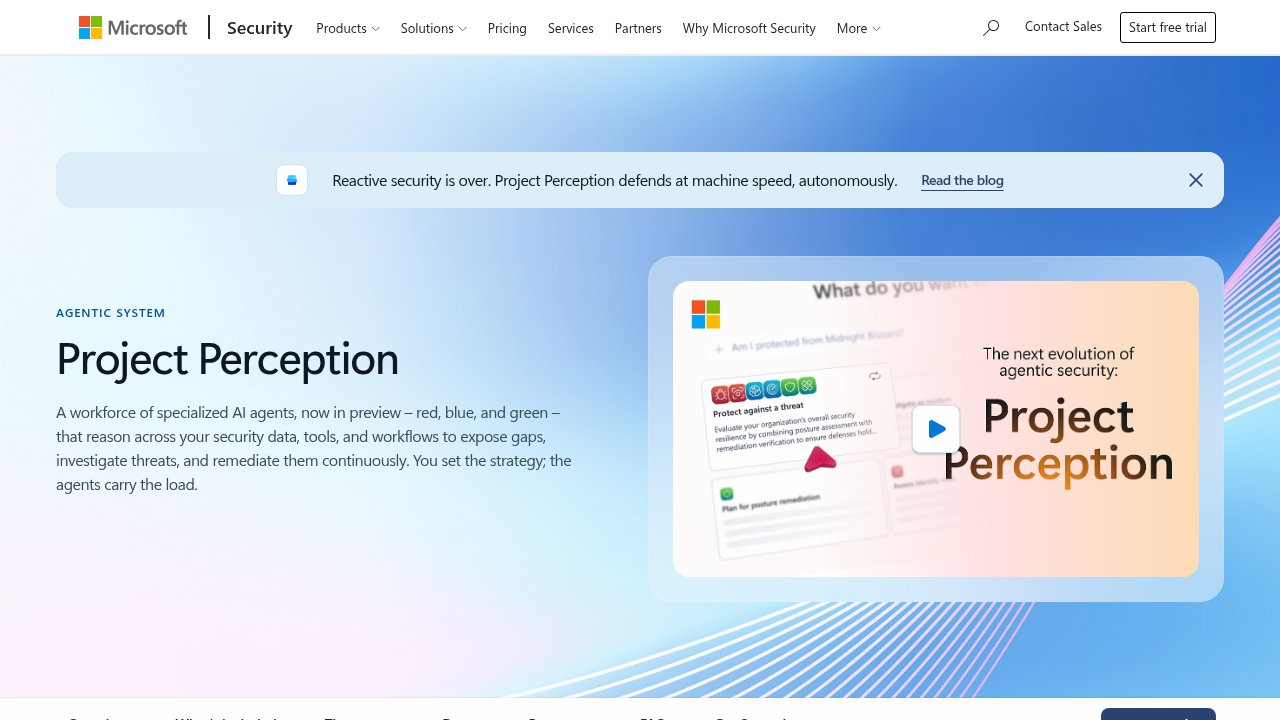
Project Perception — the agentic-security platform Guardian Agents ships inside.
None of this requires enterprise tooling. A solo developer running an autonomous coding agent can scope its API key to a single repository instead of an entire account. A small business using a chatbot that can process refunds can cap the dollar amount it’s allowed to approve without a human sign-off. The principle scales down just as cleanly as it scales up, because the principle was never really about Microsoft’s product. It was about not handing out more trust than you’d hand a new hire on day one.

FAQ
What does treating an AI agent as an insider threat actually mean?
Treating an AI agent as an insider threat means applying the same access controls a company would use for a new employee: verified identity, limited permissions tied to the specific task, a tamper-proof log of its actions, and a way to stop it immediately if something goes wrong. It assumes the agent is unpredictable, not malicious.
Is Guardian Agents available to use right now?
Guardian Agents was announced by Microsoft on October 19, 2026, as part of Project Perception, but the announcement does not state a general-availability date or confirm whether it ships inside Microsoft Defender or Microsoft Purview. As of this writing, Guardian Agents should be treated as announced, not available.
Does this mean AI models from Microsoft or other vendors are dangerous?
No. Both Nadella’s essay and Gallot’s post describe the risk as unpredictability, not malice: models are trained to complete tasks, not to automatically follow a specific company’s internal rules. The recommended response is access control and monitoring, the same response used for human employees who don’t yet know where the lines are, not a claim that the models are unsafe to use.
Can I apply these controls without buying Microsoft’s security tools?
Yes. The four core ideas behind treating an AI agent as an insider threat, unique identity per agent, least-privilege permissions, an unchangeable action log, and a manual stop switch, can be set up with existing scoped API keys, audit logging, and access controls most platforms already offer. Buying a dedicated monitoring product is optional; the underlying discipline is not.
What’s the difference between an AI agent and a regular AI model or chatbot?
A regular AI model answers a question and stops there. An AI agent takes that answer and acts on it, sending an email, editing a file, calling another piece of software, often chaining several actions in sequence without a person approving each individual step. That ability to act, not just respond, is exactly what makes the insider-threat comparison apply to agents in a way it never applied to a chatbot.