MiniMax M3: The Open-Weight Coding Model Undercutting GPT by 25x
MiniMax M3 is an open-weight coding model priced far below GPT-5.5 and Claude Opus. Here's what the cost gap actually changes for AI coding agents.
Running an AI coding agent in a loop, the kind that reads a repository, writes a patch, runs the tests, and tries again, can rack up a real bill if you’re paying frontier prices per token. That is the practical question behind MiniMax M3, a coding-focused large language model released by the Shanghai AI company MiniMax (also known for its Hailuo video-generation brand and separate audio-generation tools, under the same roof as its M-series text models). M3 is not just another leaderboard entry. Its combination of open weights and a steep price cut changes who can afford to let an AI agent work unsupervised for hours at a time.
What “open-weight” means here, and why the license still matters
MiniMax has published M3’s weights publicly, so anyone can download the model and run it on their own hardware instead of calling it through MiniMax’s API. That is genuinely useful: it means no vendor can quietly raise prices, change the model’s behavior, or cut off access the way a closed API provider could. But the common shorthand “open-source” oversells what is actually on offer. M3 ships under MiniMax’s own community license, not an OSI-approved open-source license like Apache 2.0 or MIT. In practice this means there are MiniMax-specific terms governing how you can use and redistribute the model, not the broad, standardized rights that come with a true open-source release.
This distinction is exactly the one our guide to picking an open-weight LLM by its license terms, not its benchmark rank is built around: the label “open” covers a wide range of actual legal freedom, and the license is what determines whether you truly control the model or are just borrowing it on different terms. For a hobbyist running the model locally for side projects, the distinction barely registers. For a company planning to build a product around M3 and redistribute it, reading the actual license text matters more than the word “open” in a headline.
The number that matters: roughly 20 to 25 times cheaper
MiniMax lists M3’s API pricing at around $0.30 per million input tokens and $1.20 per million output tokens, figures that show up consistently across OpenRouter’s model listings and MiniMax’s own pricing page as of this writing. Compare that to the frontier closed models it is implicitly competing with: OpenAI’s GPT-5.5 lists at $5 per million input tokens and $30 per million output tokens, and Anthropic’s Claude Opus 4.5 lists at $5 per million input and $25 per million output. Moonshot AI’s Kimi K2.7-Code, a cheaper open-weight rival, is commonly listed in between at $0.95 per million input and $4.00 per million output.
Do the math on output tokens, which dominate the cost of an agent that writes code, runs commands, and reads back results: $30 divided by $1.20 is exactly 25. That is not a rounding trick, it is the actual ratio between the most expensive frontier model on this list and MiniMax’s coding model. These exact figures will look dated within months, prices in this market move constantly, but the order of magnitude is the part worth remembering: running the same coding agent workload costs roughly a twentieth to a twenty-fifth as much on M3 as it does on the priciest closed alternatives. All four prices above are snapshots, not the article’s foundation; the foundation is what that kind of gap does to how people use these models.
Why the gap matters more for coding agents than for chat
A single question answered by a chatbot costs pennies no matter which model answers it. The economics change completely once a model is wired into an agentic loop, a setup where the AI reads files, writes code, executes it, reads the output, and repeats that cycle dozens or hundreds of times to finish one task. Each of those cycles burns tokens, and a long-running agent can easily consume millions of tokens before it is done. At frontier pricing, that adds up fast enough that teams ration how long they let an agent run unsupervised. At a 20 to 25 times lower cost, the same budget buys 20 to 25 times more agent-hours, which in practice means letting the agent work longer, retry more, and attempt harder problems before a human has to step in and either approve the spend or take over.
MiniMax is leaning into exactly this framing in its own release materials. According to the company’s official M3 release post, the model ran unattended for roughly 12 hours while replicating the methodology of an academic paper from scratch, and the same post describes a separate run where the model optimized FP8 GEMM kernels (the low-level CUDA code that handles matrix multiplication on a graphics chip) continuously for close to 24 hours, reporting a 9.4x speedup over the original version. Both are MiniMax’s own self-reported benchmark results, not independently verified by a third party, but they illustrate the kind of task the cost gap is meant to unlock: long, iterative, mostly unsupervised engineering work where a model that is “good enough” and dramatically cheaper beats a model that is marginally better but priced for occasional use.
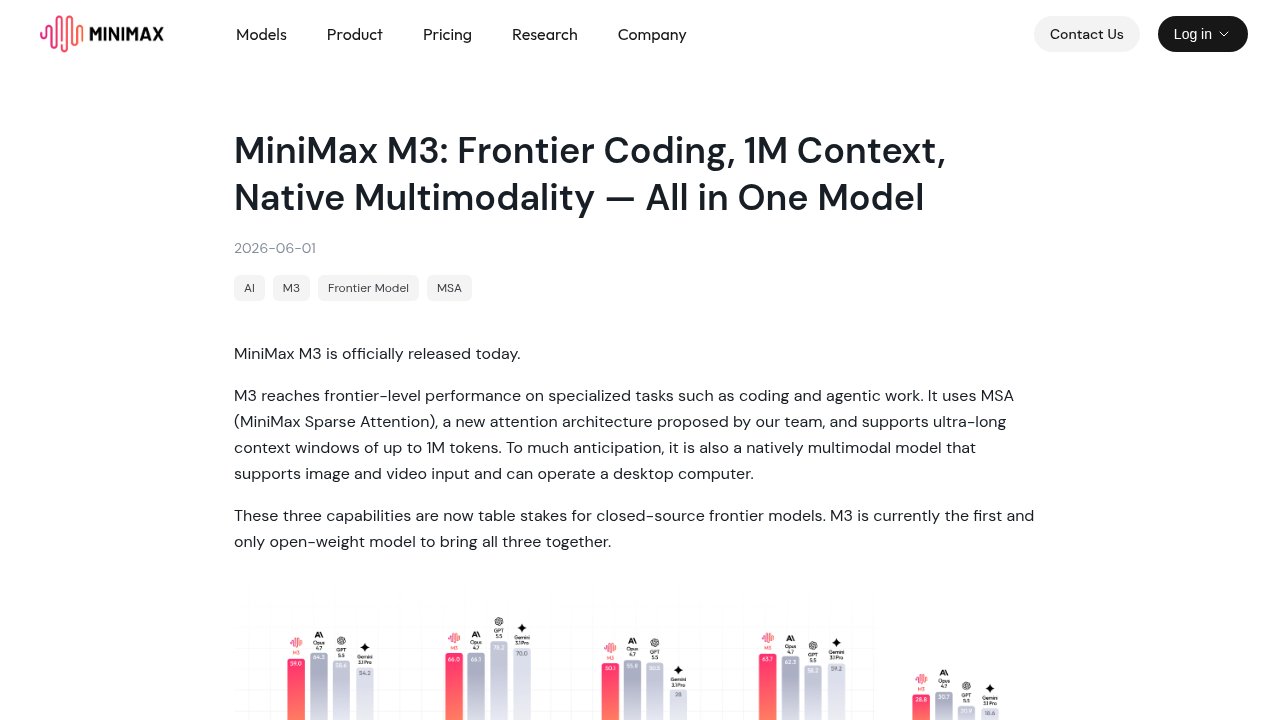 MiniMax M3 official release post — the company’s own announcement, with the benchmark charts referenced above.
What’s actually under the hood
Behind the pricing, M3 is a large model built to be cheap to run despite its size. MiniMax states the model has about 428 billion parameters in total, with roughly 23 billion actually activated for any given token. This sparse mixture-of-experts design, where only a fraction of the full network switches on for each piece of text, is how a model this large can still be served at a fraction of the cost of a smaller but fully “dense” model. It is the same basic principle responsible-pricing open-weight models from DeepSeek and Qwen have used, covered in our open-weight LLM licensing guide.
M3 also uses what MiniMax calls MiniMax Sparse Attention (MSA), its own design for how the model keeps track of long documents or long conversations. Standard “dense” attention, where the model weighs every piece of earlier text against every other piece, gets proportionally slower and can lose accuracy as the input grows. MSA is built to hold quality steadier as the context window stretches, and MiniMax backs that design with support for context windows up to 1 million tokens, roughly the length of several long novels, in a single session.
The model is also natively multimodal: it can take text, images, and video as input in the same conversation without routing them through separate specialized systems. MiniMax’s own blog post goes further, stating the model can operate a desktop computer directly, meaning it can look at a screen, decide what to click or type, and act, rather than being limited to answering questions about an image someone pastes in.
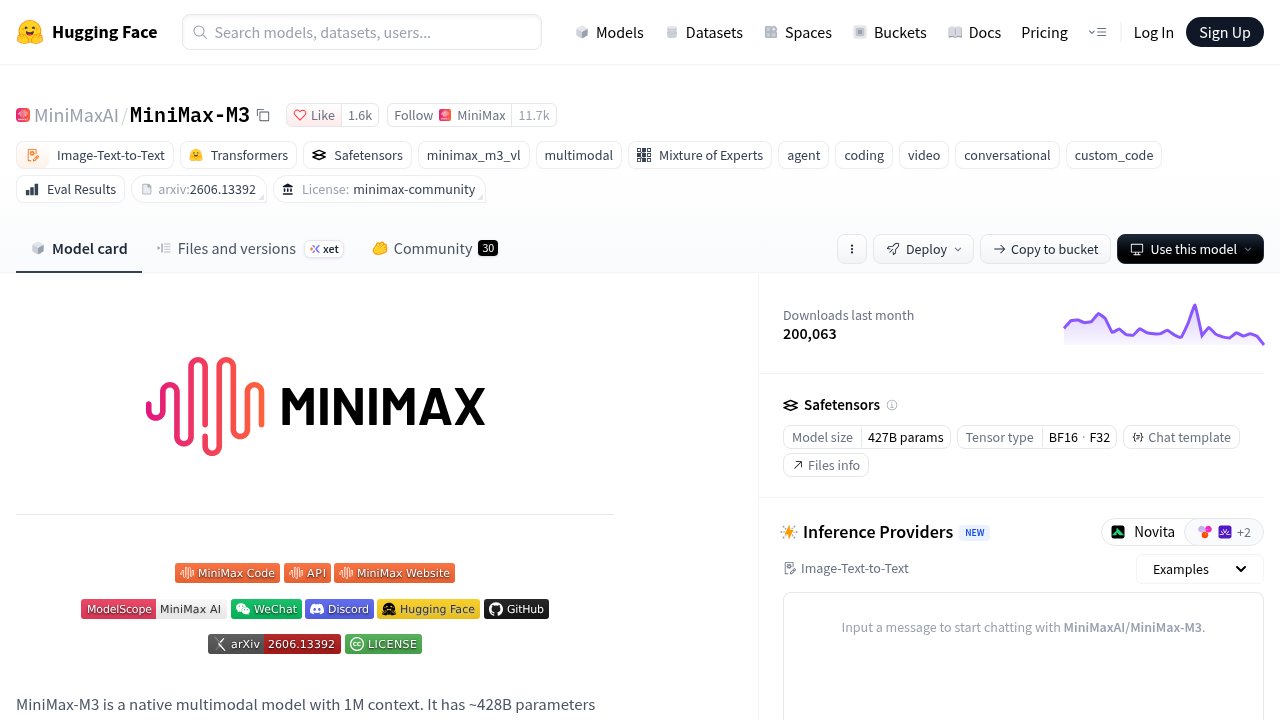 MiniMax-M3 on Hugging Face — the official model card and weights published by MiniMax.
Where the quality gap is real
None of this makes M3 a flawless substitute for the most capable closed models. On the industry’s two most-watched software engineering benchmarks, MiniMax reports M3 scoring 80.5% on SWE-Bench Verified (a test built from real, confirmed-fixable GitHub issues) and 59.0 on SWE-Bench Pro, a harder successor benchmark designed to resist the kind of memorization that inflated scores on the original test. On Terminal-Bench 2.1, which measures how well a model can operate a command-line environment to complete multi-step tasks, MiniMax reports a score of 66.0. These are strong results for an open-weight model, and MiniMax reports them itself rather than through an independent audit, which is worth keeping in mind when comparing them to numbers published by labs that submit to third-party leaderboards.
In practice, the gap between M3 and the top closed models shows up on the hardest, most unusual problems, the kind that require genuine novel reasoning rather than pattern-matching against a large volume of training examples. For the bulk of ordinary agentic coding work, writing a function, fixing a failing test, refactoring a module, following a style guide, that gap narrows considerably, which is the entire basis for the cost argument above: paying 25 times more only makes sense if the extra quality shows up on the tasks you actually run.
One illustration of M3’s behavior, worth noting precisely because it did not come from MiniMax itself: in one widely viewed hands-on test, a developer found that M3 would spontaneously write its own test scripts using a headless browser (a browser that runs without a visible window, often used for automated testing) to check its own work, without being asked to. That is a single observation from one independent tester, not a documented feature or a general claim about how the model always behaves, but it is the kind of detail that matters more to a working engineer than another benchmark percentage: a model that checks its own output unprompted needs less hand-holding in an agent loop.
For anyone weighing this trade-off against sticking with a closed frontier model, it is also worth remembering that closed-model access is not guaranteed to stay stable. Our coverage of Anthropic pulling access to one of its own models with no warning is a reminder that building a workflow entirely around one vendor’s API means accepting that vendor’s decisions about availability, not just its pricing. Open weights, even under a restrictive community license, remove that specific dependency: the model you download today keeps running on your own hardware regardless of what the vendor decides tomorrow.

FAQ
Is MiniMax M3 actually open source?
MiniMax M3’s weights are public and downloadable, which is often called “open-weight,” but the model is released under MiniMax’s own community license rather than an approved open-source license like Apache 2.0. That means some of the broad freedoms associated with true open-source software, particularly around redistribution and commercial use, are narrower than the “open source” label suggests.
How much does MiniMax M3 cost compared to GPT-5.5 or Claude Opus?
MiniMax M3 is commonly listed at about $0.30 per million input tokens and $1.20 per million output tokens, compared to roughly $5 input and $30 output for GPT-5.5, and $5 input and $25 output for Claude Opus 4.5. That puts M3 at roughly a 20 to 25 times discount on output pricing, though all of these figures will shift over time.
Can I run MiniMax M3 on my own hardware?
Yes, because MiniMax published the model’s weights, you can download and self-host MiniMax M3 instead of calling it through an API. In practice its size, roughly 428 billion total parameters with about 23 billion active per token, means self-hosting still requires substantial GPU infrastructure, not a laptop.
Is MiniMax M3 as good as GPT-5.5 for coding?
MiniMax M3 scores strongly on benchmarks like SWE-Bench Verified (80.5%, per MiniMax’s own reported figures) but is not positioned as matching the very best closed models on the hardest, most novel engineering problems. For routine agentic coding tasks, the practical quality gap is generally small enough that the large cost difference tends to matter more than the benchmark gap.
What is MiniMax Sparse Attention and why does it matter?
MiniMax Sparse Attention, or MSA, is MiniMax’s own design for how the M3 model processes long stretches of text, aimed at keeping answer quality stable even as the conversation or document grows very long. It supports MiniMax M3’s context window of up to 1 million tokens without the steep quality drop-off that standard dense attention designs can show at that length.