Claude Artifacts: The AI-Powered Mini Apps Nobody Talks About
Claude Artifacts can build small AI-powered apps with hosting and usage billing handled automatically. It has existed for over a year, quietly.
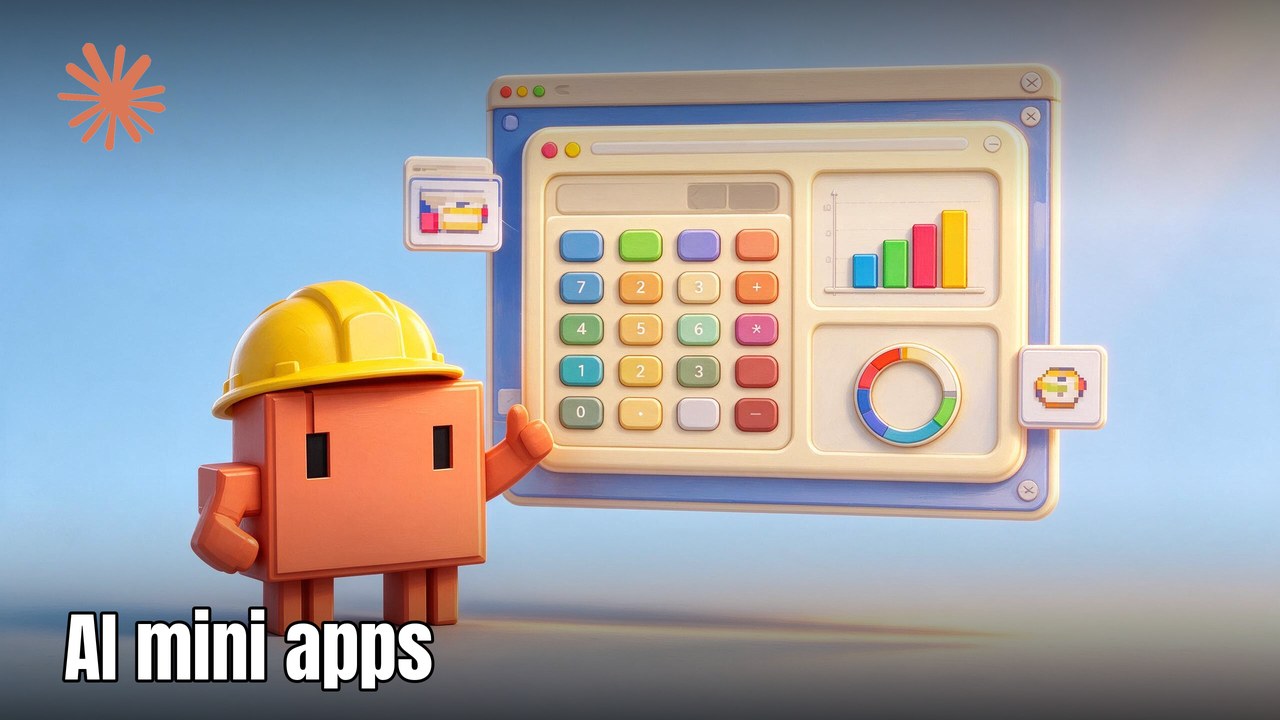
A year ago, Anthropic quietly gave Claude the ability to build small apps that call its own AI model while running, and shared them at no extra cost to the person who built them. Most people who use Claude every day have never noticed. The feature sits inside claude.ai, the chat interface anyone can open in a browser, under a capability called Claude Artifacts. It was never marketed as a launch event, it never got a splashy keynote slot, and it still works exactly the same way today. That is unusual enough to be worth explaining properly, because the actual shift it represents is not about AI getting smarter. It is about who pays for the AI to run.
What Claude Artifacts actually is
Artifacts is a feature inside claude.ai (not Claude Code, the separate command-line tool built for professional developers, and not the raw Claude API that companies pay for directly). When you ask Claude to build something like a calculator, a small game, or an interactive chart, it can generate that as a standalone piece of content next to the conversation, something you can view, use, and share independently of the chat log around it. If you have ever compared how differently Claude’s own model tiers handle a coding request, that same underlying model choice, a cheaper Claude versus a pricier one, shapes how capable an artifact turns out to be. These are the “classic” artifacts, and they have existed since the feature first launched: static, self-contained, no ongoing connection back to Claude once they’re built.
What changed in July 2025 is a single, specific addition: an artifact can now make its own calls back to the Claude API while someone is using it. Anthropic calls this AI-powered artifacts, sometimes “Claude-powered artifacts” in its own materials. A habit tracker that used to just save your entries to a file could now, for instance, read what you wrote and generate a short comment about your streak. A quiz generator could invent new questions on demand instead of shipping with a fixed set baked in at creation time. The artifact stopped being a frozen snippet of code and became a small program with a live model attached.
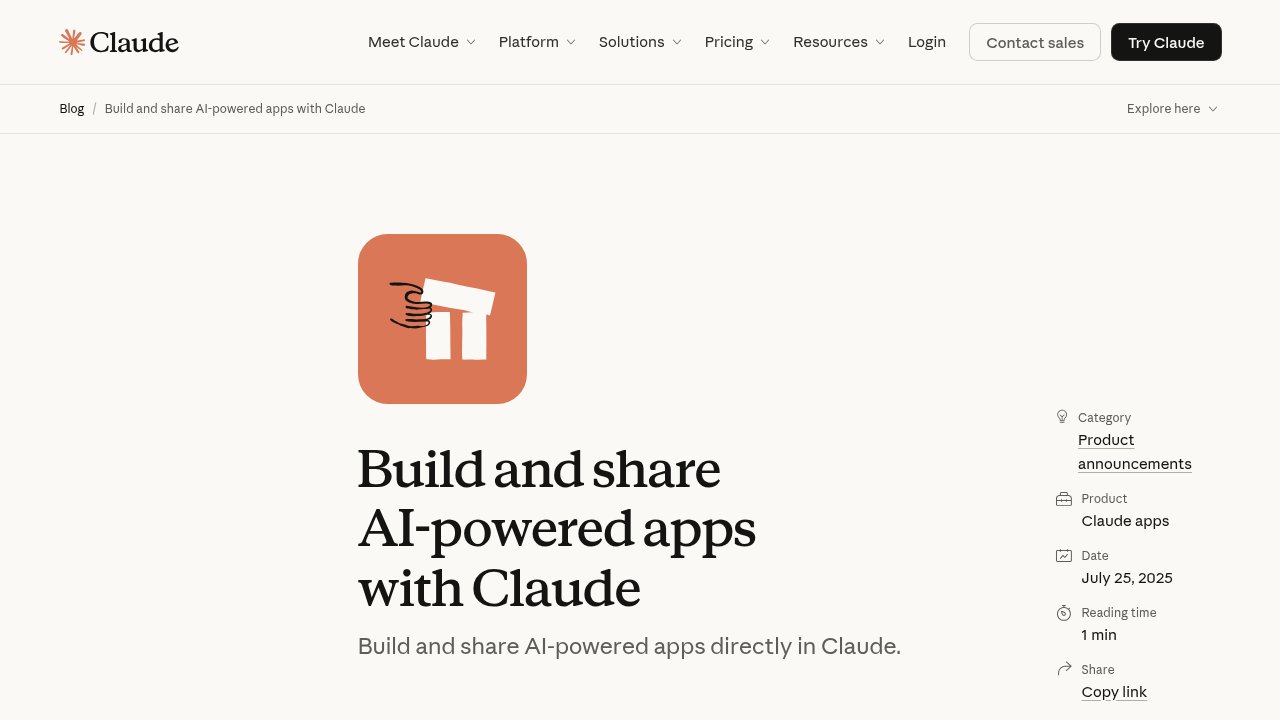 Anthropic’s Claude Artifacts announcement — the official post introducing AI-powered artifacts.
That distinction, static versus AI-powered, is the one worth holding onto, because it is easy to conflate “Claude can build apps” (true since artifacts first shipped) with “Claude can build apps that think while you use them” (true only since mid-2025, and still under-known). It is also easy to confuse Claude Artifacts with third-party app builders like Lovable, Bolt, or v0, tools that also turn a plain-English request into working code. The difference that matters is what happens after the code is written: those tools still leave the hosting and the usage bill on the builder’s own account. Claude Artifacts, for the AI-powered kind, does not.
Why hosting and billing were always the hard part
Building a small app with AI baked in was never really the hard part, even before this update. Plenty of tools let anyone describe an app in plain English and get working code back. The genuinely hard part, the part that quietly killed most side projects, was everything that happens after the code exists: you need somewhere to run it (a server, or a “serverless” platform that spins one up for you), and if that app calls an AI model, someone has to pay for every single call it makes, no matter who is actually using the app that day.
That second cost is what people underestimate most. If you build a tool with an AI model wired in and it gets shared around, every visitor’s usage lands on your bill, because the app is calling the model using your API key, your account, your credit card. A tool that costs nothing to build can still cost real money to let other people use, and that cost scales with how popular it becomes, which is exactly backwards from what most hobby builders want.
This is the part Claude Artifacts changes, and it is the actual substance of the story, not a footnote to it. According to Anthropic’s own announcement, when someone opens and uses an app built with Claude Artifacts, they sign in with their own Claude account, and their usage counts against their own subscription, not the creator’s. Anthropic states this directly: visitors authenticate with their existing Claude account, and their API usage counts against their subscription, not the builder’s, so the person who made the app pays nothing for how others use it.
Hosting disappears the same way. Once the artifact is ready, it is shared instantly through a link, with no separate deployment step, no server to configure, no API keys to manage on the creator’s side. If you have ever tried to put a small AI-powered tool in front of other people and hit the wall of “now I need a server, a database, and a billing plan for API calls I don’t control,” this removes that wall entirely, at least for the personal-scale case.
Who can actually use this
The AI-powered version of artifacts is available across every claude.ai plan: Free, Pro, Max, Team, and Enterprise. That is broader than it might sound, since a lot of Anthropic’s more advanced capabilities are gated behind paid tiers. Anyone with a free Claude account can build and share one of these apps today.
Persistent storage is the one piece that is not on Free. Anthropic added the ability for an artifact to remember data between sessions in October 2025, a separate update that arrived roughly three months after AI-powered artifacts themselves, and this part is limited to Pro, Max, Team, and Enterprise accounts. Without it, an artifact’s memory resets whenever someone closes the tab; with it, a fitness log can actually remember entries from yesterday, or a small group scoreboard can keep last week’s results in place.
Storage comes in two flavors, and the difference matters for what gets built. Personal mode gives each visitor their own private slice of data, useful for a journal or a habit tracker, where nobody wants their entries visible to anyone else who opens the link. Shared mode does the opposite: everyone who opens the artifact sees and edits the same state, which fits a small leaderboard or a shared planning board for a team. Anthropic caps this storage at 20MB per artifact, plenty for text-based data like journal entries or game scores, not something built for large files or media libraries.
There’s a catch worth knowing before building around this: according to Anthropic’s support documentation, storage only activates once the artifact is published. While it’s still being built and tested, any attempt to save or read stored data will fail, not because something is broken, but because the feature is deliberately switched off until publication. It’s a small detail, but it explains a confusing moment that trips up a lot of first-time builders: the app looks finished, storage looks wired up correctly, and yet nothing persists, simply because the publish step hasn’t happened yet.
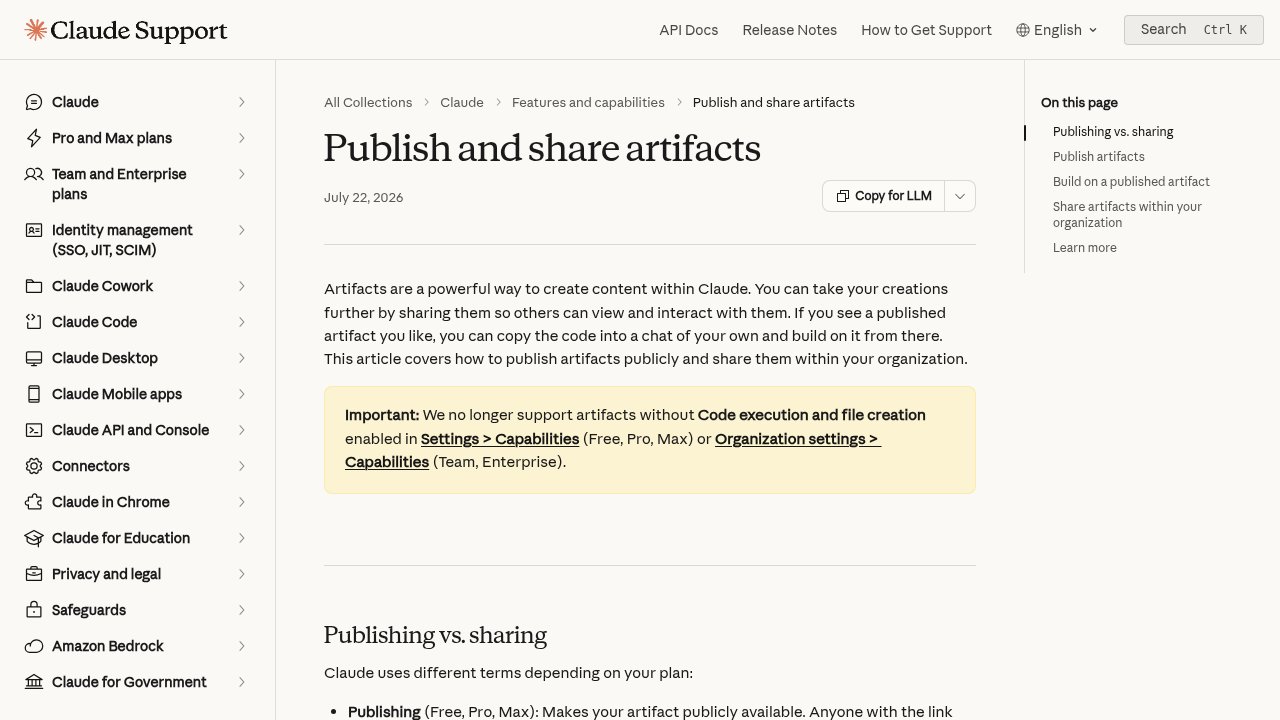 Anthropic’s support documentation on publishing and sharing artifacts — explains why storage only activates after publication.
The honest limits
This is where a lot of coverage of Claude Artifacts stops short, either skipping the limits entirely or burying them under enthusiasm. Two of them matter enough to spell out plainly.
Unpublishing is not reversible in the way you’d expect. Taking an artifact down permanently deletes every piece of data it stored, personal entries and shared state alike. The same artifact also cannot be republished afterward; getting the functionality back means building a new one from scratch. For anything with data people actually care about, that is worth knowing before hitting unpublish, not after.
This is not a substitute for real deployment at volume. A 20MB storage cap per artifact, a sharing model built around individual Claude accounts, and a “no separate hosting” design all point toward the same intended use: personal tools, small-circle sharing, and fast prototyping, not a product serving thousands of paying customers with dedicated infrastructure and a service-level agreement behind it. For testing an idea with a friend group, a small team, or personal daily use, the constraints barely register. For launching a commercial product, this was never built to replace an actual hosted backend, a real database, and a deliberate pricing model, and treating it as if it were is where the limits of the feature show up fastest.
None of this makes the underlying shift smaller. It just draws the boundary around where it applies. For hobby projects, internal team tools, and quick prototypes, the economics genuinely changed. For anything meant to scale to a paying audience, the old rules about hosting and billing are still exactly where they were. That same tension, a capability that quietly exists versus how visibly a company chooses to support it, also shows up when Anthropic pulls access to one of its own models with little warning: the underlying technology and the company’s own decisions about it don’t always move at the same pace.
How to try it
There is no separate download or install. With an existing claude.ai account, the AI-powered version of artifacts is available inside the same interface used for regular conversations, on every plan including the free one. Asking Claude to build something interactive (a small tool, tracker, or game) and wiring in a live call back to the model is available as an option during that build. Turning on persistent storage, for an artifact that needs to remember data between visits, requires a paid plan (Pro, Max, Team, or Enterprise) and requires publishing the artifact before storage actually starts working. From there, sharing is just a link. No separate deployment, no server setup, and no bill for what other people do with it.

Frequently asked questions
Is Claude Artifacts the same as Claude Code?
No. Claude Artifacts is a feature inside the claude.ai chat interface that generates small interactive apps directly in a conversation. Claude Code is a separate command-line tool built for professional developers working in their own codebase, with a different purpose and a different audience entirely.
Do I need to pay to build an AI-powered artifact?
No, building and sharing an AI-powered artifact works on the free claude.ai plan. The one piece gated behind a paid plan (Pro, Max, Team, or Enterprise) is persistent storage, the ability for the artifact to remember data between visits rather than resetting each session.
Who pays when someone else uses an app built with Claude Artifacts?
The visitor does, not whoever built the app. Each person who opens the artifact signs in with their own account, and whatever they use is billed to them, never to the creator. Anthropic built the sharing model this way specifically so a popular artifact does not turn into a growing bill for its creator.
Can stored data be recovered after unpublishing an artifact?
No. Unpublishing an artifact permanently deletes all its stored data, both personal and shared, and the same artifact cannot be republished afterward. A new one has to be built from scratch to get equivalent functionality back.
Is Claude Artifacts a real alternative to hosting an app the traditional way?
For personal tools, small groups, or quick prototypes, largely yes. For anything meant to serve a large paying audience, no: the 20MB storage cap per artifact and the account-based sharing model are built around small-scale use, not commercial-grade deployment.