Claude 5 Prompting Best Practices: Why Old Habits Backfire
Claude 5 prompting best practices have quietly flipped: step-by-step scripts that worked before now hold the model back. Here's what changed and why.

Someone who has spent the past year writing careful, numbered instructions for Claude opens a new chat, pastes the same five-step recipe they always use, and gets back something oddly worse than expected: narrower, more literal, missing things a competent assistant should have caught on its own. The instinct is to write an even more detailed list. That instinct is exactly backwards, and it points to something worth understanding about Claude 5 prompting best practices that has nothing to do with clever phrasing and everything to do with a setting most people don’t know they’re touching.
The dial nobody told you about
Every large language model ships with a default answer to one question: when instructions are incomplete, should the model guess and proceed, or stop and ask? Call it the initiative dial. Turn it one way and the model plays it safe, sticking to exactly what was written even when that leaves obvious gaps. Turn it the other way and the model fills those gaps itself, using judgment to carry a task through to a sensible end.
This dial is not fixed. It is not a personality trait of “AI” in general. It is a design choice a vendor makes for each model generation, and vendors do not always make the same choice, or keep the same one from one release to the next. That is the durable idea underneath every specific prompting tip in this piece: the right way to prompt a model is a moving target, not a skill you learn once, because the model on the other end keeps changing which way its dial is set.
What changed with Opus 5 and Fable 5.1
Anthropic’s recent model generation, which includes Claude Opus 5 (since succeeded by Opus 5.5) and the Fable 5 line (Fable 5, then Fable 5.1), turned that dial toward initiative. Anthropic’s prompting guide for Opus 5 states that the model performs best “when given the complete task specification up front and left to run”. The Fable 5.1 guide says that model “can execute very long tasks without much guidance on methodology, especially when the goal is clear”. Anthropic’s general guidance adds a preference for “general instructions over prescriptive steps”, while keeping numbered steps for cases where the order or completeness of steps matters.
That runs against a habit many users built with older models, where spelling out every step was a common way to steer the result. Anthropic now notes that Claude’s reasoning “frequently exceeds what a human would prescribe”, so a rigid checklist can get in the way instead of guiding. A list that once compensated for gaps in the model’s judgment can end up fencing that judgment in.
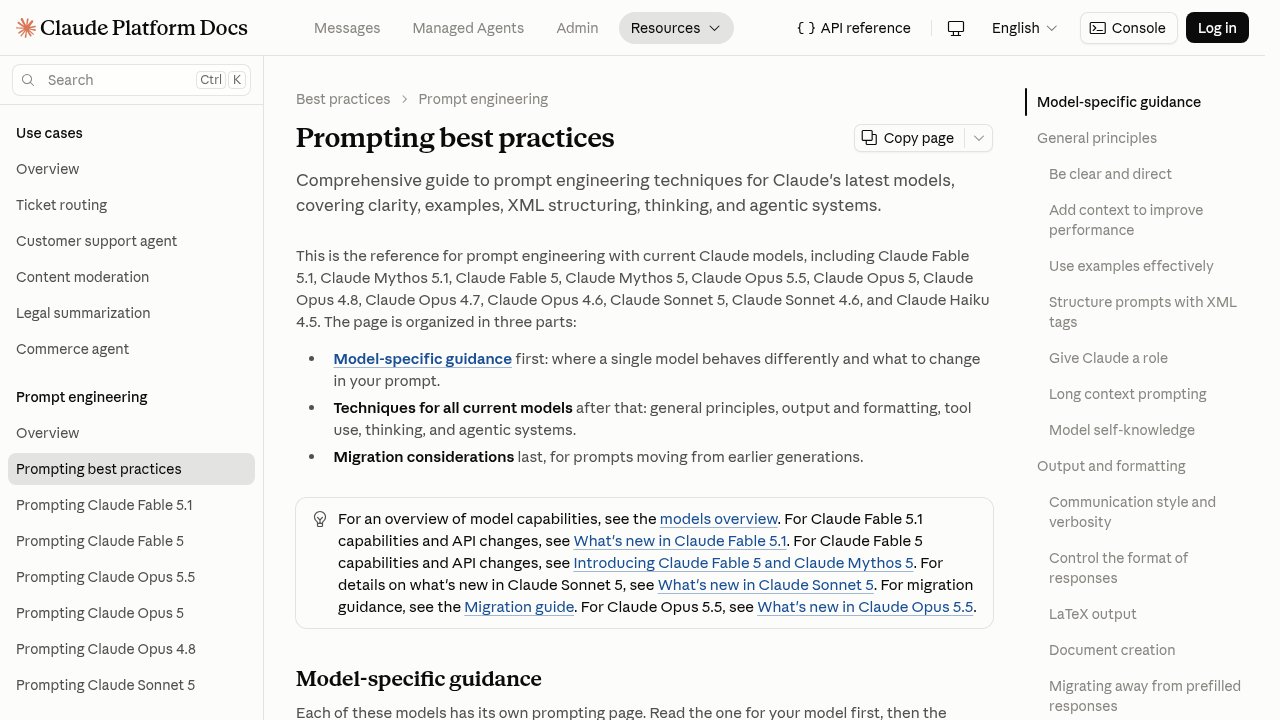 Anthropic Prompting best practices — the official Claude Platform Docs page covering model-specific guidance for Opus 5 and Fable 5.1.
Anthropic goes further than a general observation about writing new prompts. In its prompting guide for Claude Fable 5, the company advises to refactor existing prompts and “skills” (its term for reusable instruction sets saved and reused across tasks), noting that skills developed for prior models “are often too prescriptive” for the new model “and can degrade output quality”. The guide recommends reviewing those older instructions and considering removing them if the model performs better without them. The Opus 5 guide makes a related point: explicit verification instructions carried over from earlier prompts cause over-verification on Opus 5, and removing them costs nothing in quality. Prompts already tuned for Fable 5, on the other hand, should work on Fable 5.1 without changes, according to Anthropic. The common thread is a documented recommendation to audit instructions that were working fine yesterday, because the model reading them is not the same model.
Give the model the reason, not just the request
If a rigid list is out, what replaces it? Anthropic’s Fable 5 guide answers in a section titled “Give the reason, not only the request”: the model “tends to perform better when it understands the intent behind a request”. In practice, that means describing the intent behind a request rather than a sequence of actions. What larger task does this serve? Who is it for? What does “done” actually look like? That surrounding context is what lets the model make the dozens of small, unstated judgment calls that any real task involves, the ones no numbered list could enumerate in advance anyway.
This matters more than it sounds like it should, because the alternative failure mode is not “the model does nothing.” It’s the opposite.
The new failure mode: doing too much
Because Opus 5 and the Fable 5 models are built to act on their own initiative, a documented side effect is scope creep the user never asked for. Left with only a loosely specified request, the model can add things nobody requested: steps that weren’t asked for, an email drafted when none was requested, a defensive backup branch, because it decided that was part of doing the job well. Anthropic’s own fix for this is not to dial the model’s initiative back down. It’s to state explicit boundaries up front: the Opus 5 guide suggests asking the model to deliver what was asked “at the scope intended”, finish the whole task and stop short of actions clearly beyond the request, while the Fable 5 guide recommends defining explicit constraints on what the model should and should not do, rather than leaving it to guess where the task ends.
In practice, this reframes what a good Claude 5 prompt looks like. It’s not shorter because detail doesn’t matter. It’s structured differently: less “do this, then this, then this,” more “here is the goal, here is who it’s for, here is what finished looks like, and here is what’s out of scope.” The steps are the part you can now leave out. The edges of the task are the part you can no longer skip.
A separate technique for genuinely big, fuzzy asks
There’s one more piece worth separating out clearly, because it looks similar to the advice above but solves a different problem. Anthropic’s Claude Code documentation, aimed at software-building tasks, recommends a distinct technique for large or ambiguous build requests: have Claude interview the user first, asking about technical implementation, edge cases, and tradeoffs, then write a complete spec, rather than starting to build on assumptions.
This is not a contradiction of the complete-specification advice above. The advice about giving Opus 5 a full task spec up front assumes the scope of the task is already settled, the user knows roughly what they want and just needs to state it well. The interview technique is for the step before that, when the scope itself is still fuzzy and worth nailing down before any work starts. One is about how to phrase a request once you know what you’re asking for. The other is about figuring out what to ask for in the first place. Confusing the two is easy and worth avoiding: don’t ask Claude to interview you about a task you’ve already scoped in full, and don’t hand a vague, half-formed idea a rigid spec and expect it to fill the gaps correctly.
Why this same fix won’t work on ChatGPT
Here is where the initiative dial stops being an Anthropic-specific quirk and becomes a general lesson. OpenAI released GPT-6 Astra in early September 2026, according to press coverage, and describes it as “our most intelligent model yet”. Its prompting guidance does not prescribe a fixed template, but its suggested prompt snippets cover similar ground: carry the user’s intended task to completion, infer intent and scope from context, proceed unless an action is “clearly destructive or irreversible”, and treat the user’s instructions as taking precedence over the guidelines in a skill.
That sounds similar to the boundary-setting advice for Claude 5. The dial, though, is set in the opposite direction. GPT-6 Astra’s documented default behavior leans toward asking clarifying questions rather than deciding on its own, the reverse of Opus 5’s tendency to run with an incomplete brief. OpenAI’s model page notes that it is “more likely to ask for clarification where earlier models would make assumptions”, and its guidance offers a prompt for developers who want more autonomous work, telling the model to “bias towards action” and not to stop at acknowledging a request, proposing a plan, or offering to continue.
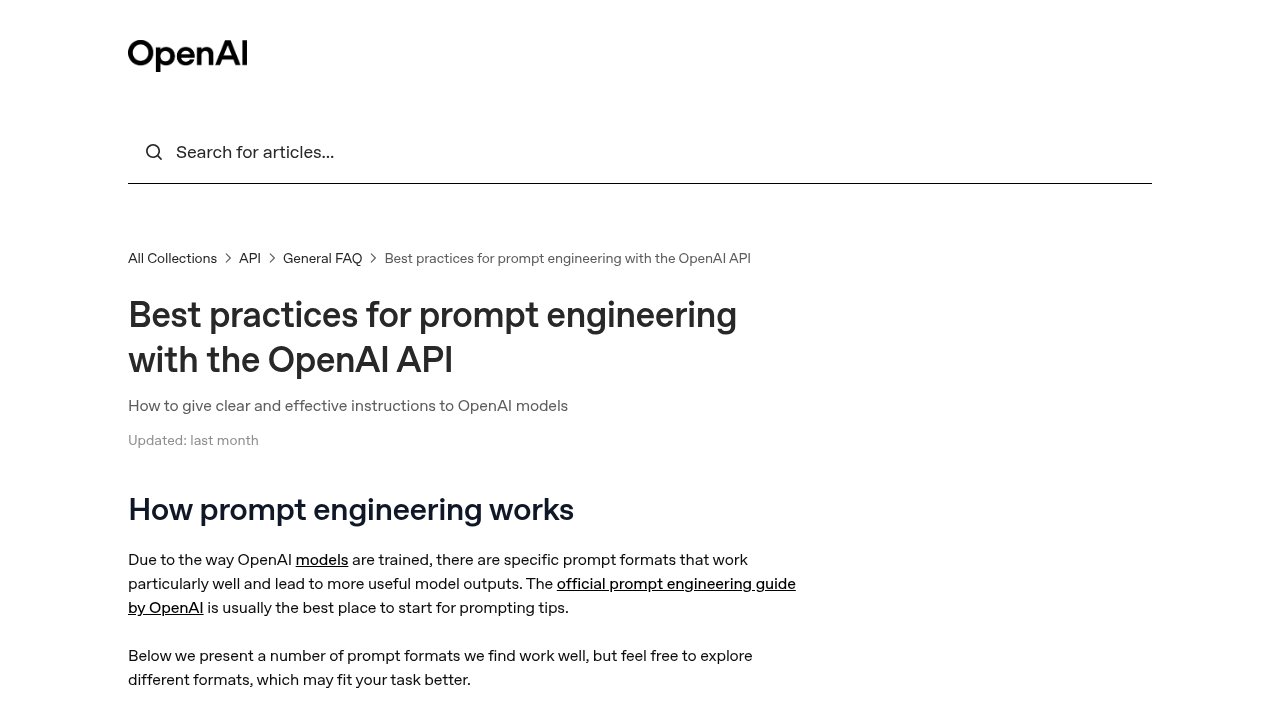 Best practices for prompt engineering with the OpenAI API — OpenAI’s general help-center article on prompt engineering with its API; the GPT-6 Astra specifics are in its prompt guidance.
That symmetry, and the mismatch inside it, is the practical trap. A habit built to rein in Claude 5’s tendency to over-act, heavy explicit boundaries, a strict definition of done, will not automatically fix GPT-6 Astra’s opposite tendency to ask before acting. Applied to a model that already leans toward asking questions, boundary-heavy prompting just adds more friction without solving the actual problem, which is getting the model to commit and act. Both vendors now document ways for the user to calibrate how much initiative the model takes, but each flagship’s factory default leans a different way, and a fix tuned for one direction doesn’t transfer to the other.
Frequently asked questions
What are Claude 5’s Opus 5 and Fable 5.1 models, in plain terms?
Opus 5 and Fable 5.1 are two models from Anthropic’s recent Claude generation (Opus 5 has since been succeeded by Opus 5.5). The practical detail that matters for prompting is not the name but the behavior: Anthropic’s documentation says Opus 5 performs best with the complete task specification handed over up front and then left to run, and that Fable 5.1 can carry long tasks without much guidance on methodology when the goal is clear.
Why would a detailed, step-by-step prompt make Claude 5 perform worse?
Numbered lists written for older models often spelled out every step to steer the result. Anthropic notes that skills developed for prior models are often too prescriptive for Claude Fable 5 and can degrade output quality, and that Claude’s reasoning frequently exceeds what a human would prescribe. A rigid list can therefore narrow the model’s judgment instead of filling a gap, and produce a narrower or more literal result than an open, well-contextualized request would.
How do I stop Claude 5 from adding things I didn’t ask for?
Claude 5’s tendency to expand scope unprompted is a documented side effect of its shift toward acting on initiative rather than waiting for explicit instruction. Anthropic’s fix is stating clear boundaries and constraining scope explicitly in the prompt itself, for example asking the model to deliver what was asked at the scope intended, rather than writing a longer list of steps, so the model knows where the task ends.
Does the same prompting style work on GPT-6 Astra?
No. GPT-6 Astra’s documented default leans the opposite way from Claude 5, asking clarifying questions more often instead of acting on assumptions. OpenAI’s own guidance offers a prompt for applications that need more autonomy, asking the model to infer intent and bias towards action, which is a different fix than the boundary-setting habit that works on Claude 5’s over-eager default.
Should I rewrite old Claude prompts and saved skills for the new model?
Largely yes, according to Anthropic’s guide for Claude Fable 5: skills developed for prior models are often too prescriptive for the new model and can degrade output quality, so Anthropic recommends reviewing them and considering removing older instructions if the model does better without them. On Opus 5, it also recommends removing verification instructions carried over from earlier prompts. Prompts already tuned for Fable 5, however, should work on Fable 5.1 without changes.