Claude Fable 5 vs Opus: When a Pricier AI Is Actually Worth It
Anthropic's Fable 5 costs twice as much to run as Opus 4.8. The honest answer to whether you should switch, and the one question that settles it.
In June 2026 Anthropic released a new top-of-the-line AI, and the first thing most teams noticed was not a benchmark. It was the price: the new model costs twice as much to run as the one they were already using. That single fact is the real question behind Claude Fable 5 vs Opus 4.8. Not which model is better on paper, but whether the better one is worth paying double for on the work you actually do.
A note before we start. This describes Fable 5 as it launched on June 9, 2026. Three days later, a US export-control ruling forced Anthropic to switch it off worldwide, so the specific model is no longer available. We are keeping the comparison because the question it raises, whether a pricier and more capable AI is worth the switch, comes back with every new release. The full story is here: why Anthropic disabled Fable 5 worldwide.
Two models, one of them twice the price
Anthropic sells its AI in tiers, from light and cheap to heavy and capable. For months the heavy one most companies ran was Claude Opus 4.8. Fable 5 sits one notch above it, the public version of a new family Anthropic calls Mythos. So for most teams this is not a choice between two new models; it is a question of whether to leave the one they already trust.
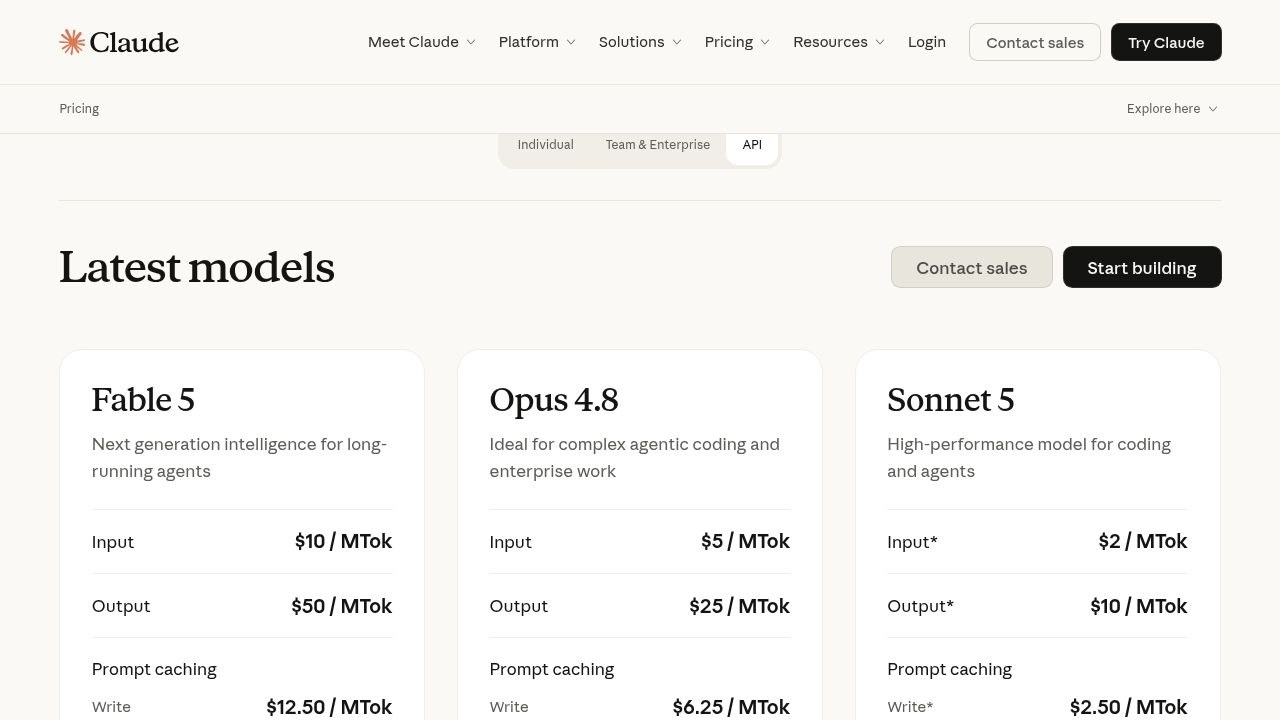
The gap that matters is cost. AI is billed by the token, a token being a chunk of text a little shorter than a word, and you pay separately for what you send in and what the model writes back. Opus 4.8 runs at roughly five dollars for a million tokens in and twenty-five for a million out. Fable 5 lists at exactly double that on both sides, so before you compare anything else, the upgrade already starts every conversation costing twice as much.
 Anthropic pricing page — per-token rates across the Claude model tiers
That is the frame the launch coverage skips. A newer model beating an older one on a test is expected. The honest question is whether it beats it by enough to justify the price, and the answer turns out to depend almost entirely on what kind of work you give it.
Where paying double actually pays off
Fable 5’s advantage is not spread evenly. It is concentrated in long, hard jobs, and nearly invisible everywhere else.
The clearest case is what the industry calls an agent: when you let the AI run on its own for a long stretch, doing one step after another without a person checking in between. That is exactly where weaker models drift. One mistake early in a long run quietly corrupts every step that follows, so the longer the job, the more the failures pile up. Fable 5’s real edge is staying on track across those long unattended runs, the moment where older models lose the thread.
Anthropic’s headline example is a coding job: it says Fable 5 rewrote part of a fifty-million-line codebase in a single day, work a team had estimated at more than two months by hand. The model also posts the top score on an independent coding test run by the firm Cognition. Treat the vendor’s own numbers as a direction rather than a promise until outside results confirm them, but the direction is not really in dispute: big, long, complex jobs are where the premium model earns its keep.
For a sense of where all this actually runs, our look at local AI hardware in 2026 covers the machines underneath.
Where the older model still holds
Now the other half, the part that decides the bill for most people. On everyday work, the difference between the two models nearly disappears.
Ask a single question, summarize a document, pull a few fields out of a form, write a short piece of code: in blind comparisons, where reviewers do not know which model produced which answer, most people cannot reliably tell them apart. And Opus 4.8 does that work at half the price. There is also a quieter value in the model you already know. A system you have run for months behaves predictably, and predictability you have measured is worth more than a benchmark you have not. A model that surprises you in production is expensive even when it is more capable, and especially when it costs twice as much.
So if most of your work is ordinary and high-volume, switching means paying double to improve the rare hard cases you barely hit. That gives you the one number the whole decision rests on. The size of your upgrade equals the share of your work that is genuinely hard. Measure that share before you move, because it is what tells you whether doubling the price is worth it.
The costs that are not on the price list
The sticker price understates the real increase, in three ways worth knowing before you commit.
First, the bill grows by more than double. A model that reasons for longer also writes more along the way, and you pay for every chunk it writes. So the real increase is twice the rate multiplied by the extra output the deeper thinking produces, not a flat two times. On a chatty workload that second multiplier can dwarf the first.
Second, switching is itself a project. The instructions and settings you tuned for the old model do not carry over cleanly, and anything you trust in production has to be re-tested before the new model handles real traffic. That is a real chunk of engineering time, and it lands once, on top of the doubled running cost.
Third, speed. A model that thinks for longer also answers a beat later. That is fine for a job running in the background and annoying in a live chat where a person is waiting. For exactly that reason Anthropic sells a faster version of the older Opus 4.8, the same quality delivered more quickly, for teams where the wait matters more than the extra capability. A better answer that arrives a second late can lose to a good-enough one that arrives now.
The quirk worth knowing: it sometimes hands off
Here is a behavior teams tend to discover in production rather than in planning. Fable 5 does not refuse sensitive requests; it quietly passes them to the older Opus 4.8, which answers instead. You still get a reply, just from a different model than the one you are paying for.
This handoff triggers on a few flagged areas: offensive hacking, biology and chemistry, and attempts to copy the model’s own abilities into another system. Anthropic says it happens in under five percent of sessions and that the filter is deliberately cautious, so it will sometimes catch harmless requests too. The catch is real for a narrow group: if your work lives near those topics, such as security research or content moderation, you can pay the premium rate and receive the cheaper model’s answer on exactly the prompts that matter most. If that is you, test the handoff rate on your own prompts before you switch.
How to decide, one case at a time
Choose Fable 5 if your core work is long, unattended, and complex, the kind of job that runs for hours across many steps or holds a large codebase together at once. That is the work the premium is built for, and there the higher price buys back the hours you would otherwise spend babysitting and fixing.

Stay on Opus 4.8 if your work is high-volume and ordinary. Chats, classification, summaries, short answers: the quality is hard to tell apart, the price is half, and the savings compound across millions of requests.
For most teams, the honest answer is to use both. Send the long, hard jobs to the pricier model and keep the everyday flood on the cheaper one. You do not have to pick a side; you have to route the work.
The bottom line
The choice between Fable 5 and Opus 4.8 is not an upgrade you take on principle. It is a bet on your own workload, against a model that costs twice as much to run. The premium model wins the hard, long jobs by enough to pay for itself when those jobs are your core product. The older one holds the everyday work at half the price, and even answers the sensitive prompts the new model hands back to it. Measure how much of your work is genuinely hard, try the new model on a slice of real traffic, and decide on your own numbers. The specific model that prompted the question is already gone. The question outlives it, and so does the answer: a more powerful AI is worth paying for only where you actually need the power.
Frequently asked questions
Is Claude Fable 5 better than Opus 4.8?
On long, hard jobs, yes, clearly. Fable 5 stays on task across long unattended runs and large coding jobs where the older model loses the thread, and it tops an independent coding test. On everyday single questions and short tasks, the difference is small enough that reviewers struggle to tell the answers apart, and Opus 4.8 costs half as much. So “better” depends entirely on which kind of work makes up most of yours.
Should I switch from Opus 4.8 to Fable 5?
Start by measuring how much of your work is genuinely hard, because Fable 5 costs exactly twice as much per token. If long unattended jobs and big coding work are your core product, the switch pays for itself in time saved. If most of your work is ordinary and high-volume, the doubled price plus the one-time cost of moving over rarely pays back. Either way, test it on a slice of your real work before committing everything.
Why is Fable 5 more expensive than Opus 4.8?
On two fronts. Its listed price is double Opus 4.8’s on both what you send and what it writes back. And because it reasons for longer, it also writes more per task, and you pay for every chunk. So your real increase is more than a flat two times. Model it on your own traffic rather than the headline rate.
Does Fable 5 refuse more requests than Opus 4.8?
It does not refuse outright; it hands off. When a request touches a flagged area, offensive hacking, biology and chemistry, or copying the model’s abilities, Fable 5 quietly routes it to Opus 4.8, which answers instead. Anthropic says this happens in under five percent of sessions. If your work sits near those topics, you can end up paying the premium rate for the cheaper model’s answer, so test the handoff rate on your own prompts first.
Can I run Fable 5 and Opus 4.8 side by side?
Yes, and for most teams that is the right answer rather than a clean switch. Route the long, complex jobs to the pricier model and keep the high-volume everyday work on the cheaper one. Let the results from each lane tell you when, and whether, to move more work across. Teams running their own customization should read our practical guide to fine-tuning before deciding whether a model swap or a smaller adjustment is the cheaper route to the quality they need.