Claude Opus 5: Half the Price on Paper, Not Always Half the Cost in Practice
Opus 5 costs half of Fable 5 per token. Two people who tracked their own bill in dollars found the real number often lands closer to a third off, or higher.

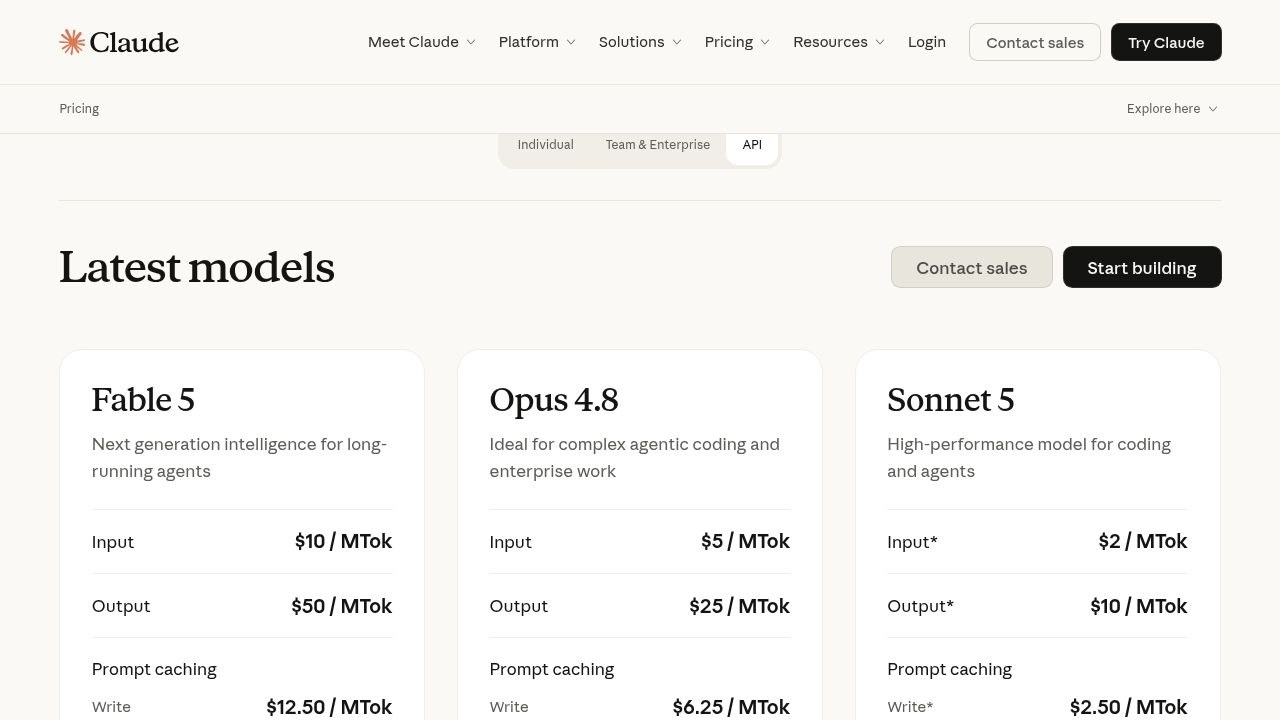
Claude Opus 5 launched on July 24, 2026, priced at $5 per million input tokens and $25 per million output tokens, roughly half of what Anthropic charges for Fable 5, its most capable model. A token is the rough unit an AI model gets billed by, close to three-quarters of a word. On the benchmarks Anthropic ran itself, Opus 5 lands close to Fable 5’s ceiling at that lower rate, which is the headline most of the launch-day coverage repeated. It is also not the whole story once you check what the model actually costs to run.
What Anthropic actually shipped
Opus 5 is available immediately on Claude.ai, in Anthropic’s coding tool Claude Code, in its Cowork product, and through the API. It is the new default model on the Claude Max plan and the strongest option on Claude Pro. It should not be confused with Opus 4.8, its direct predecessor at the same $5 and $25 rates, which Opus 5 is pitched as a straight upgrade over. Nor with Mythos 5, a separate model reserved for a small set of vetted partners, which Anthropic says is still ahead of Opus 5 at finding and exploiting software vulnerabilities.
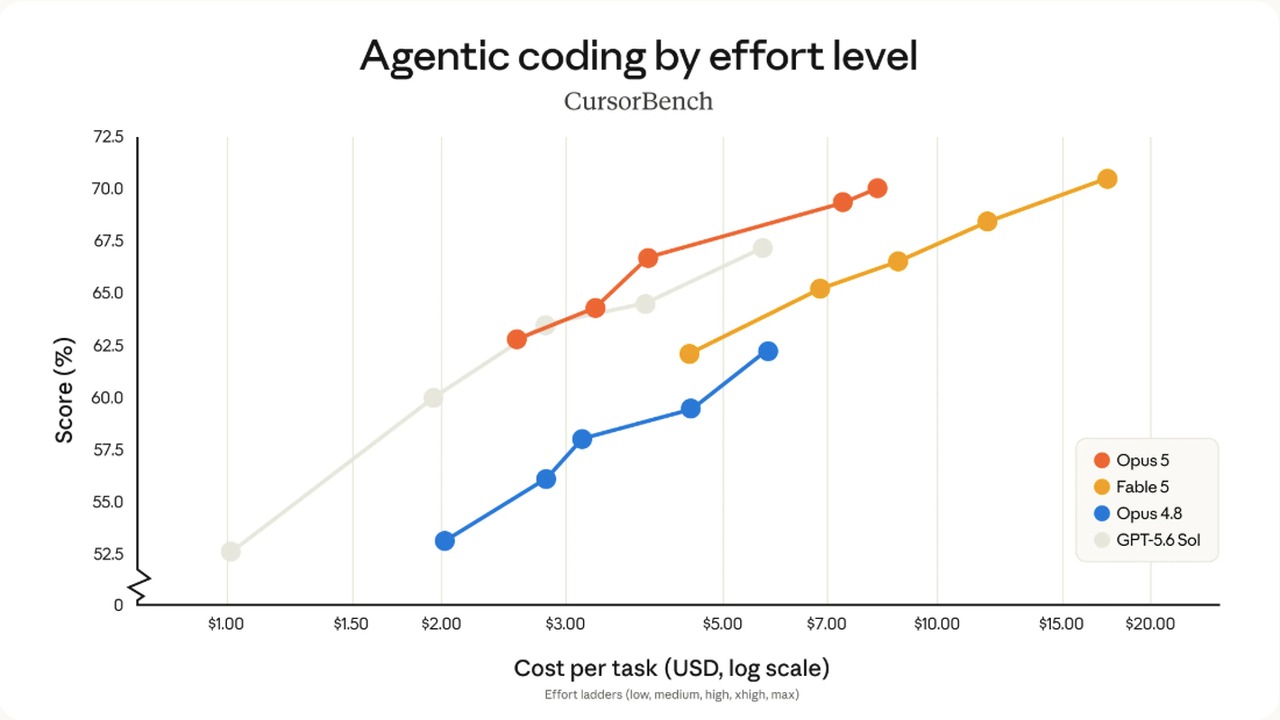
Against Fable 5, the pitch is closer performance for less money: on CursorBench 3.2, a coding benchmark, Opus 5 lands within 0.5% of Fable 5’s peak score at half the cost per task, and on OSWorld 2.0, a computer-use test, it beats Fable 5’s best result at just over a third of the cost. Its working memory, the amount of text it can hold in a single conversation, is 1 million tokens, both by default and at the ceiling, according to Anthropic’s developer documentation. A faster mode is also available, running about 2.5 times the default pace at twice the base price.
Anthropic also reports safety work alongside the capability jump. Opus 5 scored 2.3 on the company’s internal audit for misaligned behavior, its lowest, best score to date, and its cybersecurity classifiers now step in roughly 85% less often than they did on Fable 5. One access change ships with the launch: biology-related requests that Fable 5 currently declines now route to Opus 5 instead of Opus 4.8, since Opus 5 carries the same safety measures as Opus 4.8 while scoring higher on general capability. Two features remain in beta: mid-conversation tool changes on the Claude Platform, which let a developer swap which tools Claude can use without invalidating the prompt cache, and automatic fallbacks on the API, which reroute a safety-flagged request to a different model instead of simply refusing it.
What two independent testers measured in dollars
Those benchmark numbers are Anthropic’s own, measured on a fixed test; they describe cost per task, not cost per month on a real workload. Two people who tracked their own real spending independently, not a controlled benchmark, put a number on the gap. Erwan ran a controlled test the afternoon Opus 5 shipped: the same app-building prompt, once with an explicit “double-check your work” instruction and once without it. The instructed run took 5 minutes longer and produced 15 extra self-reviews, for a nearly identical result. Across his broader test batch, the real cost he measured landed about a third cheaper than Fable 5, not the half the price list implies.
Nate Herk ran a more extensive test: 8 to 10 matched real jobs in Claude Code, from bug hunts to a promotional video plan, with actual dollar costs logged for both models. Added up, Opus 5 produced 2 million output tokens against Fable 5’s 832,000, roughly 2.4 times more, and ran an average of 60 minutes per session against Fable 5’s 25. On one job, a structural-engineering simulator, Opus 5 finished in 2 hours 26 minutes for $112, while Fable 5 finished the same brief in 7 minutes for $73. Neither result is a controlled benchmark, and Herk says as much himself, but both landed on the same pattern: a cheaper price per token did not automatically show up as a cheaper bill.
Anthropic’s own guide explains why
Anthropic documents the behavior behind that gap itself. Its official prompting guide for Opus 5 states plainly that the model “verifies its own work without being told to.” If a prompt still carries an old instruction like “include a final verification step” or “use a subagent to verify,” the guide says to remove it: those instructions “cause over-verification on Claude Opus 5, and removing them reduces wasted tokens with no loss in quality.” Most teams running an AI harness or a custom prompt library carry exactly that kind of instruction, added for an older, less careful model, and never revisited.
The same document separates two things people tend to conflate: the effort setting, a dial from low to extra-high that controls how much the model reasons before answering, and how much it actually writes back. Lowering effort cuts the reasoning, Anthropic says, but “can reduce thinking volume without reliably shortening the visible response.” That matches what Erwan found on a plain factual question: 386 words and 23 seconds by default, down to a third of that once he added an explicit instruction to answer in five lines or fewer. The response length has to be prompted for directly; the effort slider alone will not do it.
The same guide flags a second habit that spends money quietly. Opus 5 hands work off to subagents, meaning copies of itself running a piece of the job in parallel, more readily than earlier models did. Anthropic’s advice is to cap that: delegation earns its keep on large independent tracks of work and multiplies cost and time when it is applied to small tasks.
Where the discount actually holds
The pattern lines up with Anthropic’s own description of the model: the overspend shows up on jobs that loop, iterate, or ask the model to check and re-check itself, exactly the shape of Herk’s and Erwan’s tests. A clean, one-shot generation task, with nothing to verify against, should not trigger the same behavior by the same logic. The discount is likely to hold on a straight build and erode on anything that loops back through review.
Getting the advertised price back
Three changes, all traceable to Anthropic’s own guidance, close most of the gap:
Delete standing verification instructions. Any “double-check” or “have a subagent review this” line left over in a system prompt or a custom harness is now working against you rather than for you. Opus 5 already does that step on its own.
Add an explicit length instruction if you want shorter answers. Effort controls depth of reasoning, not word count. One short line does the job the effort slider cannot, and Anthropic’s suggested wording is “Keep responses focused, brief, and concise.”
Reach for low or medium effort more often. Anthropic recommends using those settings “liberally” as the main lever for cost and speed, and saving the highest setting for genuinely demanding agentic and coding work rather than defaulting to it everywhere, the same lever that closed most of the gap between Sonnet 5 and Opus 4.8.

The takeaway
Opus 5 is a real capability and safety upgrade at an unchanged price, and its half-price comparison against Fable 5 holds up on Anthropic’s own benchmarks. What it does not automatically deliver is a matching cut in your own bill: Claude Opus 5 checks its own work by default, a genuine gain that also spends tokens the sticker price doesn’t account for. Whether you collect the advertised discount depends less on which model you pick than on whether your prompts still assume the old one.
Frequently asked questions
Is Claude Opus 5 actually cheaper than Fable 5?
Claude Opus 5 costs half of what Anthropic charges for Fable 5 per token, on both input and output. In practice, two independent creators measured real savings closer to a third, and one task ended up costing more in dollars despite the lower rate, because Opus 5 used far more tokens to get there.
Why does Opus 5 use more tokens than expected?
Anthropic’s own prompting guide says Claude Opus 5 checks its own work without being asked to, a behavior baked into the model rather than a prompting mistake. Leftover instructions telling it to “verify” or “double-check” make this worse, since the model is already doing that step by default.
Does lowering the effort setting cut Opus 5’s cost?
Lowering Claude Opus 5’s effort setting cuts cost only partly. Effort controls how much the model reasons internally, not how long its visible answer runs, so a lower setting alone will not shrink a verbose response. Anthropic recommends pairing it with an explicit instruction to keep answers short.
When does Claude Opus 5 stay close to its advertised price?
Claude Opus 5 stays close to its advertised price on well-scoped, one-shot jobs with no built-in verification loop, such as generating a complete site or document in a single pass. The overspend concentrates on iterative, multi-step, or review-heavy work instead.
What else changed in Claude Opus 5 besides pricing?
Beyond the price match with Opus 4.8, Claude Opus 5 brings a lower internal safety-audit score for misaligned behavior and far fewer cybersecurity-classifier interventions than Fable 5, plus a routing change that sends biology-related requests blocked on Fable 5 to Opus 5 instead of Opus 4.8. Two features, mid-conversation tool changes and automatic model fallbacks, remain in beta.