Anthropic's Fable 5 and Mythos 5 are back online. This time, access comes with strings attached.
Anthropic restored its top AI models after a 19-day US export ban, but under new government oversight. Plus what Sonnet 5 actually changes for builders.

Anthropic’s two most capable AI models are back online. Fable 5 and Mythos 5 went dark on June 12, when the US Commerce Department ordered them switched off worldwide within about an hour. They returned on July 1, after nineteen days offline, and the return came with terms attached: Anthropic, along with Amazon, Microsoft and Google, has agreed to a shared framework for scoring how dangerous a jailbreak is, and the Commerce Secretary who signed the shutdown order kept the right to order it again. The outage is over, but the mechanism that caused it is now a permanent, named part of how these models operate.
We covered the shutdown itself last month: a national-security order, no way to filter foreign users out of millions of daily requests, so Anthropic pulled the plug for everyone at once (see why Anthropic disabled Fable 5 worldwide). This piece picks up from there: what actually came back, on what terms, and what changed everywhere else in Anthropic’s line-up while the two flagship models were offline, including a new mid-tier model that has nothing to do with the ban and everything to do with what most teams should actually be running.
What actually came back, and when
Both models came back on the same day, July 1, not staggered. Some coverage in late June suggested Mythos 5 would clear first, for a narrow set of critical-infrastructure customers, while Fable 5 stayed dark. That did not happen. Anthropic restored both at once.
Fable 5 is public again, the same way it was before June 12: available through Anthropic’s own API, through Claude Platform on AWS, and through Amazon Bedrock, Google Cloud and Microsoft Foundry. Mythos 5 is not public and never has been. It is only available through Project Glasswing, a vetted-partner program, and it succeeds an earlier invitation-only version called Mythos Preview.
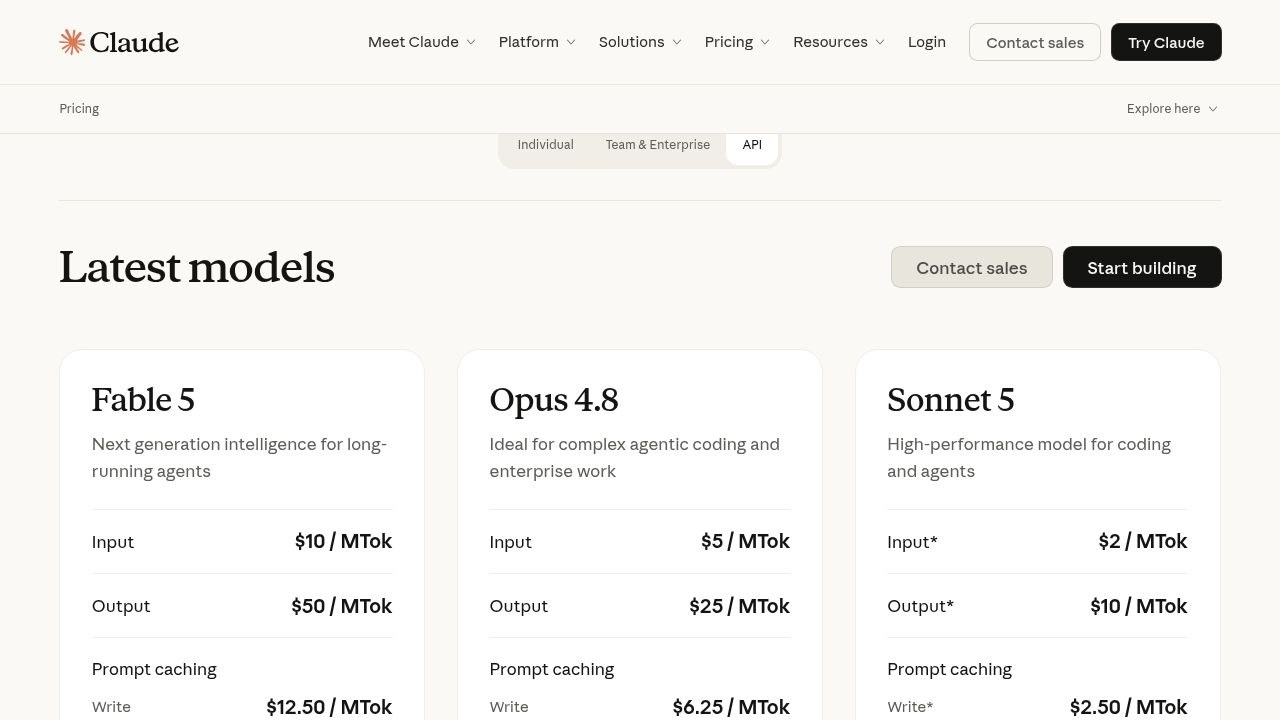
The two models share the same specs and the same price: a 1-million-token context window, up to 128,000 tokens of output per request, and $10 per million input tokens ($50 per million output). The real difference between the two is a safety layer: Fable 5 runs safety classifiers that can refuse a request outright, and Mythos 5 does not have those classifiers at all. That is the actual reason Mythos 5 stays behind a vetting process: the version without the extra guardrail is the one the government was worried about, so only checked, contracted partners get it.
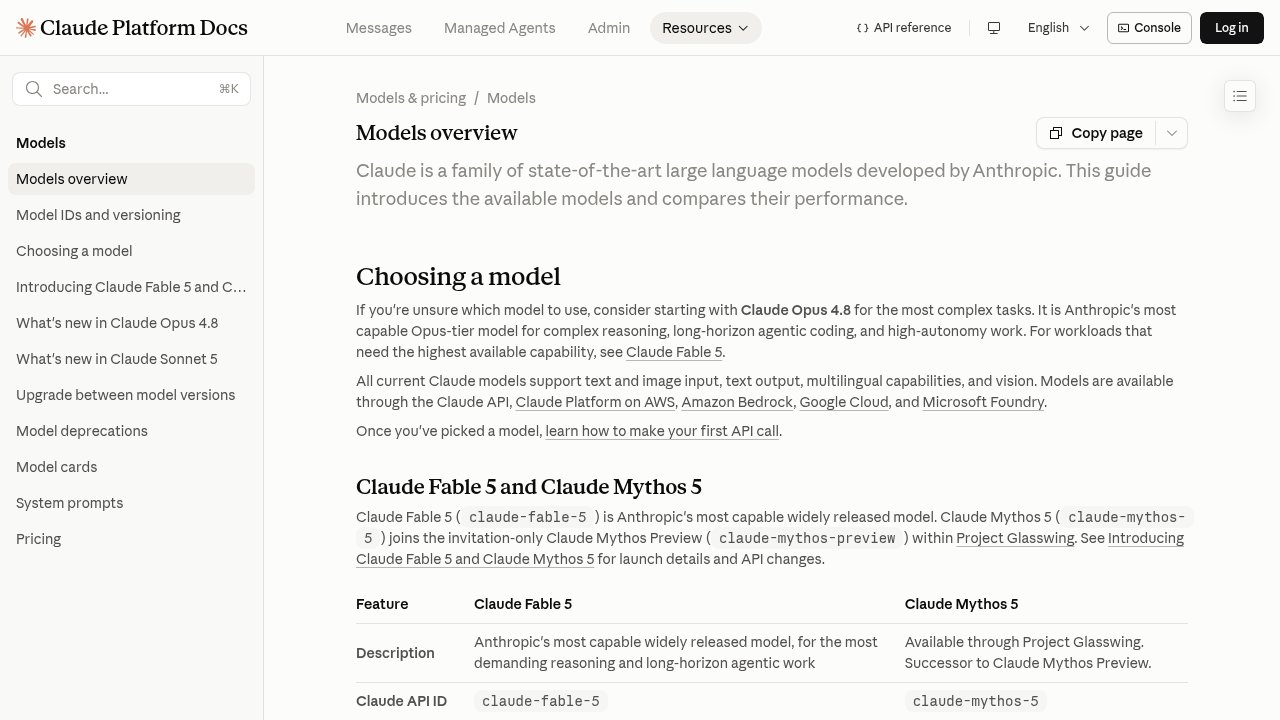 Anthropic’s own Models Overview page, listing Fable 5, Mythos 5, Sonnet 5 and Opus 4.8 side by side.
Why access now comes with strings attached
Here is the part most of the coverage skipped. Restoring access was not just flipping a switch back. Anthropic agreed to build, together with Amazon, Microsoft and Google as fellow Project Glasswing partners, a shared framework for scoring how severe a given jailbreak is. It also committed to proactively look for security risks in the models and report anything malicious it finds to the government. Commerce Secretary Howard Lutnick, who signed the original shutdown letter, kept an explicit right to re-evaluate the decision if Anthropic does not hold up its end.
That is a different kind of access than Fable 5 and Mythos 5 had when they first launched, on June 9. Before, a government shutdown of a live commercial AI model was a legal power nobody had actually used. Now it is a demonstrated capability with a named process attached, agreed to by the company that got shut down. The models are back, but they are back inside a monitoring arrangement that did not exist three weeks ago.
Sonnet 5 is the change that has nothing to do with any of this
While Fable 5 and Mythos 5 were offline, Anthropic also released Sonnet 5, and it is worth separating from the story above because none of it touches export controls. Sonnet 5 replaces Sonnet 4.6 as Anthropic’s mid-tier model, and Anthropic describes it as the best combination of speed and intelligence in that tier.
The number that matters for most teams is price and speed together, not a benchmark score. Sonnet 5 costs $3 per million input tokens and $15 per million output tokens, with a lower introductory rate through the end of August. Opus 4.8, the everyday high-end model, costs $5 and $25. Anthropic rates Sonnet 5’s latency as fast and Opus 4.8’s as moderate. For a team that does not need Fable-5-level reasoning and was defaulting to Opus 4.8 out of habit, Sonnet 5 is now the model worth trying first: cheaper, faster, and close enough in quality for most production work.
The practical shift is that the mid-tier model is now the sensible default for most production work, priced and positioned to be tried before anything above it.
Where Opus 4.8 still earns its price
Opus 4.8 has not been demoted. It is still the model to reach for when a task genuinely needs more reasoning depth than speed: long, autonomous coding runs, multi-step agents that hold context over many turns, anything where getting it right the first time is worth the extra cost. The honest rule of thumb: start on Sonnet 5, and move up to Opus 4.8 only when a specific task keeps needing a second pass to get right.
What this actually means if you build on any of these models
The lesson from the June shutdown still holds: keep a fallback model wired in behind a switch you can flip, because access to any single model can be pulled by a decision you do not control. What is new this month is that the risk now has a public measuring stick. If Anthropic, Amazon, Microsoft and Google eventually publish anything from their shared jailbreak-severity framework, that is worth watching as a leading indicator, not filing away as an academic exercise. And if you are choosing between Anthropic’s models today, the choice is simpler than the last month suggests: default to Sonnet 5 for most work, keep Opus 4.8 for the hard cases, and reach for Fable 5 or Mythos 5 only when a task genuinely needs the extra ceiling, knowing that ceiling now comes with a government watching how it gets used.

FAQ
Is Fable 5 available everywhere it was before the ban?
Yes. It is generally available through Anthropic’s API, Claude Platform on AWS, Amazon Bedrock, Google Cloud and Microsoft Foundry, the same distribution it had before June 12.
What is Project Glasswing?
Anthropic’s vetted-partner program for its most sensitive model access. Approved customers get it through their Anthropic, AWS or Google Cloud account team; Mythos 5 is currently only offered through that program.
Could the government shut the models down again?
Yes, and that is explicit now rather than theoretical. Commerce Secretary Lutnick kept the right to re-evaluate the decision if Anthropic does not meet the commitments it made, including the jailbreak-severity framework and the reporting requirements.
Should I switch from Opus 4.8 to Sonnet 5?
Try it on a slice of your workload first. Sonnet 5 is cheaper, faster, and is Anthropic’s new default recommendation for most production use. Keep Opus 4.8 for tasks that need deeper reasoning or long autonomous runs.
Photo: ThisIsEngineering / Pexels