Google Coral NPU: Why Google Is Giving Away Its Edge AI Chip Design
Google open-sourced the Coral NPU, the chip core behind a board running Gemma without the cloud. The real story is the licensing bet, not the hardware.
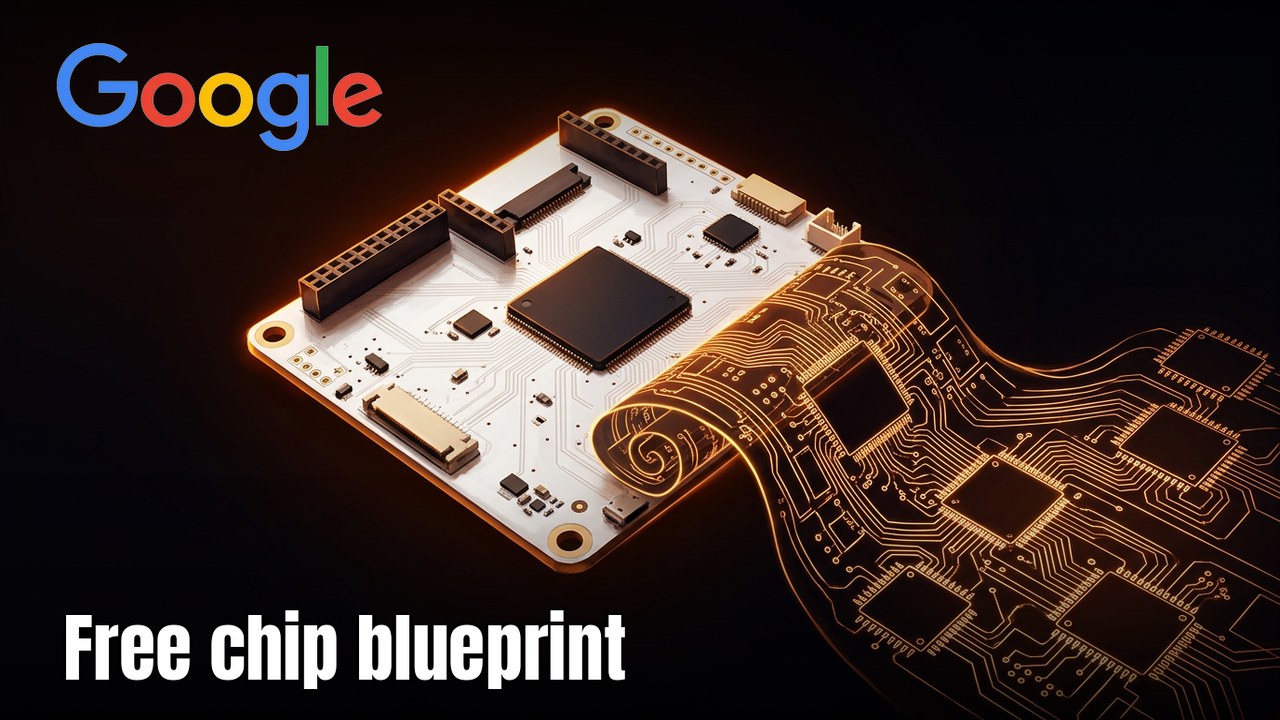
At Google I/O 2026, Google showed off a small board running a language model entirely on its own hardware, no internet connection required. The demo was the easy part to notice. The harder, more durable story is what Google did with the chip design underneath it: it gave the blueprint away for free.
That chip is called the Google Coral NPU, and it is not, strictly speaking, a product you can buy. It is an open-source design for a small AI processing chip, released under a licence that lets any chipmaker build it, modify it, and ship it without paying Google a royalty. That is the useful idea here, one that will matter long after this board is gone. Call it the Google Coral NPU Gemma edge story: one chip design, one small model, and a bet about who gets to build the hardware in between.
What Google actually showed at I/O 2026
The demo itself was straightforward. Google and the chip company Synaptics built a small circuit board called the Coralboard, that runs Gemma 3 270M, a compact version of Google’s Gemma family of AI models, completely on the device itself. No cloud server processes the request. No data leaves the board. The model reads a prompt and answers locally, the way a calculator computes without phoning anywhere for help.
This is what people mean by on-device inference: running the model’s calculations on the hardware in front of you, instead of sending the request to a distant data center. It matters for reasons close to keeping a diary in a locked drawer rather than someone else’s filing cabinet: nothing you type has to leave the room, there is no network round trip to wait on, and the thing keeps working if the Wi-Fi drops.
One useful point of comparison sits closer to a desk than a pocket. Anyone who has weighed running large language models on your own machine instead of a cloud subscription has already made this same trade at a bigger scale: control and privacy against convenience. The Coralboard applies that identical logic to something the size of a paperback.
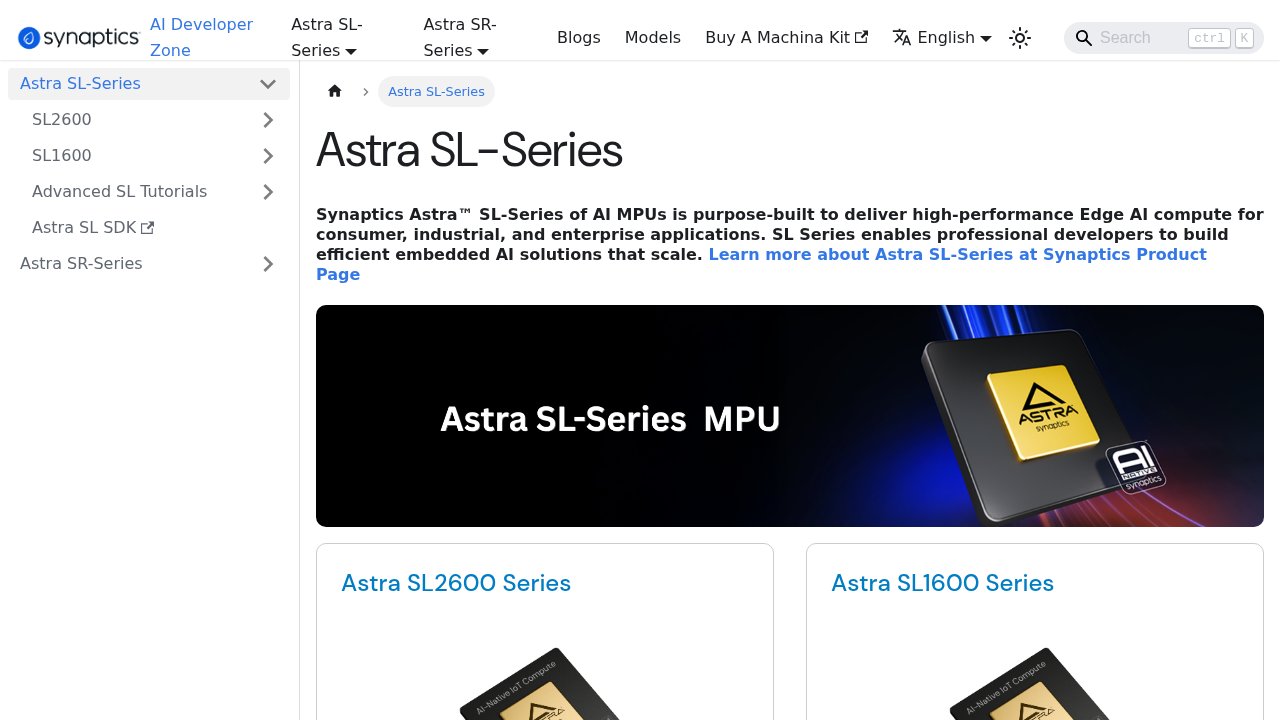
Synaptics Astra SL-series — the chipmaker’s own documentation for the SoC family that includes the SL2619, the chip inside the Coralboard.
None of this is possible without a chip built for the job. Running even a small AI model takes far more repetitive number-crunching than a general-purpose processor is efficient at. That work is handled by a dedicated chip called an NPU, or neural processing unit, a piece of hardware built specifically to do the pattern-matching math AI models rely on, quickly and without draining a battery. It belongs to the same category of specialist chip that has been quietly appearing inside newer phones and laptops for a few years, just applied here to a tiny board rather than a flagship device.
One important correction to the record: as of today, the Coralboard is not something you can buy. Google has described it as a limited batch made specifically for Google I/O 2026 attendees, and general availability and pricing have not been announced. Treat any claim that it is shipping or on sale as premature.
The part that actually matters: an open chip design
Here is where the story stops being about one small board and starts being about something that outlasts it. The Coral NPU that powers this board is not a Google-only, closed design. It is published as open-source silicon, meaning the actual engineering blueprint, the layout of circuits that a chip factory would use to manufacture it, is freely available for anyone to inspect, adapt, and build, without paying a licensing fee to Google.
That is a genuinely unusual move: chip designs are normally among the most jealously guarded pieces of intellectual property in tech. Most processors in phones, routers, and smart devices are built around designs licensed from a small number of companies, chiefly ARM, whose business rests on charging chipmakers for the right to use its blueprints. Opening up a chip design for free is a direct challenge to that model, not by competing on performance, but by removing the toll booth entirely.
That same open design is also built on RISC-V, an open standard for how a processor’s basic instructions are organized, the equivalent of a royalty-free alphabet any chip can be built to read, instead of a proprietary one a company charges to license. RISC-V has been gaining ground for years as a free alternative to licensed processor architectures, mostly in smaller embedded chips. This is Google putting real engineering weight behind that movement for AI-specific hardware, rather than just general computing.
Inside the design itself, the chip splits its work across three specialized sections: one that handles general instructions, one built for SIMD processing (a technique where the chip performs the same calculation on many pieces of data simultaneously instead of one at a time, exactly the kind of repetitive math AI models need), and a third dedicated to the matrix multiplication that sits at the core of how neural networks compute their answers. Google’s own reference version is rated at roughly 512 billion operations per second on just a few milliwatts, enough number-crunching for a compact model, running on something closer to a hearing-aid battery than a laptop charger.
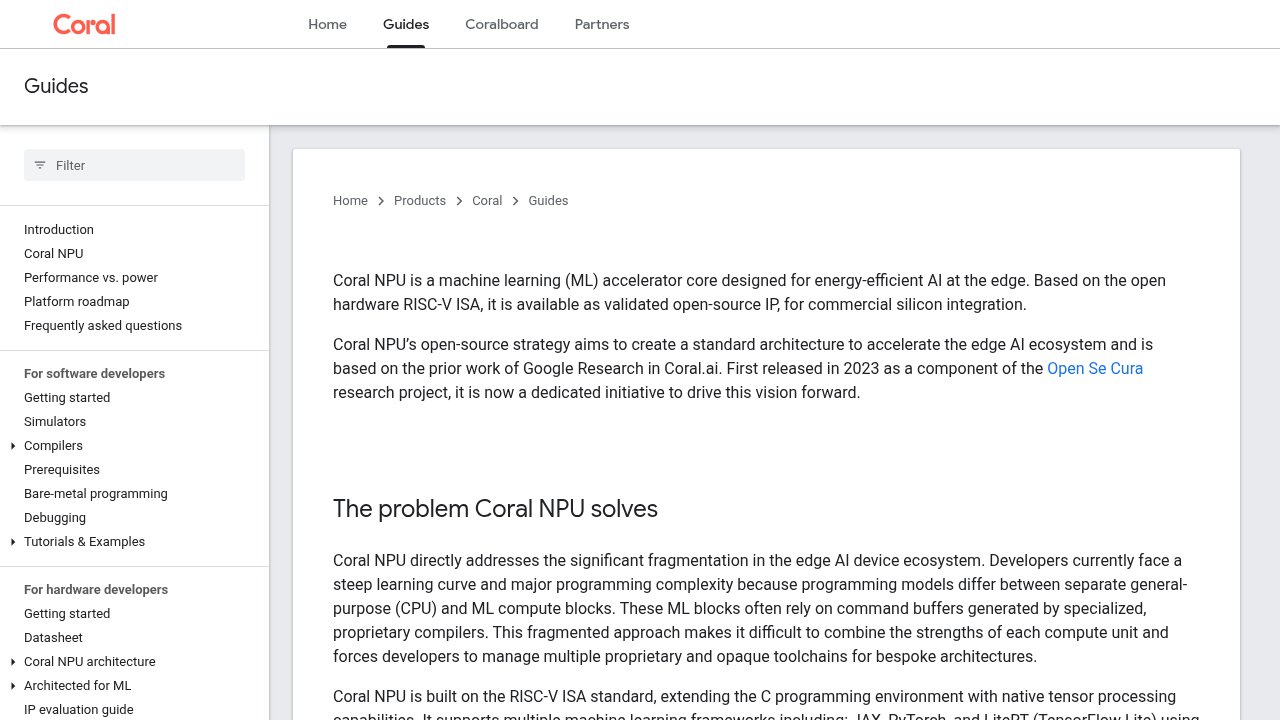
Google Coral NPU — Google’s own developer page introducing the open-source chip design at the center of this story.
Synaptics is the first chipmaker to actually build this design into real silicon. Its Astra SL2610 family, announced in late 2025, pairs the Coral NPU core with Synaptics’s own Torq NPU to reach about 1 TOPS combined (a common shorthand for a trillion operations per second, roughly double Google’s single-core reference figure). The Coralboard’s exact chip is the Astra SL2619, which pairs that combined NPU with two general-purpose processor cores and a smaller low-power core for background tasks. The board carries 2GB of memory and up to 64GB of storage, running a lightweight version of Linux built for embedded devices.
Why giving the design away solves a real problem
Edge AI, meaning AI running on local devices instead of the cloud, has had two persistent headaches unrelated to raw chip speed. The first is fragmented software. Every chipmaker’s NPU tends to come with its own proprietary toolchain, the set of software that translates an AI model into instructions that specific chip can run. A model tuned for one company’s chip often needs rework before it runs on a rival’s, discouraging developers from building for edge hardware at all. The second headache is licensing cost and control. Building a custom chip around a licensed processor design means negotiating terms with whoever owns it, a cost smaller chipmakers and hobbyist projects generally cannot absorb.
Open-sourcing that blueprint attacks both problems directly. On the software side, Google has confirmed a toolchain built around MLIR, a compiler framework designed to translate AI model code down toward hardware instructions in a structured, reusable way, paired with TensorFlow Lite Micro, a lightweight version of Google’s TensorFlow software built specifically for small AI models on constrained embedded chips. Because the underlying NPU design is public, the toolchain can target any chip built around it, instead of one proprietary product line. On the hardware side, any chipmaker can pick up the same free blueprint and build its own silicon version, with no fee and no negotiation.
That is the durable idea worth holding onto: Google is betting that giving away a chip design and its software layer for free grows a bigger, more standardized edge AI ecosystem than trying to sell a closed one ever could. It is the same logic Google applied years earlier when it open-sourced Android’s core rather than keeping mobile software proprietary, on the theory that a free, shared foundation invites more manufacturers in than a locked one does.
Who this challenges, and who it helps
The most direct pressure lands on ARM, whose business depends on chipmakers paying for a processor design instead of taking one for free. A credible, free, open alternative for AI-specific chips does not need to outperform ARM’s designs to matter. It only needs to be good enough and free, the same argument that has slowly pulled parts of the embedded chip market toward RISC-V generally over the past several years. The same pressure toward opening up formerly closed hardware economics is already visible further up the stack, where pairing the same underlying chip with a far smaller price tag has started reshuffling who can afford serious local AI hardware at all.
Smaller chipmakers stand to gain the most. A startup that could never justify licensing a proprietary AI chip design can now build one for free, provided it has the manufacturing expertise to turn a design into working silicon, a genuinely hard and expensive step on its own. Google gains something too, less directly: an ecosystem of AI chips built around its software toolchain and its Gemma model family, without Google having to manufacture any of that hardware itself.
None of this guarantees the bet pays off: open designs have a long history in computing, and plenty stayed niche while closed alternatives kept the market. Whether the Coral NPU becomes a real standard depends on more chipmakers following Synaptics’s lead, and on the software toolchain staying genuinely usable as it matures, not just publicly available on paper.
Readers curious about the model doing the actual thinking on that board, rather than the chip underneath it, will find the wider context in how open-weight AI models are reshaping what runs locally, a parallel trend of companies giving away the software layer for similar strategic reasons.

Frequently asked questions
Is this the same as the older Coral Edge TPU USB accelerator?
No. Google Coral NPU is a new, open-source chip design based on RISC-V, an open processor architecture, and is not a physical product on its own. The older Coral Edge TPU USB stick was a different, separate product built around Google’s proprietary TPU chip architecture, sold directly to developers. The two share a product name but nothing underneath it.
Can I buy a Coralboard right now?
Not yet. Google has described the current Coralboard as a limited batch made specifically for attendees of Google I/O 2026, not a generally available product. General availability and pricing have not been announced as of this writing, so treat any listing claiming otherwise with caution.
What does it mean that the NPU chip design is open source?
It means the actual engineering blueprint for the chip, not just the software that runs on it, is publicly available for any chipmaker to use, modify, and manufacture free of charge. This is unusual for processor hardware, which is normally licensed for a fee, and that is what let Synaptics build the first real chip around the design.
Does the chip run any AI model, or just Gemma?
It is a general-purpose AI chip design, not one locked to a single model family. Google’s demo used Gemma 3 270M, a small member of its Gemma lineup, but the confirmed software toolchain, built on MLIR and TensorFlow Lite Micro, is meant to bring a range of compact AI models onto the chip, not exclusively Google’s own.
Why does the open design matter more than the board itself?
Because the board is one limited-run demonstration, while the underlying blueprint is meant to be reused indefinitely by any manufacturer. A single product can be discontinued or stay a niche curiosity; a freely licensable design that other companies adopt can quietly become the default way a whole category of hardware gets built, the way open standards elsewhere in computing have.