iPhone Duo: Why Apple's First Foldable Waited So Long
Apple's first foldable, iPhone Duo, skips the usual foldable trade-offs. Here's the design bet behind the wait, and what it means for the price.
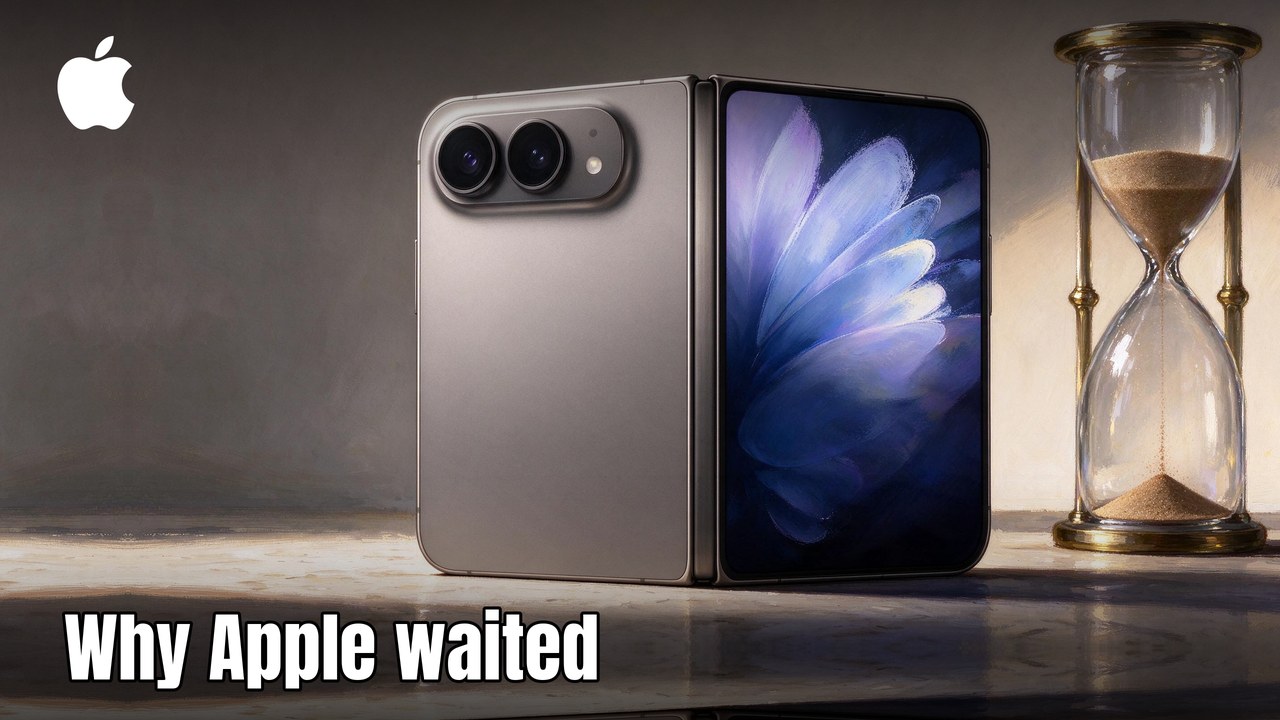
Apple announced its first folding smartphone, the iPhone Duo, on September 9, 2026, alongside the iPhone 18 Pro line, AirPods 5, and the new Apple Watch models. Foldable phones have existed since 2019. Apple waited seven years to make one, and the announcement makes that wait look deliberate rather than late. The interesting part isn’t that Apple finally built a folding phone. It’s what the company chose to fix before shipping one at all.
Most folding phones on the market today are, in practical terms, two different phones stitched together. Open them up and you get a large square-ish tablet screen. Close them and you get a narrow, cramped strip of a display for quick glances, texts, or the camera viewfinder. Apps often have to be redesigned, or awkwardly stretched, to work on both. The iPhone Duo’s core pitch is that this compromise was never necessary. Both of its screens, the folded outer one and the unfolded inner one, share the same aspect ratio, meaning the same width-to-height shape as the standard iPhone. An app built for one looks and behaves the same on the other. Nothing has to be redesigned, stretched, or cropped.
The screen math that actually matters
The inner display measures 7.6 inches when unfolded, roughly the size of a small tablet, using Apple’s Super Retina XDR panel technology (their name for a bright, high-contrast OLED screen). It carries a nano-texture finish, a matte surface treatment Apple already uses on some iPad and MacBook Pro screens to cut glare, applied here for a second reason: Apple says it minimizes the visibility of the crease down the middle, an unavoidable physical fold line in any bendable screen.
The outer display, the one you see when the phone is closed and held like a normal phone, measures 5.4 inches. Apple’s own comparison is not “how much of the inner screen is it,” which invites confusion, but how much usable screen area it offers next to Apple’s own non-folding flagship: by Apple’s account, closed, the iPhone Duo gives you about 90% of the screen area of an iPhone 18 Pro. That’s the number that actually describes the experience. You are not carrying a phone with a crippled outer display that only handles notifications. You’re carrying something close to a full-sized iPhone screen on the outside, and a tablet-sized one when you open it up, both shaped the same way.
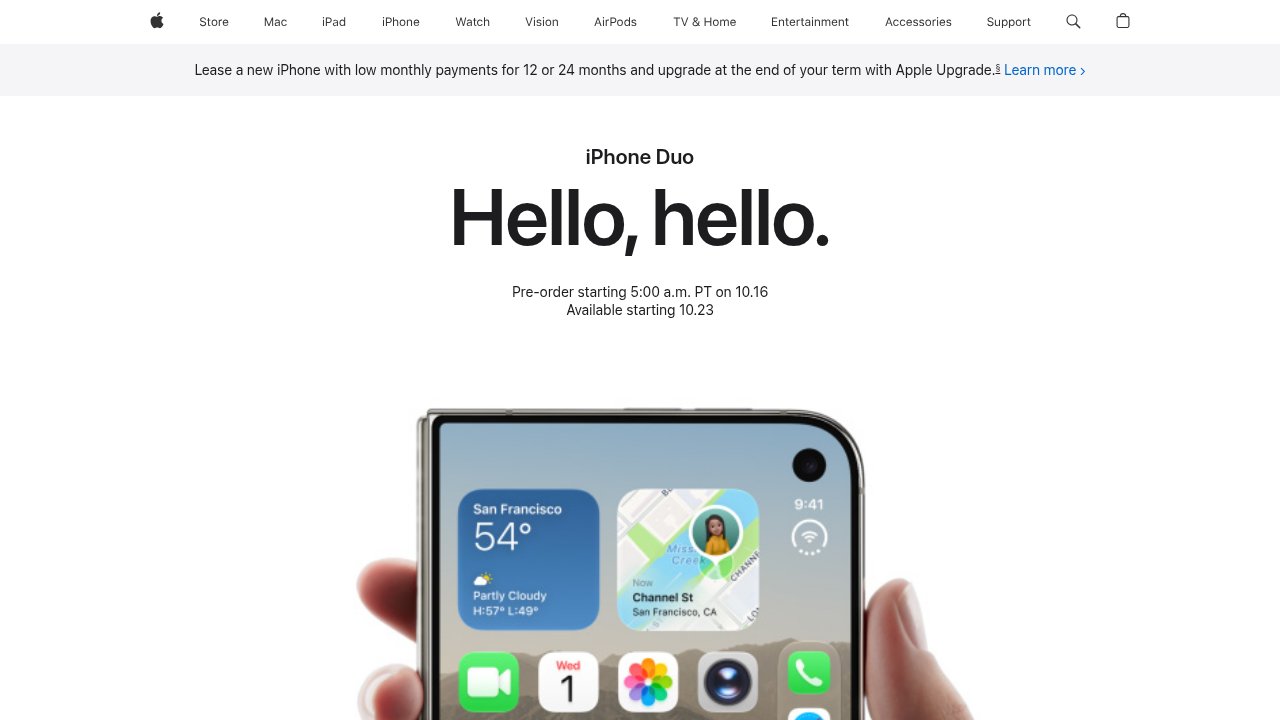
iPhone Duo — Apple’s official product page for its first foldable iPhone.
A camera choice that says a lot about the trade-offs
Apple hid the front-facing FaceTime camera underneath the inner display itself rather than placing it in a notch or a small hole punched into the screen, the way most phones (folding or not) still do it. This only works because of how thin and precisely layered the screen technology has become; the camera sensor looks up through the display material itself. It removes one more visual interruption from an already unusual screen.
But the trade-offs on this first model are real and worth naming plainly, not burying in a spec table. There is no dedicated telephoto lens like the one on Apple’s own Pro-tier phones, no LiDAR scanner (a depth-sensing laser used for faster autofocus and some AR features), and no variable aperture (a camera lens that physically adjusts how much light it lets in). Zoom comes from the main Fusion sensor (an optical-quality 2x, not a separate telephoto element) and the ultra-wide, for a 4x optical-quality zoom range, per Apple’s spec sheet. If photography quality at the very top end is your priority, the iPhone Duo is not that phone. Apple appears to have spent its engineering budget on the fold itself, the hinge, and the batteries, rather than matching the camera array of its most expensive flagship.
That trade-off shows up again in one more decision: Touch ID is built into the side button, not Face ID. Face ID relies on a small sensor module embedded above the screen that projects and reads a depth map of your face, hardware that does not fold. Putting a fingerprint sensor into a button instead is the practical answer for a screen that bends in the middle. It’s a downgrade in convenience for people used to just glancing at their phone to unlock it, but it’s an honest one, not a hidden one.
Two batteries, one balancing act
Folding a phone in half means you effectively have two separate bodies joined by a hinge, and Apple built iPhone Duo with a genuine dual-battery architecture rather than one oddly shaped cell. Keeping both halves charging and discharging evenly, without one draining faster or overheating near the hinge, needed dedicated power-management silicon and a custom vapor chamber (a thin, sealed component that spreads heat away from the chip using evaporating and condensing liquid, a cooling method also used in gaming laptops).
By Apple’s own measurement, not an independently verified test, the device lasts up to 31 hours of video playback using the inner display, or up to 44 hours using the smaller outer display. Apple frames these as best-case numbers under specific test conditions, and real-world use, especially with the larger screen active for browsing or video calls, will land lower. The number worth remembering isn’t the hour count itself, since battery-life claims from any manufacturer tend to soften once a device is in the hands of ordinary reviewers; it’s the framing: the outer screen exists partly as a battery-saving mode, not just a convenience screen.
The rest of the hardware sits in familiar Apple territory: the same A20 Pro chip, built on a 2-nanometer manufacturing process (nanometers here describe transistor size, where smaller generally means more efficient), found in the iPhone 18 Pro, paired with a new C2 cellular modem that Apple says delivers meaningfully faster upload speeds than its previous C1X modem while drawing 15% less power. That modem is eSIM only, meaning there is no physical SIM card tray at all, a continuation of a shift Apple began years ago in some markets. The frame uses grade-5 titanium (an aerospace-grade metal Apple already uses in recent iPhone Pro models), with Ceramic Shield 2 glass on the front and the older Ceramic Shield on the back, and IP68 water and dust resistance, meaning it can survive brief submersion and resist dust ingress under lab test conditions. It will also be the first iPhone to support Apple Pencil, connected over USB-C rather than the magnetic pairing iPads use, though Apple says that support is coming later this year rather than at launch. None of that is unique to a folding phone. What is unique is that Apple engineered a precision hinge to hold all of it together while still meeting that same durability bar, a harder problem than sealing a phone that doesn’t bend.
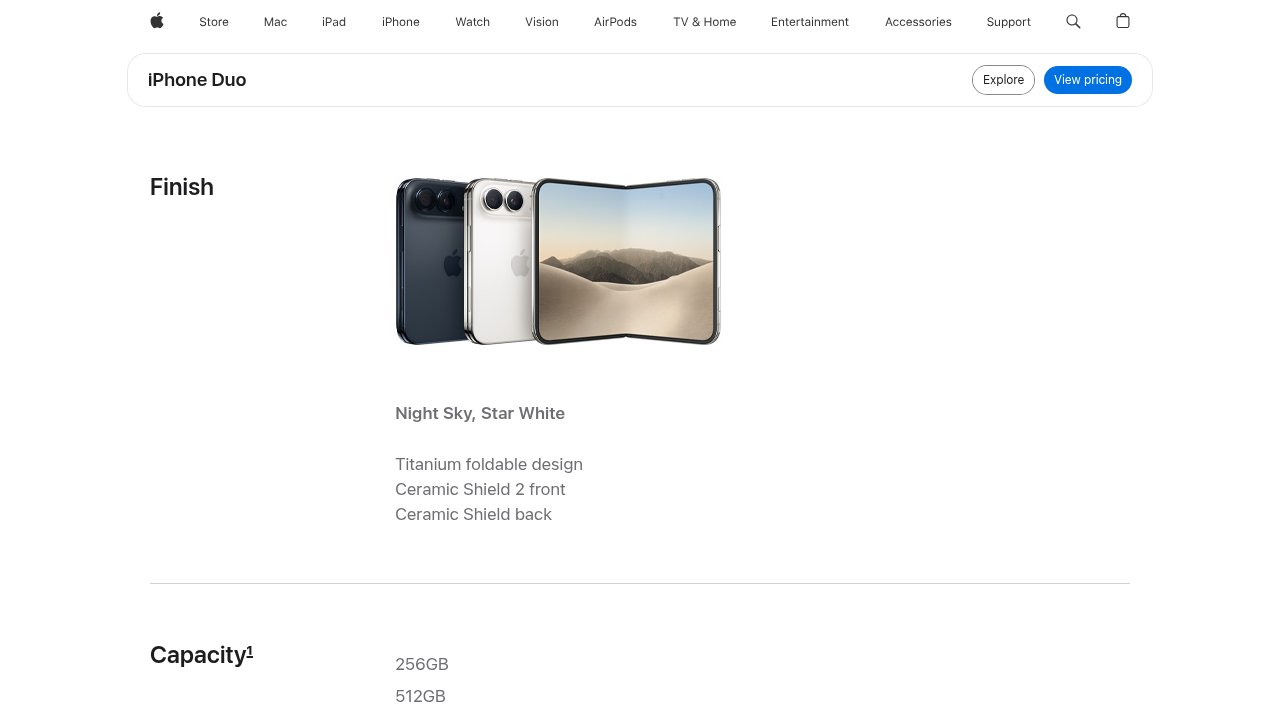
iPhone Duo specs — Apple’s official technical specifications page, detailing the titanium frame, vapor chamber cooling, and dual-battery design.
Why a bigger screen fits Apple’s AI ambitions
Apple’s launch release says a rebuilt Siri, alongside Apple Intelligence, makes iPhone Duo “an intelligent personal hub”: a phone that increasingly does more of the thinking and organizing for you, not just responds when asked. That kind of assistant benefits from a bigger canvas. Summaries, multi-step suggestions, live translation, and app-spanning tasks all read more comfortably on a 7.6-inch screen than a standard phone display, the same reason a tablet handles document work better than a phone even when both run the same software.
Software features built for the fold reinforce this framing rather than existing as gimmicks. Dual Capture, a FaceTime feature that shares the front and rear camera feeds simultaneously during a call, gets a fold-specific counterpart in Duo FaceTime, which lets someone standing next to the phone’s owner join the call using the outer screen and camera. Duo Preview lets the person being filmed see themselves on the outer screen while the photographer uses the inner one, solving a real problem of not knowing how you look mid-shot. Smart Take uses on-device AI to automatically trigger a photo capture at a good moment, rather than requiring a manual shutter press. None of these need the fold to exist as a concept, but they use the extra screen real estate as the reason to build them at all.
It’s worth being clear-eyed about this: Apple’s own newsroom material frames the iPhone Duo as the hardware expression of its AI strategy, and that framing serves Apple’s narrative as much as it describes an engineering reality. A bigger screen genuinely helps a more capable assistant feel useful. Whether that assistant is capable enough yet to justify the extra size, weight, and a starting price $800 above the iPhone 18 Pro is a separate question the hardware alone can’t answer.
For readers curious how that same push toward bigger, more capable on-device AI hardware is playing out beyond phones, DecodeStack has also covered how compact AI workstations bring large language models onto local hardware instead of the cloud, a parallel bet on doing more processing close to the user rather than sending everything to a remote server.
What it costs, and when you can actually get one
The iPhone Duo starts at $1,999 for the 256GB storage tier, rising to $3,199 for the 2TB version. Apple opens preorders on October 16, 2026, with the phone reaching stores on October 23, 2026. As of this announcement, nobody outside Apple has used the finished device day to day; every performance and battery figure in circulation traces back to Apple’s own testing, not independent reviews.
The starting price is $800 above the iPhone 18 Pro ($1,199 for 256GB), the only iPhone 18 models announced so far, which puts the iPhone Duo firmly in early-adopter territory rather than a mainstream upgrade path. That’s consistent with how Apple has entered new hardware categories before: price the first version for people who want the category itself, refine the economics over a few generations. The first Apple Watch and the first AirPods both followed that pattern.
FAQ
Is the iPhone Duo the first foldable phone Apple has made?
Yes. The iPhone Duo, announced September 9, 2026, is Apple’s first folding smartphone. Competing brands have sold foldable phones since 2019, but Apple waited until it could build one with matching screen shapes on both displays before entering the category.
Why does iPhone Duo use Touch ID instead of Face ID?
Face ID needs a depth-sensing camera module built into a fixed, flat section above the screen, hardware that cannot bend. Apple placed a Touch ID fingerprint sensor inside the side button instead, a practical trade-off for a screen that folds in the middle rather than a downgrade Apple chose for its own sake.
How much does the iPhone Duo cost and when does it ship?
The iPhone Duo starts at $1,999 for 256GB of storage, rising to $3,199 for the 2TB model. Apple opens preorders on October 16, 2026, with general availability starting October 23, 2026, $800 above the iPhone 18 Pro’s $1,199 price for 256GB.
Does the iPhone Duo have the same cameras as the iPhone 18 Pro?
Not quite. The iPhone Duo skips the dedicated telephoto lens, the LiDAR depth sensor, and the variable aperture found on Apple’s Pro-tier phones, offering a 4x optical-quality zoom range built from its main and ultra-wide sensors, with an optical-quality 2x from the main sensor rather than a separate telephoto. Apple appears to have prioritized the folding mechanism, hinge durability, and dual-battery engineering over matching its flagship’s camera hardware on this first model.
What does “same aspect ratio” actually mean for using the phone?
It means the folded outer screen and the unfolded inner screen share the same width-to-height shape, so apps look and function the same on both without redesign. Many rival foldables use a squarer, cramped outer screen that forces apps into an awkward secondary layout.