Meta's Muse Code: The Real Price of a Cheap Coding Agent
Meta's Muse Code enters the AI coding agent race with a twist: a cheaper tier that trades your code's privacy for a lower bill.

On August 5, 2026, Meta released Muse Code, an agentic coding tool that installs with one command and then writes, tests, and runs code on its own inside a developer’s terminal (the text-based command window developers use instead of a graphical app). What makes it worth a second look isn’t the tool itself. It’s the pricing menu behind it, which asks developers to choose between paying full price to keep their code private, or paying a fraction of that price in exchange for letting Meta train future models on what they write.
That choice is not a footnote. It’s becoming the real question every developer needs to ask about any coding agent they adopt, and Meta’s Muse Code just made it explicit in a way few competitors have.
What Muse Code actually does
Muse Code is what’s called an agentic coding tool: instead of just suggesting a line of code when you pause typing, it can read an entire project, plan a multi-step change, run the code to check its own work, and fix what breaks, largely without a human approving each individual step. It joins a category already occupied by Anthropic’s Claude Code and OpenAI’s Codex. Meta’s own launch post never names either rival; the head-to-head framing comes entirely from the press coverage that followed, not from Meta itself.
Installation is a single shell command on macOS or Linux (a Windows version is not yet part of the beta). Once running, Muse Code asks for approval before making changes by default and operates inside an OS-level sandbox, a restricted environment that limits what the tool can touch on the machine, so a bad instruction or a bug in the agent’s reasoning can’t wander off and delete files or hit systems it shouldn’t.
The more distinctive feature is how Muse Code handles bigger jobs. It can spin up several parallel subagents, essentially copies of itself working on different parts of a task at the same time. By default they share the same working copy, which can mean parallel edits collide; enabling worktree isolation gives each subagent its own git worktree, a separate copy of the codebase, so they don’t step on each other or on the main branch. If one subagent’s approach fails, it gets discarded; the working code stays untouched throughout. Meta says this is aimed squarely at large, established codebases, not the quick one-off script a solo developer might knock out in an afternoon.
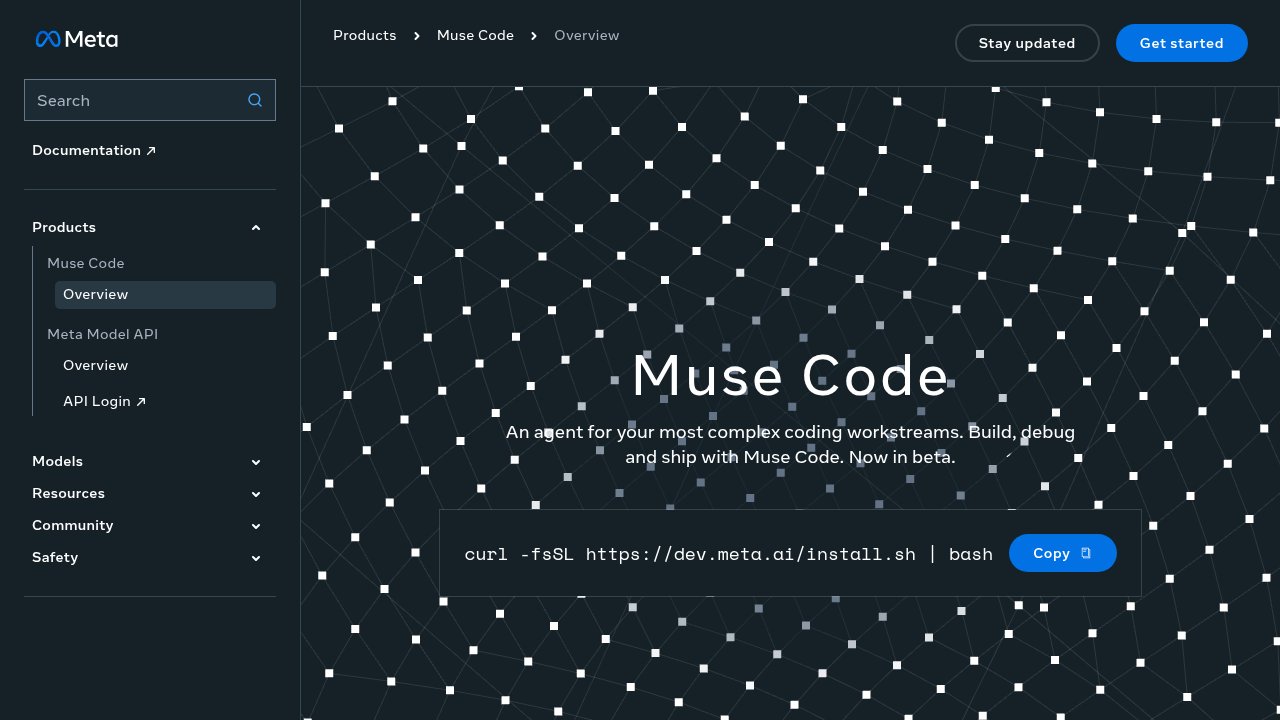
Muse Code — Meta’s official product page for the terminal coding agent, in beta since August 5, 2026.
The model underneath, and why its name causes confusion
Muse Code runs on a model Meta calls Muse Spark 1.2, which Meta describes as having been co-trained with the coding agent itself, tuned specifically for the kind of multi-step reasoning an agent needs rather than for general chat. It’s the coding-focused successor to Muse Spark, the multimodal reasoning model (one that can handle text, images, and other formats together) Meta unveiled on April 8, 2026, its first proprietary closed model after years of releasing Llama under an open-weight license.
Here is where a lot of search traffic gets misled. People look up “Meta Muse Spark Hugging Face” or “Meta Muse Spark open source,” reasonably assuming Meta’s newest model behaves like Llama, the open-weight model family that built Meta’s reputation in AI. Open-weight means the actual trained parameters of the model are published for anyone to download, inspect, and run on their own hardware. Muse Spark is not that. It is Meta’s first fully closed, proprietary model line: no downloadable weights, no Hugging Face listing, no self-hosting, no fine-tuning your own copy. The only way to use it is through Meta’s cloud API, a system where your requests get sent to Meta’s servers and the answers come back over the network. If you want to read more about why that distinction matters more than any benchmark score, see our guide to what actually decides the best open-weight LLM, which is really a guide to reading a license before you read a leaderboard.
The pricing menu is the actual story
Standard pricing for Muse Spark 1.2 is $1.25 per million input tokens and $4.25 per million output tokens (tokens are the small chunks of text, roughly a word or part of a word, that the model reads and generates; a million is a useful approximation for a few hundred thousand words of code and conversation), per Meta’s own pricing documentation. That tier is what you’d expect from a frontier-grade coding model in mid-2026, comparable to what Anthropic and OpenAI charge for their own top agents.
Then there’s a second option Meta calls the contributor tier, priced at $0.10 per million input tokens and $0.20 per million output tokens — a discount of roughly 12 to 21 times against the standard rate, per Meta’s pricing page. The catch is spelled out plainly in Meta’s own terms, not buried: by choosing the contributor tier, a developer grants Meta permission to use their code to train future models. Cheaper access, in exchange for handing over training rights to whatever you feed the agent, which for many developers means their employer’s proprietary codebase, not just their own side projects.
This is the part worth sitting with, because it isn’t really about Meta specifically. It’s a preview of how the whole agentic coding market may end up shaped. Every coding agent priced as a two-tier product deserves the same question asked of it: what does the cheap tier actually cost, in rights rather than dollars. A price alone tells you nothing about what you’re giving up to get it. Right now Meta is simply the company that put that trade-off in writing instead of leaving it implicit in a terms-of-service page nobody reads.
Introducing Muse Code and Muse Spark 1.2 — Meta’s own announcement, the source for the pricing figures above.
Where Muse Code sits against Claude Code and Codex
Anthropic’s Claude Code and OpenAI’s Codex both already do the core job: read a codebase, plan changes, run tests, iterate. Meta’s pitch for Muse Code is less about outperforming them at that core loop and more about the sandboxed, multi-subagent approach to large codebases, plus, implicitly, the pricing lever the contributor tier gives budget-conscious teams. Whether that’s a genuine edge or a rough edge depends entirely on a team’s tolerance for its code training someone else’s model, which is a decision with almost nothing to do with how fast the agent writes a function. Readers weighing Anthropic’s own pricing calculus against a rival’s have a parallel case study in how Claude’s own tiers get judged on whether the higher price is worth it, a useful comparison because it’s the same underlying question in a different market: is the extra cost buying something real, or just a badge.
As of its August 5 launch, Muse Code is in public beta, meaning it’s openly available to try but Meta has not called it generally available (GA), the label companies use once a product has cleared the testing phase and is considered stable and supported for everyone, not just early adopters. Expect rough edges, changing pricing, and feature gaps typical of a beta, and expect Meta to iterate on exactly the trade-off described above as developer feedback comes in.
Why this matters beyond one product launch
Coding agents are becoming standard equipment fast. The interesting fork in the road isn’t really which agent is fastest or cleverest this month, since that ranking will look different by next quarter regardless of what anyone writes today. It’s that the market is now openly split into a cost tier and a control tier, and Meta’s Muse Code just made that split visible with a specific dollar figure attached to it. The next agentic coding tool that launches, whoever builds it, will likely face the same fork: charge more and let developers keep full ownership of what they write, or charge less and use that code as training fuel for the next model. Reading the pricing page as carefully as the feature list stops being optional once you know that’s the actual choice on offer.

Frequently asked questions
Is Meta Muse Spark open source?
No. Muse Spark, the model family behind Meta’s Muse Code, is closed and proprietary, with no downloadable weights and no Hugging Face listing. It’s accessible only through Meta’s paid API, a real departure from the open-weight Llama models Meta is known for.
What is the difference between Muse Code and Muse Spark?
Muse Code is the coding agent, the tool a developer installs and runs in their terminal to write and test code automatically. Muse Spark is the underlying AI model that powers it, currently at version 1.2, which Meta tuned specifically for coding tasks.
What does Meta’s contributor tier actually mean for my code?
Choosing Meta’s lower-priced contributor tier for Muse Code, reportedly $0.10 per million input tokens and $0.20 per million output tokens versus the standard $1.25/$4.25 rate, means granting Meta permission to use the code sent through the agent to train its future models. It’s a real trade, not a marketing label, so weigh it against how sensitive the codebase is.
Is Muse Code available on Windows?
Not at launch. Meta’s Muse Code installs and runs on macOS and Linux as of its August 2026 beta release, with no Windows version mentioned in the initial rollout.
How does Muse Code compare to Claude Code and Codex?
Muse Code enters a category Anthropic’s Claude Code and OpenAI’s Codex already established, though Meta’s own announcement doesn’t name either rival — the comparison comes from press coverage, not Meta. Its distinguishing features are a default sandbox, approval-gated changes, and (optionally) parallel subagents that can run in isolated git worktrees for large codebases.
The takeaway
The lasting lesson from Meta’s Muse Code launch has nothing to do with sandboxes or subagents. It’s that a coding agent’s price tag is no longer just a cost decision, it’s a sovereignty decision, and any developer choosing between tiers should read the fine print on what the discount actually buys the vendor before they read the benchmark scores.