Mistral Shieldstral: A Guardrail Model You Rewrite, Not Retrain
Mistral's Shieldstral guardrail model lets anyone rewrite content rules in plain English, no retraining. Here's why that changes who controls AI moderation.
On August 4, 2026, the French AI lab Mistral AI released a small model called Shieldstral, and the interesting part is not what it does but how you tell it what to do. Shieldstral is a guardrail model: a piece of software that reads text or an image and decides whether it violates a set of rules, sitting alongside a bigger AI model to catch anything unsafe before it reaches a user. Most AI safety filters have worked the same way since the current wave of chatbots launched: a vendor decides, once, which categories of content to block, bakes that list into the model during training, and everyone who uses the model inherits the same rules. Mistral Shieldstral breaks that pattern. Its rules are not fixed at training time, they are written in plain English at inference time (the moment it is actually being used to check a piece of content), which means the person running it can change what counts as unsafe just by rewriting a sentence.
That shift matters more than the model’s size or its benchmark scores, though those are worth knowing too. This is a review of what Mistral Shieldstral actually changes, not a spec sheet.
What this kind of safety check is, in plain terms
Most people picture AI moderation as a single system: you ask a chatbot something, and if the request is dangerous, the chatbot itself refuses. In practice, many AI products run two models side by side. The main model generates the answer, and a second, smaller model checks the request and the response against a policy before anything is shown. That second model is the guardrail. It never talks to the user directly. It reads and returns a judgment: safe, unsafe, and often which category of unsafe.
Mistral Shieldstral is built specifically for that second role. It is not a chatbot and it is not related to Mistral’s flagship conversation and coding models like Mistral Large or Codestral, which generate answers. Shieldstral only classifies. According to Mistral’s own announcement, it checks both text and images against a moderation policy, which covers a real gap: a lot of guardrail tools only look at text, leaving image uploads and image outputs unchecked. Anyone weighing which open-weight model to run locally will eventually hit this same question, since a capable local model without any content check is just a capable model with no seatbelt.
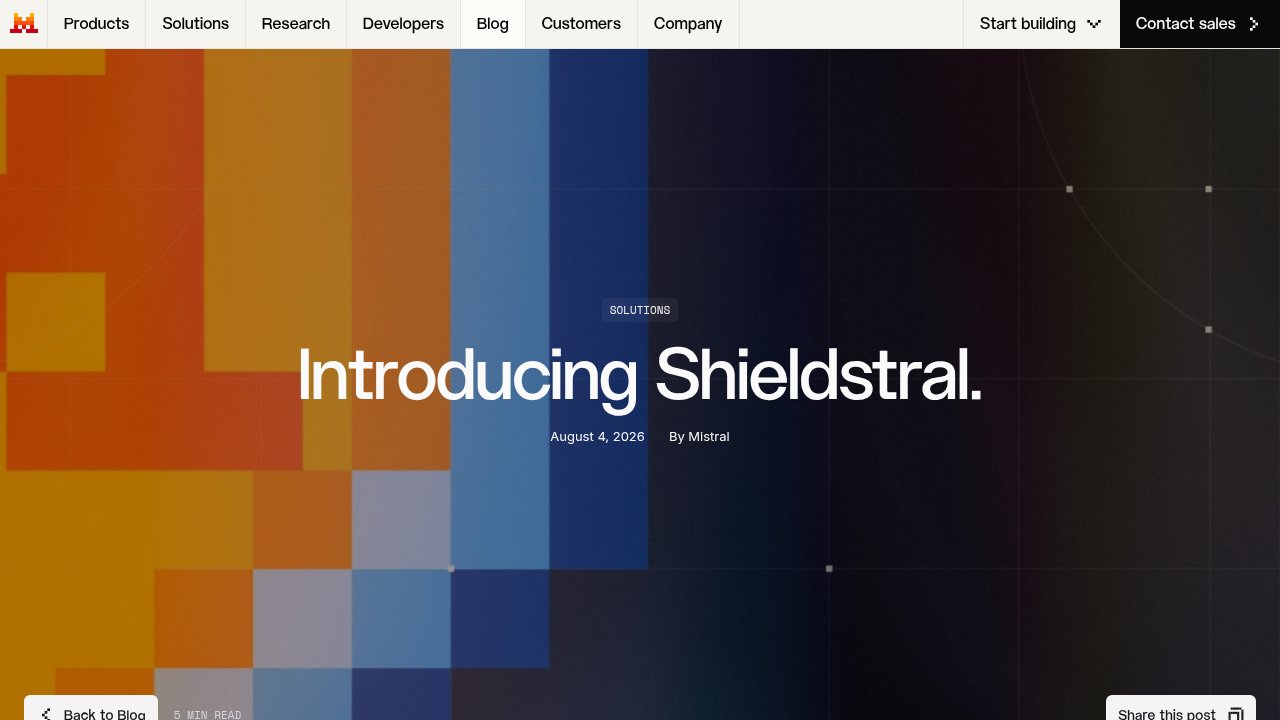
Mistral AI — the official announcement page for Shieldstral, Mistral’s guardrail model.
The part that’s actually new: you write the rule, not the training data
Here is the mechanic that makes Mistral Shieldstral worth a second look. In older guardrail systems, the list of banned categories, self-harm content, hate speech, explicit material, and so on, gets fixed during training. Changing that list means retraining the model, which is slow, expensive, and usually only the original vendor can do it. Everyone downstream is stuck with whichever categories that vendor picked.
Shieldstral instead takes its moderation policy as a plain-language question, supplied each time it is asked to check something. An operator does not select from a preset list of categories baked in at the factory. They write, in ordinary sentences, what they want flagged, and Shieldstral applies that instruction on the spot. Want to flag content that recommends unlicensed medical treatment? Write that instruction. Running a platform for a specific country with its own legal definition of prohibited speech? Write that instruction instead. No retraining, no waiting for the vendor to ship an update, no fine-tuning pipeline.
The practical effect is that moderation policy becomes something an operator owns and edits, rather than something they inherit from whoever built the underlying model. A hospital chatbot, a children’s education platform, and a game studio’s in-game chat have wildly different ideas of what “unsafe” means for their users. Under the old setup, all three either share one vendor’s default categories or pay to have a custom model trained. Under this approach, all three can point the same small open model at three different plain-English policies and get three different, sensible results.
Small on purpose: why the size is the point, not a limitation
Mistral describes Shieldstral as a 3-billion-parameter model (parameters are the internal values a model adjusts during training; roughly, more of them usually means a bigger, more capable but more expensive model to run). Three billion is small by current standards, and that is deliberate. A guardrail has to run on every single request that passes through a system, in addition to whatever the main model is already doing. If the guardrail itself is expensive to run, it can double the cost and slow down every interaction.
Mistral says Shieldstral runs on a single 16GB consumer-class graphics card, the kind found in a decent gaming PC rather than a data center rack. That design choice is deliberate: it is meant to sit cheaply next to a much larger model, checking its inputs and outputs without becoming a second expensive system to operate. For a team already running a large model on serious hardware, adding a lightweight checker that fits on one modest GPU is a far easier sell than adding a second heavyweight model.
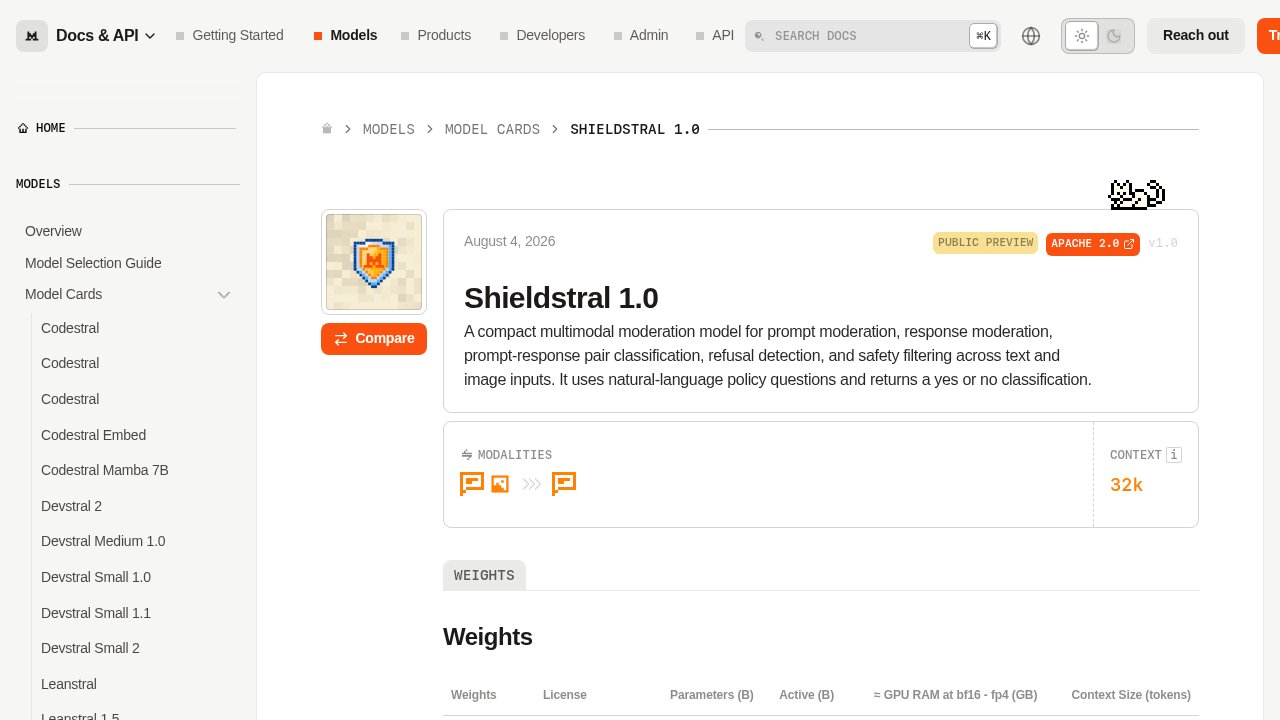
Mistral AI — the official Shieldstral model card, listing specs, benchmarks and hardware requirements.
Shieldstral ships under the Apache 2.0 open-source license, and its weights (the trained numerical values that make it work) are downloadable from Hugging Face, the platform most open AI models are distributed through. Mistral has not published API pricing for Shieldstral specifically, which fits the open-weights approach: you are meant to download and run it yourself rather than pay per request through Mistral’s hosted service.
What Mistral claims about accuracy, and why that claim needs a grain of salt
Mistral states that Shieldstral matches or outperforms other open guardrail models up to seven times its size on safety benchmarks (standardized test sets used to measure how well a model catches genuinely unsafe content without over-flagging safe content). That claim is notable if it holds, since it would mean a lab running Shieldstral gets guardrail performance close to a much bigger, more expensive model for a fraction of the compute cost.
It is worth being precise about what that claim is: it is Mistral’s own reported benchmark result, not an outcome independently verified by a third party at the time of the model’s release. Benchmark comparisons chosen and run by the company that built the model tend to favor that model, intentionally or not, by the choice of which benchmarks get highlighted. None of that means the claim is false. It means a careful reader treats it as a starting data point rather than a settled verdict, the same way any vendor-reported number deserves a moment of skepticism before it gets repeated as fact.
On language coverage, Mistral’s model documentation already lists a specific set of supported languages, English, French, Spanish, German, Italian, Portuguese, Dutch, Chinese, Japanese, Korean, Arabic, and Russian, but flags “uneven coverage” as a known limitation, since these languages are represented unevenly in the training data. Mistral’s own announcement separately says it is “continuing to push on multilingual coverage” going forward, which reads as a commitment to close that reliability gap rather than a promise to add entirely new languages later. That distinction matters for anyone deploying it outside Mistral’s strongest languages: the guardrail already runs in a dozen languages, just not with guaranteed equal reliability across all of them.
Who this actually changes something for
The people most likely to feel the difference are not casual chatbot users, who will probably never know a guardrail model is running behind the scenes. It is the teams building AI-powered products who previously had exactly two options: accept whatever content rules the model vendor shipped, or spend real engineering time and money training a custom filter. A rewritable, plain-English policy collapses those two options into one lightweight step. A school system, a healthcare provider, a regional platform operating under local speech laws, and an indie game studio all have different lines they need drawn, and none of them previously had an easy way to draw their own line without either accepting someone else’s default or building a custom system from scratch.
This is also a small but telling data point in a broader story about open-weight AI, where Mistral has positioned itself as one of Europe’s most visible open-source labs, in contrast to the closed, subscription-gated models from the largest US labs. The earlier confusion around Mistral’s brand, including the made-up “Le Chaton Fat” model that briefly circulated online, showed how much attention swirls around what Mistral actually ships versus what gets attributed to it. Shieldstral is real, documented on Mistral’s own site, and narrowly scoped: a safety checker, not a general chatbot, and worth evaluating on that narrow job rather than as a flagship release.

Frequently asked questions
What is Mistral Shieldstral used for?
Mistral Shieldstral is a guardrail model, a small AI system that checks text or images against a set of content rules and flags anything that violates them. It runs alongside a larger AI model, screening what goes in and out, rather than generating responses to users itself.
How is Shieldstral different from a normal content filter?
A normal content filter is trained once on a fixed list of banned categories, so changing the rules means retraining the model. Shieldstral instead takes its moderation policy as a plain-language instruction supplied each time it checks content, so an operator can rewrite what counts as unsafe without any retraining.
Is Shieldstral free to use?
Mistral released Shieldstral’s weights under the Apache 2.0 open-source license on Hugging Face, meaning anyone can download and run it without a licensing fee. Mistral has not published separate API pricing for it, since the model is designed to be self-hosted rather than accessed through a paid endpoint.
Does Shieldstral replace Mistral’s main chatbot models?
Shieldstral does not replace Mistral’s main chatbot models. It is not related to Mistral’s generation models like Mistral Large or Codestral, and it does not produce answers for users. It is a narrow safety checker meant to run beside a larger model, not a replacement for one.
What hardware do you need to run Shieldstral?
Shieldstral runs on a single 16GB consumer-class graphics card, the kind found in an ordinary gaming PC rather than specialized data center hardware, according to Mistral. That low requirement is intentional, since a guardrail model has to check every request without adding major extra cost to the system it protects.
The takeaway
The headline number in Mistral’s announcement, matching bigger models on safety benchmarks at a fraction of the size, is a nice detail, but the change worth remembering is quieter: content moderation policy has moved from something a vendor decides once for everyone, to something an operator can write and rewrite in plain English whenever their situation calls for it. That shift changes who holds the pen on what gets blocked, and it is the kind of change that keeps mattering long after this particular model’s benchmark scores are out of date.