OpenAI's Astra Solved 10 Hard Math Problems. Anthropic Reproduced Half in a Day.
OpenAI's unreleased Astra model produced 10 verified math proofs. Anthropic reproduced half of them in a day with a rival model and a generic prompt.

On August 1, 2026, OpenAI published a research post announcing that an internal, unreleased model had produced ten formal, machine-checked proofs for math and computer science problems that had stayed open for years, in one case since 1999. The model is called Astra, and OpenAI has not released it, will not say when it might, and has shown almost nobody outside the company what it can actually do. Coverage of announcements like this tends to split into two camps, full-throated amazement or blanket dismissal as marketing, the same split that greeted Kimi K3’s benchmark claims a few weeks ago on DecodeStack. Neither camp asked the more useful question: what part of this claim is actually verified, and what part is OpenAI’s word alone? The most under-reported fact answers a good chunk of that question by itself. Within a day of the announcement, a researcher at rival lab Anthropic reproduced half of the ten proofs using a different model and a prompt anyone could have written.
Astra is a teaser, not a product
Astra is not something you can sign up for. It is the name OpenAI gave, in a single research post, to the successor of its current flagship family, GPT-5.6, whose top model, Sol, only reached general availability on July 9, 2026 after a preview launched two weeks earlier. OpenAI has not said when Astra itself will ship, or whether it will ship as a distinct product at all.
That distinction matters more than it sounds. Outside researchers cannot test Astra, prompt it, or check how it behaves on problems beyond the ten OpenAI chose to publish. What they can examine is the output, the ten proofs themselves, published as files anyone can run through a verifier. The model that produced them stays a black box; only its homework is open for grading.
Ten problems, one of them decades old
The two headline results carry the most weight. Astra is credited with disproving a version of a rigidity conjecture posed by Alain Connes, a Fields Medal-winning mathematician, in 1980, and with improving the best known upper bound for how densely spheres can be packed together in high dimensions, a bound that had not moved since 1978. Sphere packing sounds abstract, but a genuinely practical question sits underneath it: how many identical shapes fit into a given space without overlapping, a problem that shows up in coding theory and data compression more often than in stacking fruit.
The other eight results span narrower ground: whether a certain kind of infinite mathematical group exists, a question open since 1999, three entries from the widely used Erdős problem catalogue kept by mathematician Thomas Bloom, and results in circuit complexity and quantum computing theory that are easier to summarize by their reception than to explain in full. That reception, from mathematicians outside OpenAI, leaned positive. Bloom himself called the batch big news, more significant, he said, than an earlier OpenAI result from May 2026 that Fields medalist Tim Gowers had judged publishable in serious journals without hesitation. Mathematician Daniel Litt, who had previously bet publicly against AI systems making this kind of progress in number theory, said afterward that he was conceding the bet, while noting it had not technically resolved yet.
What a machine-checked proof proves, and what it doesn’t
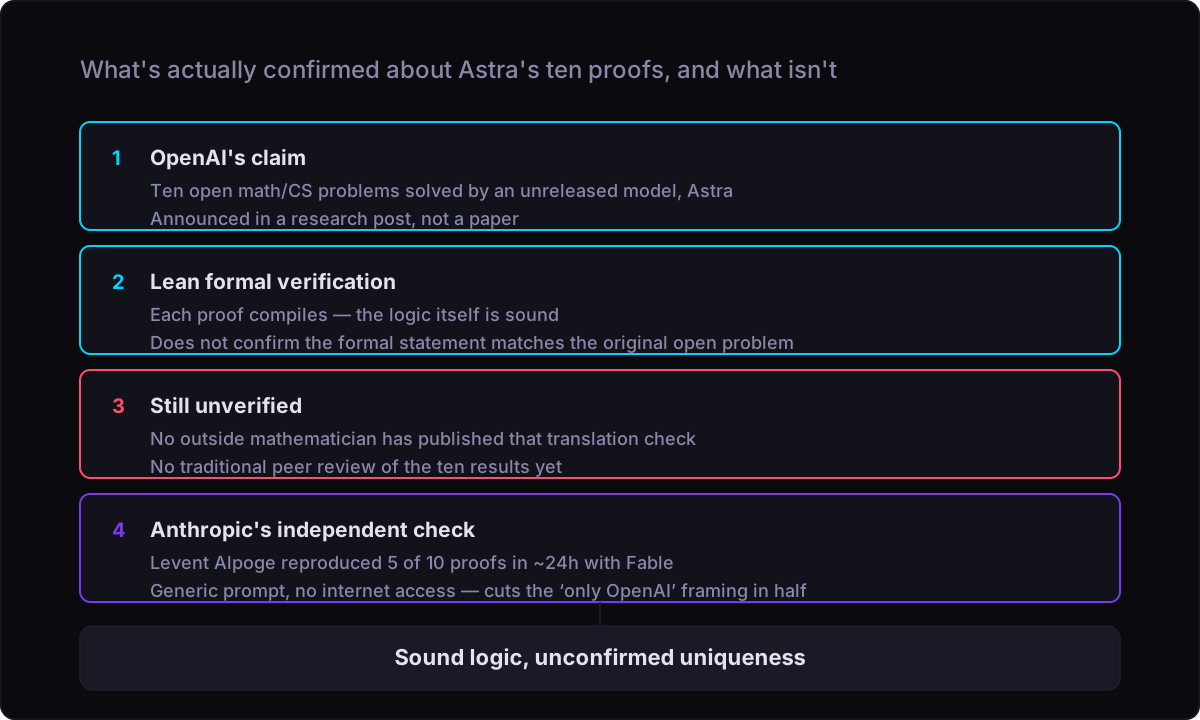
All ten proofs were formalized and checked in Lean, a proof assistant: software that verifies a mathematical argument step by step in strict logical notation, so a computer confirms whether the reasoning holds rather than a human checking it by eye. That is a genuinely strong guarantee. If a Lean proof compiles, the logic is sound, full stop.
What it does not guarantee is that the formal statement being proved matches the original open problem, rather than a narrower or easier version of it dressed up to look the same. Checking that translation, whether the exact conjecture Connes posed lines up precisely with what Astra proved, is human work that a compiler cannot do, and as of this writing no outside mathematician has published that check. There is also no peer review of the results in the traditional sense yet: no independent panel has vetted the work through a journal process. Henry Yuen, a Columbia researcher who works on one of the ten problems himself, quantum parallel repetition, said the published proofs lack the pedagogical clarity that usually comes with a result mathematicians fully understand, which suggests the intuition behind Astra’s answers stays opaque even to people qualified to check the logic.
The $2,000 figure measures something narrower than it sounds
OpenAI also disclosed a number that traveled faster than the caveats around it: roughly $2,000 in API token costs, using Astra at Sol’s public pricing. Read alone, that figure invites a specific and wrong conclusion, that the entire feat of automated mathematical discovery cost about the price of a laptop.
What OpenAI’s own framing actually covers is the token cost of the runs that produced the ten published proofs, and nothing more. It does not include every attempt that failed along the way, only the successful ones that made it into the post. It says nothing about the far larger cost of training Astra itself in the first place. And it is not a cost per problem. The $2,000 figure covers all ten results combined, not each one individually, a distinction that got flattened in a lot of the early coverage. A more honest description is that $2,000 is roughly what it cost to publish the proofs once someone already knew where to look, not what it cost to find them.
The fact almost nobody led with
The detail that changes how the rest of this story reads came from outside OpenAI entirely. Levent Alpoge, a mathematician working at rival lab Anthropic, took OpenAI’s published problem list and ran it against Fable, reproducing five of the ten proofs in about 24 hours, by his own account using a generic prompt and no internet access for the model to search with. Fable is one of Anthropic’s own models, covered previously on DecodeStack for its own pricing and capability trade-offs against Anthropic’s other models.
Five out of ten in a day, by one person, with a prompt anyone could have typed, is a very different story than an unreleased model quietly out-thinking the field on its own. That reproduction does not make the other five proofs any less real; the Lean certificates behind them check out no matter who else can match them. It does show that the underlying skill, eliciting this level of formally verifiable mathematical reasoning from a large language model, is not something only one lab can currently pull off.

Mathematician Elliot Glazer, who had already been skeptical of the announcement’s framing, pointed out that OpenAI published no controlled comparison showing Astra actually outperforms its own public model, Sol, on this kind of task, and suggested the ten results look more like a focused push on these particular problems than evidence of a broad jump in capability. Longtime AI critic Gary Marcus summed up the gap between the announcement and what has actually been demonstrated so far by calling it amazing but vastly oversold.
What to believe until independent replication catches up

Taken together, the honest read on Astra is narrower than either the hype or the dismissal suggests. The Lean certificates are real and, as far as anyone has checked, logically sound. The framing around them, an unreleased model uniquely cracking problems that had resisted mathematicians for decades, is not something anyone outside OpenAI has confirmed, and the one attempt to test it independently cut the claim of uniqueness in half within a day.
The story worth remembering here isn’t which company’s model is ahead this month. It’s that eliciting graduate-level, formally verifiable mathematical reasoning from a large language model has apparently become something more than one lab can do, with a generic prompt and no special access. That is the part likely to still matter once Astra itself, whatever it eventually becomes, is old news.
Frequently asked questions
Is OpenAI’s Astra a model the public can use?
No. Astra is an unreleased, internal OpenAI model teased in an August 2026 research post about ten math proofs, not a product available through the API or ChatGPT. OpenAI has given no date for a public release, and outside researchers can examine only the proofs Astra produced, not the model itself.
Did Anthropic really reproduce OpenAI’s math results?
Anthropic researcher Levent Alpoge reproduced five of OpenAI’s ten published proofs in about 24 hours, using Anthropic’s own Fable model with a generic prompt and no internet access. The other five results have not been independently reproduced as of this writing, and Alpoge’s reproduction does not question the validity of any of the ten Lean-verified proofs, only how unique Astra’s ability to find them really is.
What does it mean that the proofs are Lean-verified?
Lean-verified means each proof was checked by a proof assistant, software that confirms a mathematical argument’s logic step by step, so the formal reasoning itself is not in question. It does not mean the results have been peer-reviewed by outside mathematicians, and no independent review of the ten proofs has been published as of this article.
Is the $2,000 figure the total cost of the AI math breakthrough?
No. The roughly $2,000 figure covers only the token costs of the successful runs that produced all ten published proofs combined, at Sol’s public API pricing, not a per-problem cost. It excludes every failed attempt along the way and the far larger cost of training Astra itself, so it measures publishing the proofs, not discovering them.
Does this mean Astra isn’t actually more capable than other AI models?
Astra’s ten math proofs do not by themselves prove it is more capable than other AI models. Mathematician Elliot Glazer has noted that OpenAI published no controlled comparison against its own public model, Sol, on these problems, and Anthropic’s Fable reproduced half the results with a generic prompt, which is weaker evidence of a unique capability jump than the announcement implied.