PHP's Critical Flaws: What AI-Assisted Vulnerability Research Found
Two severe PHP bugs made headlines in October. The PHP Foundation's own post on AI-assisted research shows what models did, and what a human still had to do.
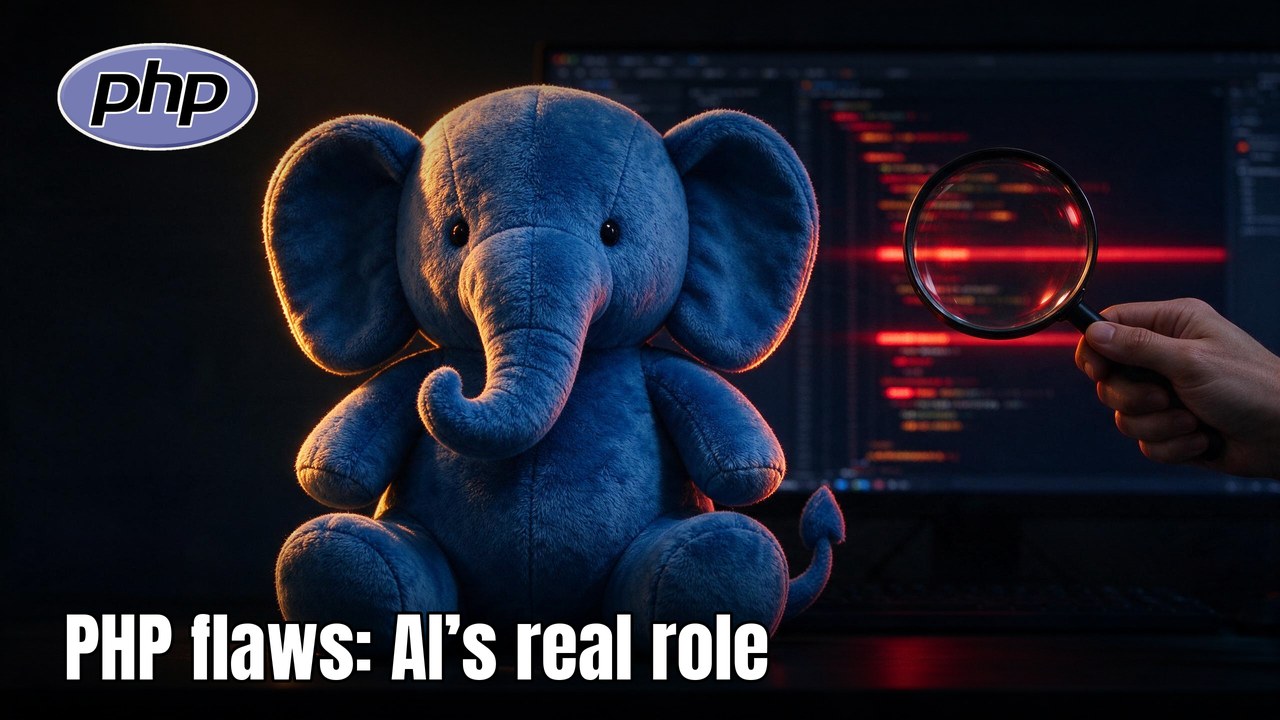
Two severe flaws in PHP, the programming language that runs a large share of the web’s back end, were patched on October 21. What made this round of patching unusual was not the bugs themselves but what the PHP Foundation, the nonprofit that funds core PHP development, published alongside them: a detailed account of how the reports reached them, and where AI tools fit into that process. For anyone who relies on software built by volunteers and a small paid team, that account is the more durable story. It shows, in plain terms, where PHP vulnerability AI-assisted research actually helps, and where the Foundation still insists a person has to sign off.
Two flaws, one chaotic week
The two issues carry the identifiers CVE-2026-109618 and CVE-2026-109619 (a CVE is the public catalog number assigned to a specific security flaw once it’s confirmed). The first is a memory corruption bug that triggers under an out-of-memory condition, meaning the server runs low on working memory and PHP mishandles that state in a way an attacker can exploit. The second involves stale global state, a piece of internal bookkeeping that PHP fails to reset properly between requests. Both were scored 9.2 out of 10 on CVSS v4.0 (the industry’s standard severity scale, where higher means easier to exploit and worse to suffer). A figure of 10.0 circulated briefly online but was later denied by the Foundation. Both flaws allow unauthenticated remote code execution, meaning an attacker with no login credentials could run their own code on a vulnerable server. Fixes shipped in PHP 8.5.12, 8.4.27, 8.3.36, and 8.2.35.
The disclosure itself did not go smoothly. According to the PHP Foundation’s post, CVE details leaked on October 20 with the wrong date attached and that incorrect CVSS 10.0 score, which pushed the Foundation to move its planned publication up to October 21. A demo video showing the exploit was published by mistake by one of the researchers involved. Separately, container images from Chainguard, a vendor that ships hardened base images for running software, had already shipped the fix before the coordinated embargo lifted. None of this changes the severity of the bugs, but it is the kind of detail that explains why the week felt messier than a routine patch Tuesday.
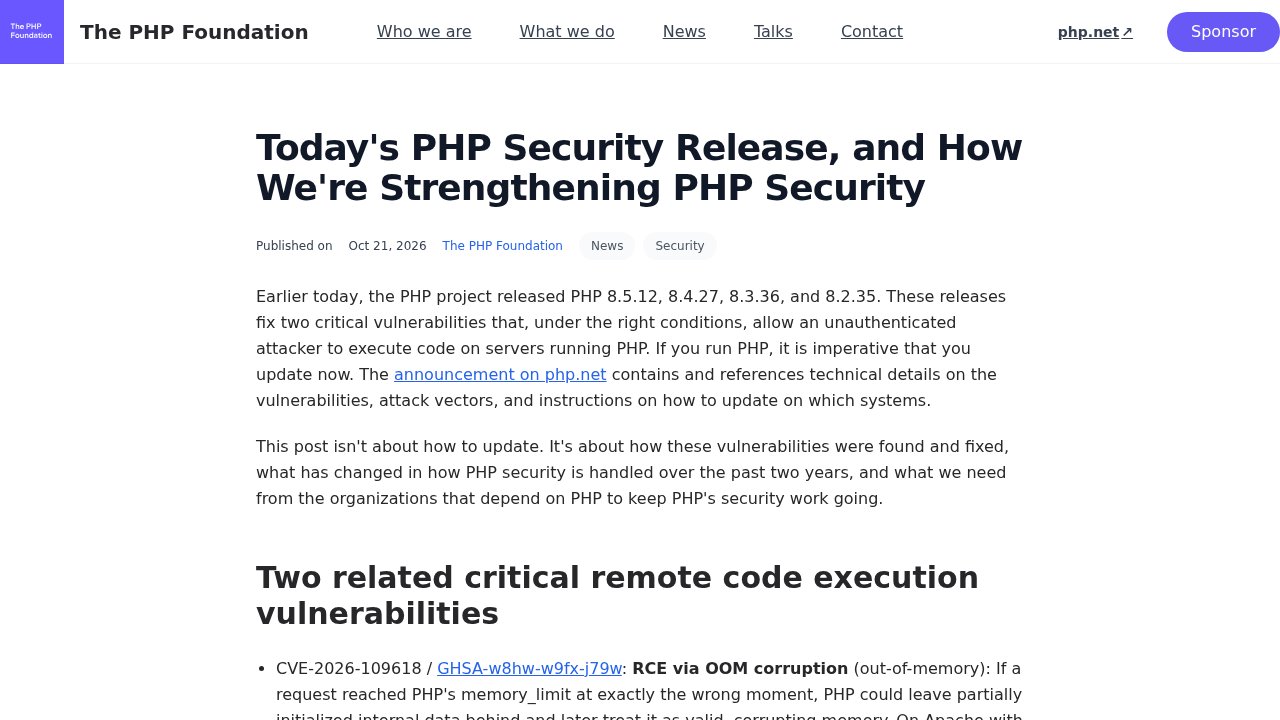 The PHP Foundation — the nonprofit’s own account of the October 21 patch release and the AI tools involved.
If you’re weighing how to think about open-source risk more broadly, DecodeStack has covered the layered-trust problem in software supply chain attacks, which covers similar ground on why a single upstream bug can ripple outward.
What the Foundation says its AI tools actually did
This is the part that matters, separate from the marketing version of that story. That post names several tools. Earlier in 2026, a scan was run using Claude Mythos together with Alpha-Omega, a research collaboration focused on open-source software security. Separately, the Foundation uses OpenAI’s Daybreak Red to help validate incoming reports and proof-of-concept exploits, checking whether a report describes a working flaw before a human spends hours chasing it. That reliance on an outside vendor’s model carries its own risk: access to a model is not guaranteed to last, as DecodeStack covered when a vendor pulled a model’s access overnight.
None of that is a small claim. But the Foundation draws its own line around what the tools do not do. Its post states, close to its own wording, that a person makes every call and works on every patch. The models triage and validate. They do not decide what ships, and they do not write the fix. That distinction matters: a tool that confirms a report is real is not the same as a tool that found the bug.
The same bug, found from several directions
The discovery story for CVE-2026-109618, as the Foundation describes it, did not come from one source. A core PHP developer under contract with the Foundation first noticed signs of the problem while fixing an unrelated flaw that had been flagged by Quarkslab’s 2024 security audit. A report from a party identified as Calif, submitted August 11, then confirmed the scope of the issue. After that, OpenAI and then Wiz Research, a cloud security firm, separately reported the same underlying root cause. For CVE-2026-109619, the Foundation’s post does not specify who found it first.
Wiz Research published its own account of the work, signed by researchers Sagi Tzadik, Shir Tamari, Nir Ohfeld, and Tomer Schwartz. According to that post, Wiz’s first discovery came on August 19, using a combination the company names as Wiz Atlas (a Wiz tool that the post does not describe) alongside the models Gemini 4 Argon and GPT-5.6 Sol. Wiz says it confirmed the unauthenticated remote code execution risk against real applications: Drupal on August 20 and WordPress on August 21, both popular content-management systems built on PHP. Wiz reported its findings to the PHP security team on August 24 and received acknowledgment on September 21. Wiz’s post thanks the PHP team, Calif, and OpenAI for their roles in discovery, coordination, and verifying the fix, but it does not say which party found which of the underlying bugs. The two CVEs, per Wiz, actually bundle four separate underlying bugs, and the exact mapping of bug to CVE number isn’t spelled out in either post.
That several independent parties, using different tools and different approaches, converged on the same root cause is arguably the most reassuring fact in this whole episode. It suggests the flaw was findable by more than one method, which is the kind of cross-checking that gives a severity score like 9.2 some real weight rather than resting on a single researcher’s claim.
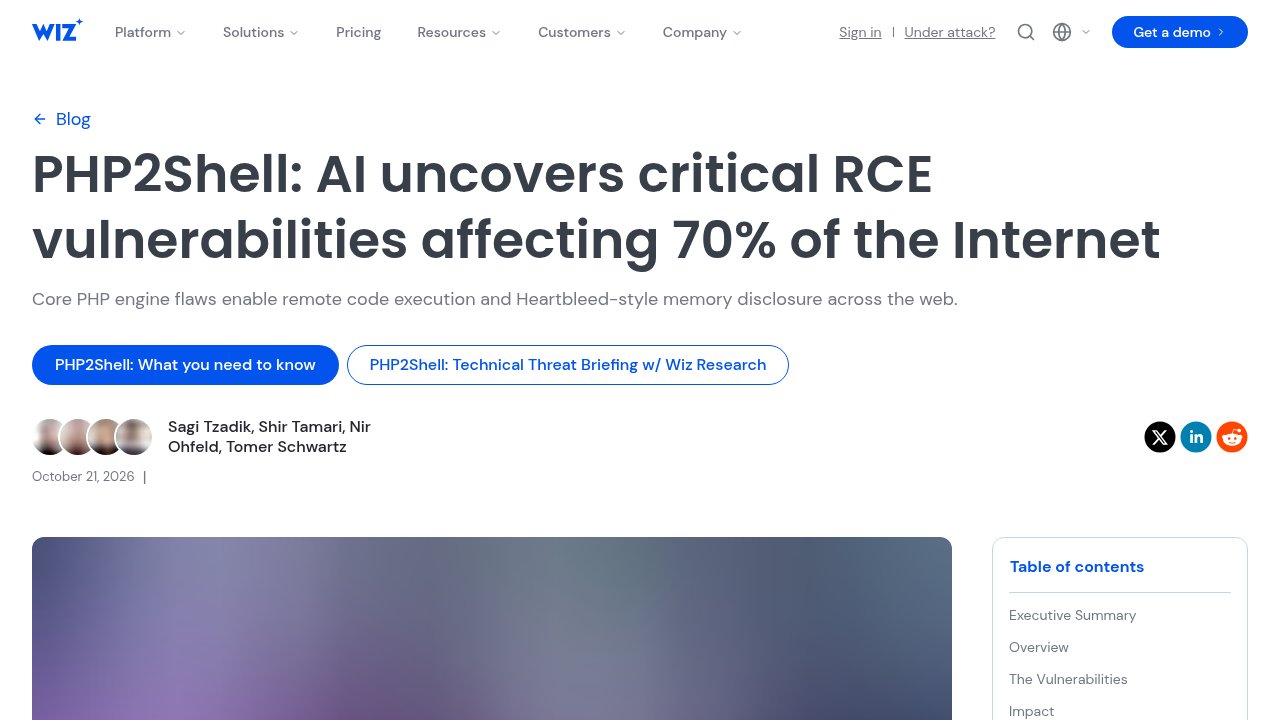 Wiz Research — the cloud security firm’s own writeup of the discovery it names “PHP2Shell.”
The slow part was never detection
Here is the detail that the Foundation’s post is most candid about, and it cuts against the instinct to credit or blame AI for how this went. The Foundation itself describes the handling delay, the gap between reports landing and a coordinated fix shipping, as a structural failure, specifically in its decision-making process and in the resources it had available to act on what it already knew. In other words, the bottleneck was not finding the bug. Multiple independent parties found it within weeks of each other using different techniques. The bottleneck was organizational: too few people with authority to make the call, stretched across too much incoming signal.
The Foundation’s response has been organizational too, not more automation. It created an Ecosystem Security Team in May 2026. Volker Dusch was named to a role the Foundation calls AI Security Engineer in Residence, a position focused specifically on how AI tools get used in the vulnerability pipeline, with Alexandre Daubois joining in July and Daniel Scherzer in September. The Foundation also changed how it makes decisions: majority-vote decisions are now possible, rather than requiring a narrower group to reach unanimous agreement before acting. Alongside that, the Foundation made a funding appeal, since the resourcing problem it names is partly a money problem: more reviewers, more hours, more decision-making capacity. If one idea should outlast this specific patch cycle, it’s that one. The industry’s running assumption is often that finding flaws faster is the hard part, and that AI is the fix for that. Here, the finding happened fine, from several angles at once. What slowed things down was the plumbing behind the decision, and that got fixed with governance, not with a bigger model.
If you’re tracking how AI research tools are evaluated more broadly for security and engineering work, see our comparison of OWASP, MITRE, and NIST frameworks for AI security, which covers how organizations structure that kind of risk assessment.
What this means if you run PHP
For anyone who actually operates a PHP application, the practical list is short and the two flaws discussed above are not the only thing worth checking this week. Update to a patched release: PHP 8.5.12, 8.4.27, 8.3.36, or 8.2.35, depending on which branch you track. After patching, restart your PHP workers or server processes, since an in-memory process that was already running will keep running the old, vulnerable code until it’s restarted, even after the files on disk are updated.
Separately, on October 23, php.net published an advisory about a different issue, CVE-2026-115560, affecting the session.upload_progress feature (a PHP setting that tracks file-upload progress for display to the user). The suggested mitigation, pending the next full release, is to set session.upload_progress.enabled to 0, disabling the feature entirely until a proper fix ships. It’s worth reading that advisory directly rather than relying on a secondhand summary, since the exact configuration syntax matters.
On the question of whether attackers are actively using the first two flaws, the available sources disagree and neither should be read as the final word. watchTowr, a security research firm, says it has observed exploitation attempts since October 21 through honeypots, decoy systems set up specifically to detect and log attack attempts without exposing a real target. Separately, the Canadian Centre for Cyber Security has stated that only a proof-of-concept existed, with no active exploitation identified at the time of its assessment. An observed attempt against a honeypot is not the same claim as a confirmed compromise of a real system, and neither source is adjudicating the other; they are simply describing what each party saw from its own vantage point. As of October 22, per watchTowr, the flaw was not listed in CISA’s Known Exploited Vulnerabilities catalog, a US government list of vulnerabilities confirmed to be under active attack.
Partial mitigations exist, described in the php.net announcement, but none of them replace actually updating the software. If you manage a PHP deployment, that update is the one action item that matters more than any of the detail above.

FAQ
Did AI actually find the PHP vulnerabilities?
No source claims a model independently discovered either flaw on its own. The PHP Foundation’s post says AI tools, including OpenAI’s Daybreak Red, were used to validate and triage reports after humans and automated scans had already flagged suspicious behavior. Wiz Research says it used AI models alongside its own scanning tool during its investigation, but credits the discovery process to a combination of tools and human researchers, not the model acting alone.
What does CVSS 9.2 actually mean for a website owner?
CVSS is the industry’s standard severity score, running from 0 to 10, with higher numbers meaning the flaw is both easier to exploit and more damaging if it is. A score of 9.2 sits in the “critical” range, and combined with the fact that both flaws let an attacker run their own code on the server with no login required, it means patching promptly matters more than usual.
Is my site actually being attacked right now?
Two named sources disagree on this point, and the honest answer is that it depends on the source. watchTowr reports exploitation attempts observed through honeypots since October 21, while the Canadian Centre for Cyber Security says only a proof-of-concept exploit was confirmed, without identified active exploitation. Neither claim cancels the other; patch regardless of which turns out to describe your situation.
Why did the disclosure feel so disorganized?
That same post attributes the messy rollout to a structural failure in its decision-making process and available resources, not to any technical surprise about the bugs themselves. A leak with an incorrect CVSS score, an accidentally published demo video, and container images that shipped early all point to a coordination problem rather than a discovery problem.
What changed at the PHP Foundation because of this?
The Foundation created an Ecosystem Security Team in May 2026, named Volker Dusch as AI Security Engineer in Residence with two more hires following, and introduced majority-vote decision-making so fewer people can block a response. It also made a public funding appeal, framing the fix as a resourcing problem rather than a tooling one.