Scrapling's Self-Healing Web Scraper: What It Actually Does
Scrapling's self-healing web scraper is often called AI-powered. It isn't. Here's the real mechanism, its limits, and where AI genuinely fits in.
Every web scraper breaks the same way. A site redesigns its checkout page, renames a CSS class, or shuffles a few div tags, and the script that worked yesterday returns nothing today. Scrapling, an open-source Python framework for building web scrapers, built a name for itself by promising a fix for exactly this problem, and recent coverage has taken to calling it “AI-powered self-healing.” That phrase describes a real feature. It also describes it wrong, and the gap between the two matters if you are the one deciding whether to build on this tool.
What actually breaks when a website changes
Most scrapers work by giving a computer precise instructions for where to find a piece of information on a page: grab the text inside the element with this exact class name, or go three levels down this branch of the page’s tree. Those instructions come in two common forms, CSS selectors (the same shorthand used to style web pages) and XPath (a path-like address you write to point at one exact spot). Both describe a page’s structure, which developers call the DOM, short for Document Object Model, essentially the tree of nested boxes a browser builds out of a page’s code.
The problem is that this structure is not a contract. A shopping site can rename a button’s class from one label to another during a routine redesign, and every scraper pointed at the old label goes blind instantly, even though the button itself, its text, and its position on the page have not meaningfully changed. This is the single most common reason scraping pipelines fail in production, and it is exactly what Scrapling’s self-repair feature was built to survive.
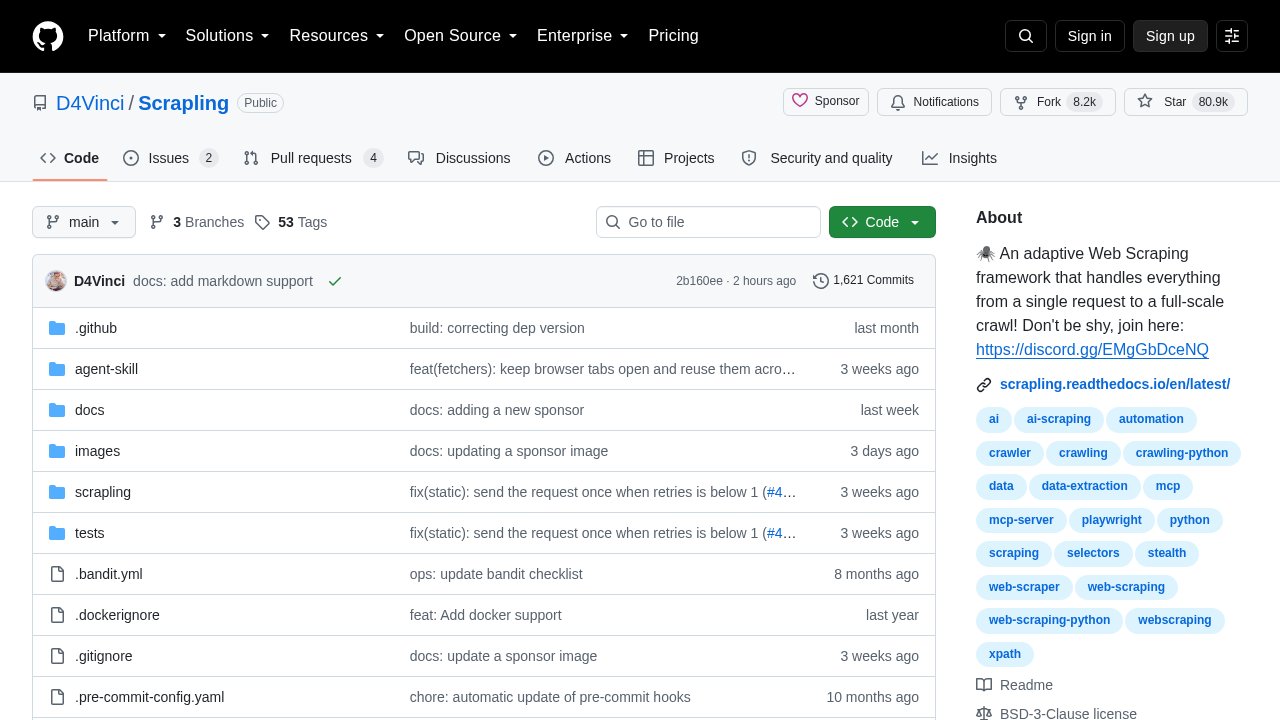 Scrapling — the open-source Python scraping framework at the center of this article.
The mechanism press coverage keeps calling AI
Scrapling’s maintainer, Karim Shoair, built a feature the project calls Smart Element Tracking. When the scraper successfully finds an element the first time, it does not just remember the selector that worked. It records a signature: the element’s visible text, its attributes, and roughly where it sits in the page’s tree relative to its neighbors. The next time the scraper runs, if the original selector no longer matches anything, it searches the current page for the element whose signature is the closest match to the one it saved, and relocates it there.
That is a similarity-matching algorithm, a deterministic method that scores how alike two things are and picks the closest one, comparable to how a spellchecker suggests the nearest correctly spelled word rather than understanding what you meant to write. It runs the same way every time on the same inputs. No model is being consulted, no page is being interpreted for meaning, no judgment call is made about what the button is for. It is closer to a very good fuzzy-matching lookup than to anything that understands the page it is reading.
That distinction is not academic. The shorthand AI-powered self-healing circulates around tools like this one in secondhand summaries and social shares, even when the primary coverage gets it right: korben.info’s own writeup on Scrapling cites the maintainer’s explicit “without AI” framing of the feature, and the project’s own documentation reserves AI language for the MCP server, not for Smart Element Tracking. Still, the label sticks, and it is an understandable shorthand: the feature does behave like something intelligent, recovering from a change nobody told it about in advance. But calling the mechanism itself artificial intelligence overstates what is happening under the hood, and it sets the wrong expectation for what the tool can and cannot survive.
Where the similarity trick genuinely helps, and where it gives up
The honest case for Smart Element Tracking is real. According to the project’s own published benchmark, comparing its relocation approach against the older AutoScraper library on the same element-relocation task, Scrapling’s engine comes out substantially faster at the job. For the common case of a site renaming a class or nudging an element to a nearby spot during a redesign, the saved signature usually still matches closely enough to relocate it correctly, and a maintenance task that used to mean opening the code and rewriting a selector by hand happens automatically instead.
The honest limit is just as real. A signature match only works if enough of the original fingerprint survives the redesign. If a page’s structure changes radically, say the element moves to a completely different part of the page, its text is rewritten, and several of its identifying attributes disappear all at once, there may no longer be enough of a match to find with confidence, and the scraper fails the same way an old-fashioned selector-based one would. Self-repair narrows the range of changes that break a scraper. It does not remove the category of failure altogether, and nothing about the mechanism changes that ceiling, because it was never reading the page for meaning in the first place.
 Scrapling’s adaptive-scraping docs — the official reference for Smart Element Tracking, the mechanism this article breaks down.
The part of Scrapling that actually is AI
Here is where the real distinction pays off. Scrapling ships with a built-in MCP server, short for Model Context Protocol, a standard that lets an AI agent, something like Claude or Cursor, call an external tool or data source directly, instead of the agent having to fumble through raw web pages on its own. With this server running, an AI agent can ask Scrapling to fetch and extract a page, and get back the content it needs rather than a wall of raw HTML markup.
That handoff matters for a very practical reason: cost. Every piece of text an AI agent has to read costs money and processing time, measured in tokens, the small chunks of text a language model processes one at a time. Raw HTML is bloated with markup, scripts, and styling that carries no information for the agent’s task, so feeding it directly to an AI model burns through a large token budget for very little useful signal. By doing the extraction first and handing the agent clean, already-parsed content, the MCP server cuts that token cost substantially, which is a real, measurable saving for anyone running an agent against many pages a day.
This is the feature that genuinely puts artificial intelligence into the picture, not by making the scraper smarter about reading pages, but by making the scraper usable as a tool an AI agent can call on its own. The self-repair engine and the MCP server solve two different problems, and neither one requires the other to work.
Why the distinction matters if you are actually building something
Someone evaluating Scrapling for a real project needs to know which claim they are relying on. If the pitch is that this scraper heals itself when a site changes, the honest expectation is a deterministic pattern-matching safety net that handles common, incremental redesigns and will still need a human to step in after a major overhaul. That is a genuinely useful property for a maintenance-heavy scraping pipeline, and it does not need artificial intelligence to be true.
If the pitch is that you can plug this into an AI agent, that is a separate and also genuinely useful claim, resting entirely on the MCP server, and it is worth evaluating on its own terms. Does the agent framework already in use support MCP tools. Does the token savings from pre-extracted content actually change the operating cost at the volume the project plans to run.
Confusing the two leads to a bad decision either way. Someone who picks Scrapling expecting an AI system that grasps the meaning of arbitrary page redesigns will be disappointed the first time a site is rebuilt from scratch. Someone who assumes the self-repair feature has nothing to do with AI at all might overlook the MCP server entirely, missing the part of the project that is actually useful for the agent-building work a lot of teams are doing right now.
The project behind the framing
None of this is a knock against Scrapling as a tool. It is an actively maintained, open-source project distributed under the permissive BSD-3-Clause license, meaning it can be used, modified, and redistributed with very few restrictions, and it has drawn more than 80,000 stars on GitHub, a rough but visible sign of how many developers have found it useful enough to bookmark or adopt. Beyond the two features covered here, it also includes built-in proxy rotation, which routes requests through different IP addresses to avoid being blocked, and it can block requests to roughly 3,500 known ad and tracker domains when that option is turned on, which speeds up page loads by not fetching content the scraper does not need. Those are solid, practical engineering choices, independent of how any single feature gets described in a headline.
The marketing shorthand around AI-powered self-healing is not a lie so much as a compression that loses the one distinction a technical reader actually needs. The self-repair engine is a fast, well-built piece of pattern matching, not artificial intelligence, and its limits follow directly from what pattern matching can and cannot do. The AI angle is real, but it lives in the MCP server, in the choice to let an agent call the scraper as a tool instead of parsing pages itself. Knowing which one is actually being evaluated is the difference between the right expectation and a surprise six months into a project.

Frequently asked questions
Is Scrapling’s self-healing feature actually artificial intelligence?
Scrapling’s self-healing feature, known as Smart Element Tracking, is not artificial intelligence. It is a deterministic similarity-matching algorithm that compares a saved signature of an element, its text, attributes, and position, against the current page to relocate it after a site’s structure changes. No language model or AI system is involved in that process.
What happens when a website redesign is too drastic for Scrapling to handle?
When a redesign changes an element’s text, attributes, and position all at once, Scrapling’s signature-matching mechanism may no longer find a close enough match, and the scraper fails just as a traditional selector-based script would. Self-repair narrows the range of changes it survives; it does not eliminate the underlying limitation.
What is the MCP server in Scrapling, and why does it matter?
Scrapling’s built-in MCP server implements the Model Context Protocol, a standard that lets an AI agent call the scraper directly as a tool rather than parsing raw web pages itself. The agent receives already-extracted content instead of raw HTML, which meaningfully reduces the token cost of running an AI agent against many pages.
Is Scrapling free to use for commercial projects?
Scrapling is distributed under the BSD-3-Clause license, a permissive open-source license that allows commercial use, modification, and redistribution with minimal restrictions, such as keeping the original copyright notice. It is not a paid SaaS product and carries no licensing fee.
How is Scrapling’s self-repair different from a scraper that just retries on failure?
A scraper that simply retries repeats the same broken instruction and fails again if the underlying selector is gone. Scrapling’s self-repair instead searches the current page for the element whose recorded signature most closely matches what it saw before, and updates its target to that new location, which is a fundamentally different kind of recovery than a plain retry.