The Linux Kernel Vhost Vulnerability an AI Tool Actually Found
CVE-2026-74580 lets a local user escalate to root through a 9-year-old Linux kernel vhost bug. Here's what Tencent's AI tool really did, and who should patch.

The Linux Kernel Vhost Vulnerability an AI Tool Actually Found
A Linux kernel vhost vulnerability patched in early August quietly became one of the more interesting security stories of the year, not because the bug itself is unusual, but because of who found it. Tencent’s Zhuque Lab says its in-house AI system, Corvus AI, pinpointed the flaw in about two hours, and that the same system later drove cross-distribution reproduction and patch verification. The bug, tracked as CVE-2026-74580 and nicknamed “Vghost,” had been sitting in the kernel since 2017. That gap between a nine-year-old bug and a two-hour discovery is the real story here, and it is more interesting once you stop reading it as “an AI hacked the kernel.”
What Vghost actually is
CVE-2026-74580 lives in vhost, a Linux kernel subsystem that speeds up virtual machines by letting a VM’s virtual network or storage device talk almost directly to the host kernel instead of routing every packet through a slower emulation layer. It is the plumbing behind fast virtual networking on KVM and QEMU, the virtualization stack that underlies a large share of cloud and enterprise virtual machines. The bug sits squarely in the kind of unglamorous, rarely-touched code that zero trust security thinking already treats with suspicion by default, on the assumption that any local account could eventually turn hostile.
The flaw itself is a caching bug, not an exploit chain built by magic. Inside vhost, the kernel keeps a lookup cache called the IOTLB, short for input/output translation lookaside buffer, which maps a virtual machine’s memory addresses to the right physical memory. When certain commands reconfigure the VM’s virtual network ring (the queue structure vhost uses to pass data back and forth), that cache is supposed to be cleared out. It wasn’t. Tencent Zhuque Lab’s own technical writeup traces the defect to two commits, one from Linux 4.11 (2017) and one from Linux 5.9 (2020), whose interaction leaves the cache stale; the affected range runs from 4.11 through 7.2. The bug was present for roughly nine years before anyone caught it.
A stale cache entry sounds minor until you see what it enables: a local, unprivileged user (not an anonymous remote attacker) with access to a vhost device node, /dev/vhost-net or /dev/vhost-vsock, whose permissions vary by distribution (0666 on some, 0660 root:kvm on others), can trick the kernel into reading or writing memory it should not touch, and ride that into full root privileges. The official CVE record rates it 8.8 on the CVSS 3.1 scale, in the “High” band, reflecting low attack complexity and a low bar for required privileges once someone has local access.
What Tencent’s tool really did, and didn’t do
The framing that traveled fastest after this disclosure was some version of “an AI found a 0-day in the Linux kernel,” and that framing is the shorthand that circulated after the disclosure; Tencent itself says Corvus AI “discovered” the flaw, without using the term 0-day. It is worth separating the two.
Tencent Zhuque Lab, the security research arm that found the bug, built an AI system it calls Corvus AI, and brought in Tencent’s own Hunyuan Hy4-preview language model for two specific stages: exploit verification and patch regression analysis. Tencent’s writeup does not detail how Corvus AI located the bug; it says only that the system “pinpointed” the defect in two hours. The later stages are documented: dynamic exploit verification, reproduction of the same generic x86-64 exploit on five distributions (Ubuntu 26.04 LTS, RHEL 9.8, Amazon Linux 2023, Azure Linux 3.0, Oracle Linux 10.2), and patch verification. By Tencent’s timeline the flaw was identified on July 31, the fix reached mainline on August 3, and full local privilege escalation was verified on five distributions on August 24.
That is a genuinely fast discovery, and worth taking seriously on its own terms. But it is a different claim than an AI autonomously discovering and weaponizing a 0-day on its own initiative. What the writeup supports is a gain in speed on a known kind of work (finding a cache-invalidation mistake, then verifying the exploit and the patch, tasks security teams already do by hand or with existing tools), not a machine inventing a new class of attack or operating with judgment no tool had before. The bug itself was always findable; a cache that doesn’t get cleared on reconfiguration is a textbook category of mistake. It simply hadn’t drawn the two hours of focused attention it needed, for nine years, until this system got pointed at it.
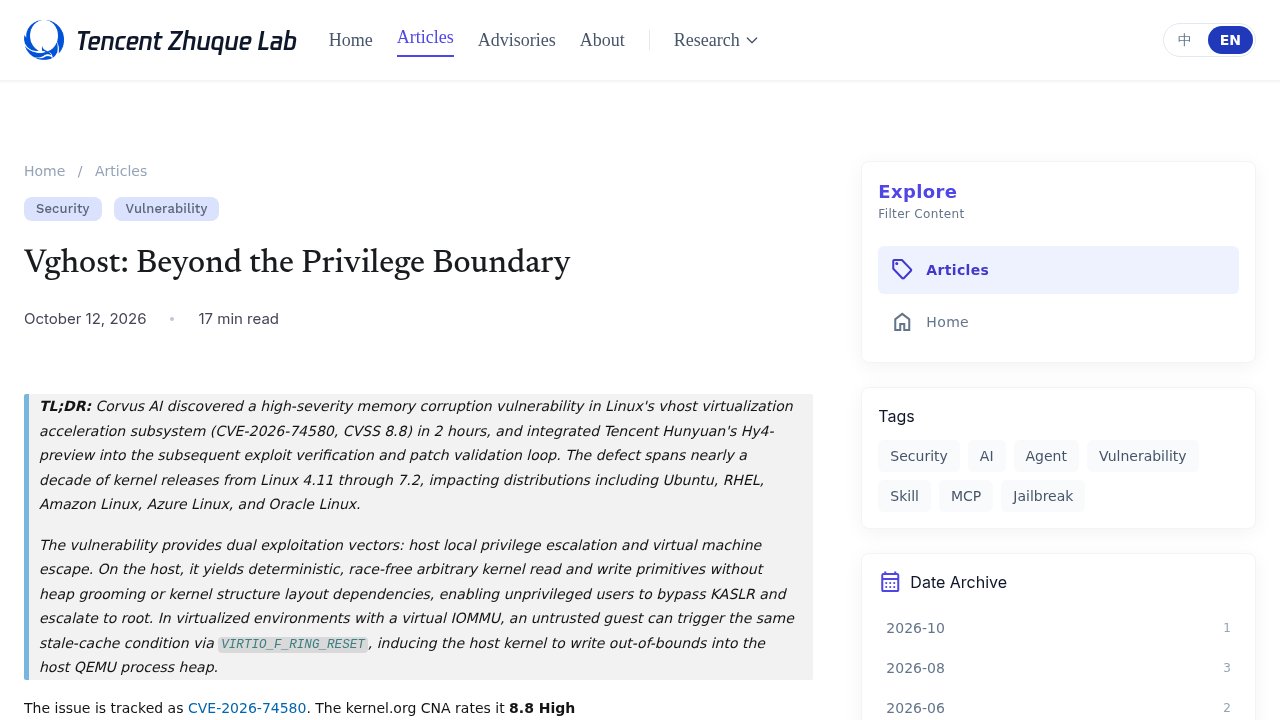 Tencent Zhuque Lab — the security research arm whose Corvus AI system pinpointed the Vghost bug.
Who is actually exposed
This is where the details matter for anyone actually running virtualized infrastructure. The vulnerability does not mean every KVM virtual machine can break out to its host by default. Tencent’s own testing confirmed two specific exploitation paths: vhost-net (the virtual network device) and vhost-vsock (the virtual socket device used for host-guest communication). Tencent names only vhost-net and vhost-vsock as affected frontends; it does not mention vhost-scsi.
Reaching a full VM-to-host escape also requires a specific setup, not a default configuration. The host needs an active vIOMMU (a virtualized version of the hardware component that translates memory addresses for I/O devices), the guest and host need to have negotiated a virtio feature called VIRTIO_F_ACCESS_PLATFORM, the device needs to be running in device-IOTLB mode, and the trigger path runs through another virtio feature, VIRTIO_F_RING_RESET. Strip away the acronyms and the practical point is this: you need a reasonably specific, deliberately configured virtualization setup, not a bare default KVM install, for the worst-case outcome to apply. Even then, Tencent’s writeup describes the escape landing in an out-of-bounds write inside the host’s QEMU process memory, which opens the door to further exploitation (specifically, hijacking a function pointer) rather than handing an attacker instant root access on the host in one step.
If you administer systems that run KVM or QEMU with vhost-net or vhost-vsock enabled, this is the bug to check for. If your workloads don’t touch vIOMMU or device-IOTLB configurations, the host-escape scenario doesn’t apply to you the same way, though the local privilege escalation inside a single Linux system (no virtualization required) still does, provided the local user can open the vhost device nodes, since the underlying cache bug sits in the same vhost code regardless.
Patch now, and how to check
The fix has been available since August 3, 2026, in mainline commit de845981da67, and it has already been backported to the stable kernel branches most production systems actually run: 5.10.265, 5.15.216, 6.1.183, 6.6.152, 6.12.104, 6.18.45, 7.1.9, and 7.2. If your distribution tracks upstream stable kernels at a normal cadence, a routine kernel update already covers you, or will shortly.
To check where you stand, run uname -r to see your current kernel version and compare it against the patched line for your branch above. Distribution kernels may carry the backport under an older base version, so a lower number alone does not prove you are exposed; check your vendor’s advisory. If you are several point releases behind on a 6.1 or 6.6 kernel, for instance, that is the gap to close. There is no indication of active exploitation of CVE-2026-74580 in the wild as of this writing, which puts it in a different risk category than some of the actively exploited flaws, like certain Palo Alto PAN-OS or Cisco Secure Email Gateway bugs, that have circulated in the same disclosure cycle. A patch window with no confirmed in-the-wild abuse is exactly the moment to schedule the update calmly rather than treat it as an emergency.
The fix itself was also discussed in the open on the oss-security mailing list on October 14, 2026, which is the normal, public channel the Linux security community uses to coordinate and verify kernel fixes, not a sign of anything unusual about this particular bug.
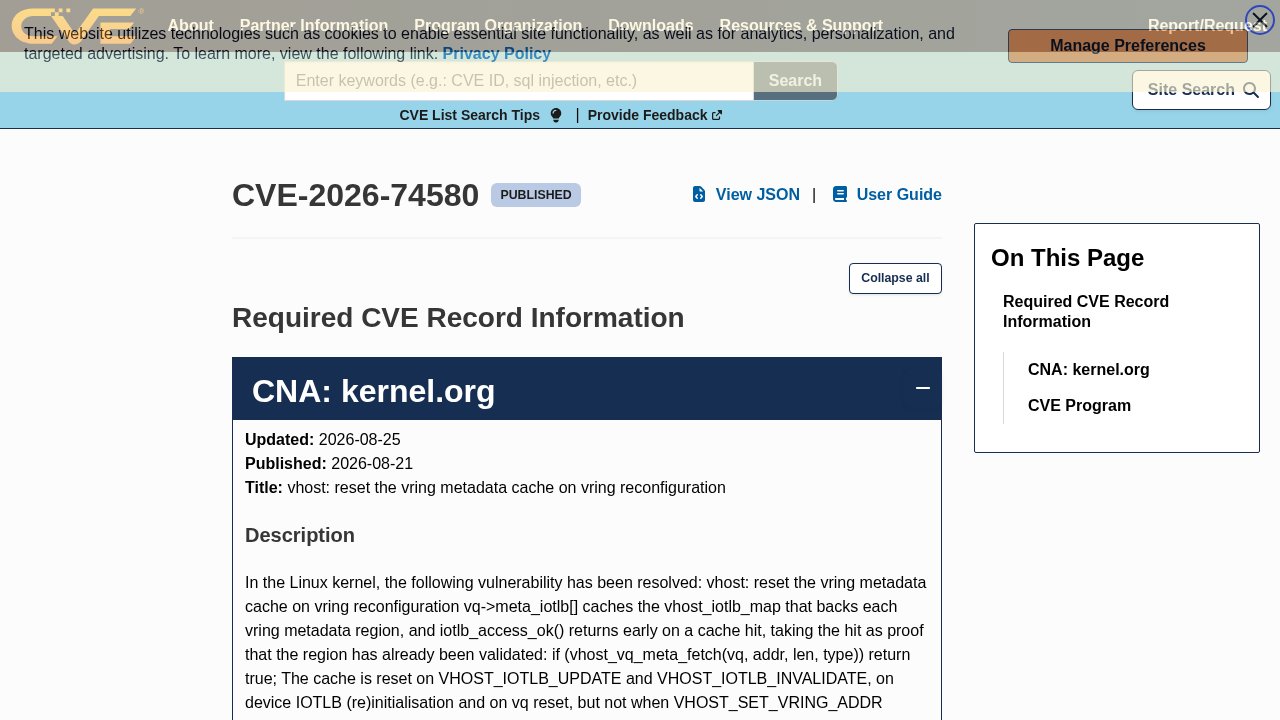 CVE-2026-74580 — the official record, rated 8.8 (High) on the CVSS 3.1 scale.
The real signal behind the headline
Strip the marketing framing away and what is left is a useful, modest lesson rather than a dramatic one. An AI system pinpointed, in two hours, a mundane, nine-year-old bug that nobody had gotten around to looking for closely. That is a story about attention and tooling catching up to a backlog of unglamorous code, not about a machine developing the judgment to hunt for novel vulnerabilities on its own. For readers tracking what AI security tools can and cannot yet do, that distinction is the one worth keeping. The same week’s disclosure digest included flaws under active exploitation elsewhere, a reminder that the more urgent security work right now is still patching what is already being used against people, not speculating about what an AI system might find next.
The practical takeaway for anyone running Linux, virtualized or not, is narrower and more durable than any single CVE: old, boring subsystems accumulate the exact kind of bug that automated, systematic checking is good at catching, and the value of tools like Corvus AI is in shrinking the time between a bug existing and a bug being confirmed and fixed, not in replacing the human judgment that decides what gets built, shipped, and trusted in the first place. It is the same lesson DecodeStack keeps returning to with software supply chain risk: a piece of code nobody is actively watching can carry a serious flaw for years without anyone noticing, whether the gap is a dependency or, as here, a subsystem inside the kernel itself.

Frequently asked questions
Is CVE-2026-74580 being actively exploited right now?
No confirmed active exploitation of this Linux kernel vhost vulnerability has been reported as of this writing. That sets it apart from other flaws in the same disclosure window, such as certain Palo Alto PAN-OS and Cisco Secure Email Gateway bugs, which have seen confirmed in-the-wild abuse. A patch has been available since early August 2026.
Do I need vhost-scsi enabled to be affected?
No. Tencent names only vhost-net and vhost-vsock as affected frontends and does not mention vhost-scsi.
Can any KVM virtual machine escape to its host through this bug?
No, a full VM-to-host escape through Vghost requires a specific setup: an active vIOMMU, the VIRTIO_F_ACCESS_PLATFORM virtio feature negotiated between guest and host, device-IOTLB mode enabled, and a trigger through VIRTIO_F_RING_RESET. A default KVM configuration without these settings is not exposed to the full escape scenario, though the underlying local privilege escalation still applies on an affected, unpatched kernel.
Did an AI really discover this Linux kernel bug on its own?
Tencent says its Corvus AI system, with the Hunyuan Hy4-preview model integrated for exploit verification and patch regression analysis, pinpointed the flaw in about two hours. The writeup does not detail how the bug was located; it documents dynamic exploit verification, reproduction on five distributions, and patch verification. That is a gain in speed on a known kind of work, not evidence of a system inventing a new kind of attack.
How do I know if my kernel is patched against Vghost?
Run uname -r to check your current kernel version and compare it against the patched stable branches: 5.10.265, 5.15.216, 6.1.183, 6.6.152, 6.12.104, 6.18.45, 7.1.9, or 7.2 and later. Vendor kernels may contain the backport while keeping an older base version, so check your distribution’s advisory before concluding you are exposed. Mainline kernels received the fix in commit de845981da67 on August 3, 2026, and most distributions that track upstream stable kernels will already include it in a routine update.