OWASP, MITRE, NIST: Three Tools for AI Security, and the Order to Use Them
Three big AI-security frameworks look like rivals. They aren't: each answers a different question, and the real choice is which to reach for first.

Any company building something with AI today hits the same wall: a market full of security frameworks that all seem to do the same thing. OWASP, MITRE, NIST. Three respected names, three sets of guidance on keeping artificial intelligence safe, and a natural urge to pick one and move on. That urge is the trap. The three were never built to compete, and choosing between them is the wrong question. Each was made for a different job, and the decision that actually matters is the order in which you use them.
All three deal with the same kind of software: large language models, the text-generating engines behind chatbots and AI assistants, plus the apps built on top of them. Beyond that shared subject, they part ways completely.
Three different questions
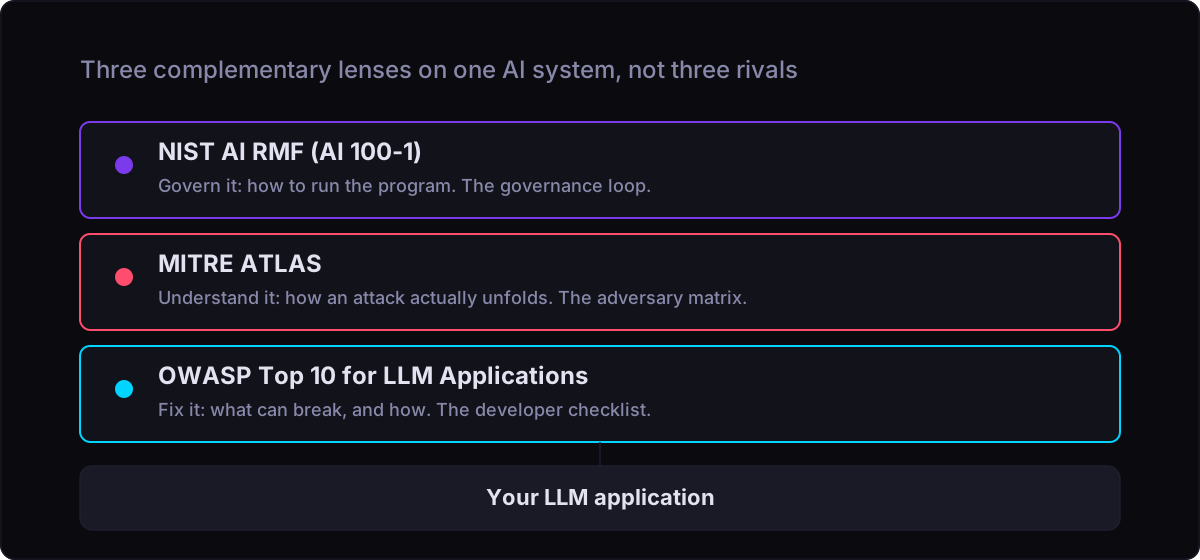
The cleanest way to tell them apart is to ask what each one answers.
OWASP answers: what can go wrong in my AI app, and how do I fix it. It is a checklist for the people writing the code. MITRE ATLAS answers: how would a real attacker actually break into an AI system. It is a catalogue of the moves attackers use. NIST answers: how does my organization keep AI risk under control over the long run. It is a management playbook for the people in charge.
A checklist, an attacker’s playbook, and a management framework are not three versions of the same thing, any more than a spell-checker is a substitute for a fire drill. They sit at different heights above the same system.
They do overlap on a handful of problems, which is what fuels the “just pick one” instinct. Three keep coming up. Prompt injection is the trick of hiding fresh instructions inside the text an AI reads, so it quietly ignores its own rules. Data poisoning means slipping bad examples into the data a model learns from, so it learns the wrong lesson. Supply-chain risk covers the outside models, libraries and datasets a team reuses instead of building itself. Every serious framework touches these three, because no one defending AI can afford to ignore them, but each handles them at a different level.
OWASP: the builder’s checklist
The OWASP Top 10 for LLM Applications is exactly what its name suggests: the ten most common ways an AI app breaks, each paired with a fix an engineer can apply right away. The current edition is tagged 2025 and was published in late 2024 by the OWASP GenAI Security Project, a volunteer community of security practitioners. Prompt injection sits at the top of the list, because it remains the single most reliable way to make an AI misbehave.
The rest of the list reads like a builder’s worry sheet. Two of the newer entries show where real systems are breaking. One is the leak of an app’s own hidden instructions, the private prompt that tells the assistant how to behave. The other targets the document store many AI tools search before they answer: poison those documents, and you poison the reply without ever touching the model itself.
The most useful idea in the list, for a non-engineer, is what OWASP calls excessive agency. It warns against handing an AI assistant more power than it needs: access to your files, your database, the ability to send messages or run commands. The more an assistant can do, the more damage a single successful trick can cause. Scope the powers down, and you shrink the blast radius. It is the same least-privilege logic behind zero trust architecture, applied to a tool that improvises.
Steve Wilson, who founded the project and co-chairs the GenAI Security Project, has described the list as a practitioner’s resource meant to keep pace with real incidents, not a compliance stamp to wave at auditors. That is also its limit. OWASP tells you what to fix and roughly how, but not how a full attack chains those weaknesses together, and not whether your leadership should accept the risk that remains.
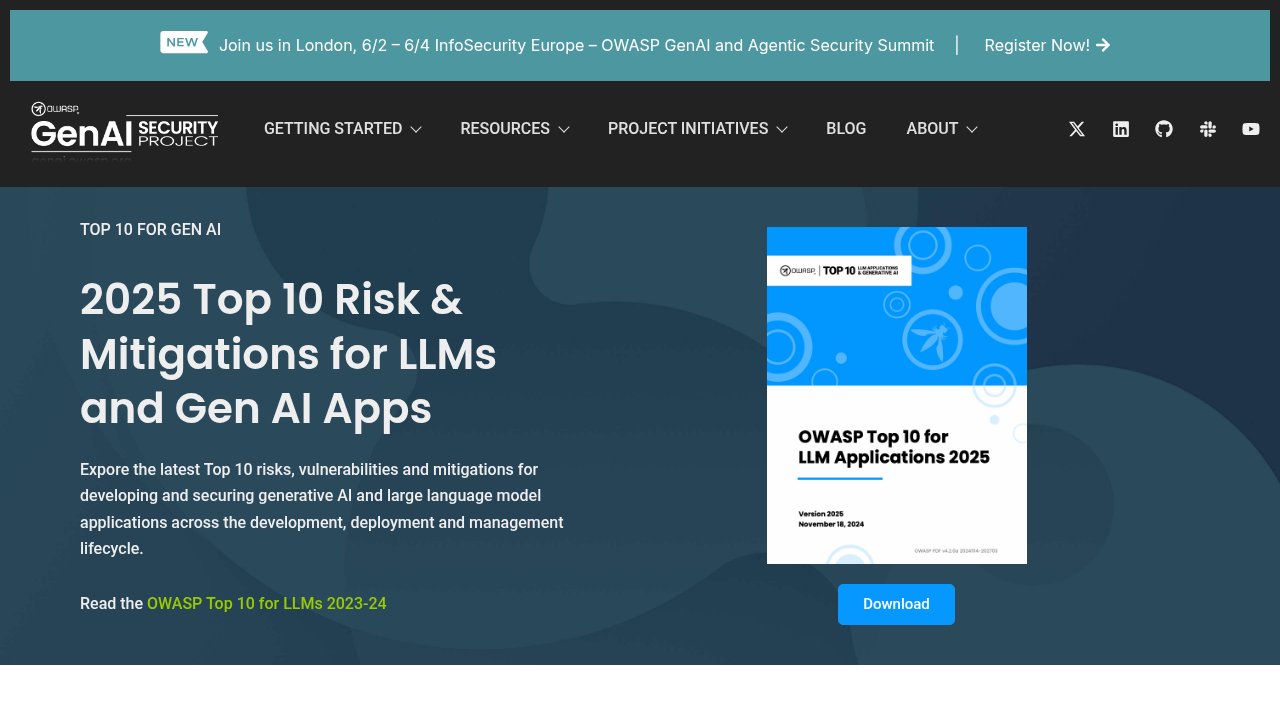
The OWASP Top 10 for LLM Applications, the builder’s checklist of ways an AI app can break.
MITRE ATLAS: the attacker’s playbook
MITRE ATLAS is the AI version of a much older and more famous catalogue, MITRE’s ATT&CK, which security teams use to study how intruders move through ordinary computer networks. ATLAS does the same for AI: it lays out the steps an attacker takes against an AI system, from first probing it to stealing data or corrupting it, all grounded in real-world cases. Where OWASP lists what can go wrong, ATLAS shows how an attack actually unfolds, step by step, in the attacker’s own language.
The catalogue keeps growing as new attacks appear, and recent additions focus on autonomous AI agents, the assistants that act on their own across several tools. The exact count is a moving target, which is the point: ATLAS is a living document, not a fixed list.
Its value is in stress-testing a defense. A security team can walk the attacker’s path step by step and ask, at each move, would we even notice this. Take data poisoning: the warning signs live in checks on the data pipeline, not in the network alarms a company already runs. ATLAS surfaces exactly that kind of blind spot. It assumes the system already exists and is under attack, and it hands the defender the attacker’s vocabulary.
Two confusions sink most discussions of ATLAS. The first is mixing it up with ATT&CK; ATT&CK covers ordinary IT, ATLAS is the AI extension built on the same structure. The second is treating ATLAS as a governance tool. It carries no risk-acceptance process and no rules for running a program, only attacker moves and the cases that prove them.
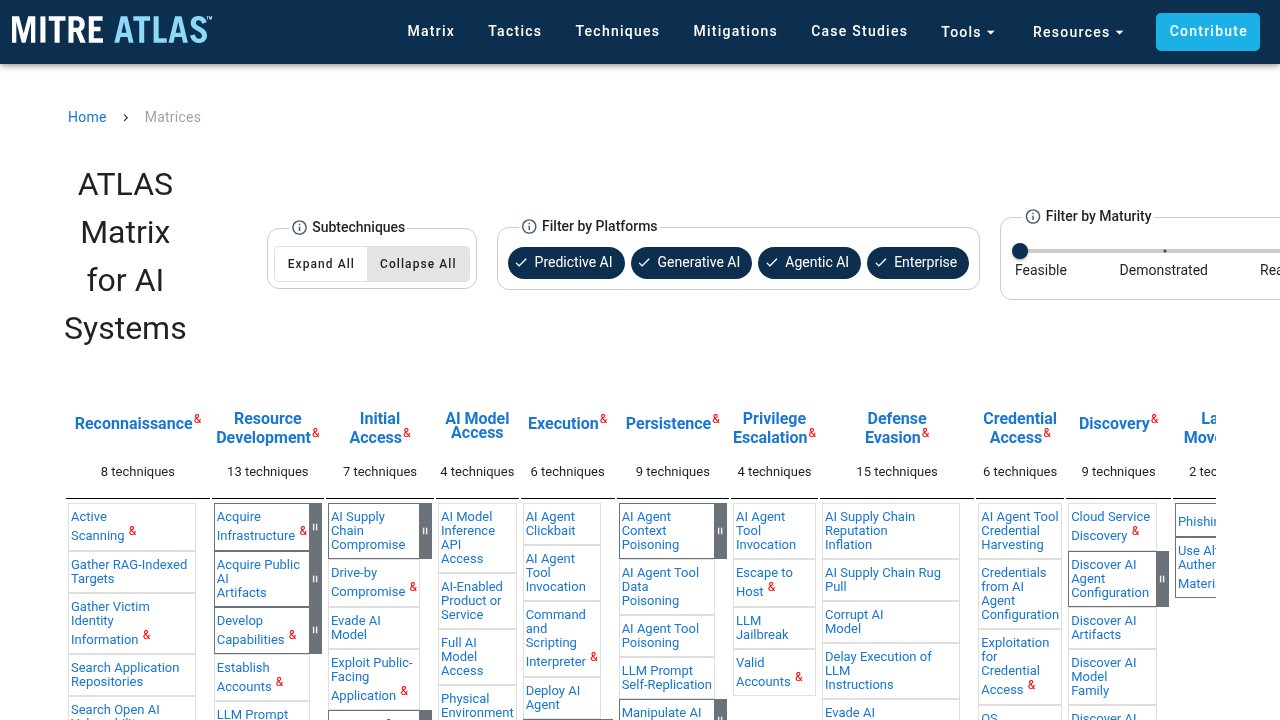
MITRE ATLAS, the catalogue of real attacker moves against AI systems.
NIST: the management playbook
NIST AI RMF, formally numbered AI 100-1, is a voluntary framework published by the US standards body in 2023 for managing AI risk across a system’s whole life. It operates at the level of the organization, not the code, and it never names a single bug or attack. Instead it rests on four jobs: govern (set who is accountable and what the culture is), map (work out the context and the risks), measure (track them), and manage (act on them). Underneath, it fans out into dozens of more specific practices.
There is a companion document worth knowing, because comparisons often confuse the two. The Generative AI Profile, numbered AI 600-1 and published in 2024, applies the same framework to generative AI specifically and adds a dozen risks unique to it. The profile extends the main framework, it does not replace it: a team working with generative AI uses both, with AI 100-1 as the backbone.
The audience here is leadership, risk and compliance, not the engineer mid-build. NIST gives an organization a defensible structure and a shared vocabulary that auditors and regulators increasingly expect. Diana Kelley, a longtime security executive and former Microsoft cybersecurity chief, has argued that the organizations actually reducing AI risk are the ones adopting these frameworks together rather than in isolation, because a checklist with no governance drifts, and governance with no checklist has nothing concrete to govern. What NIST does not give you is a list of bugs to fix or a map of how an attacker operates.
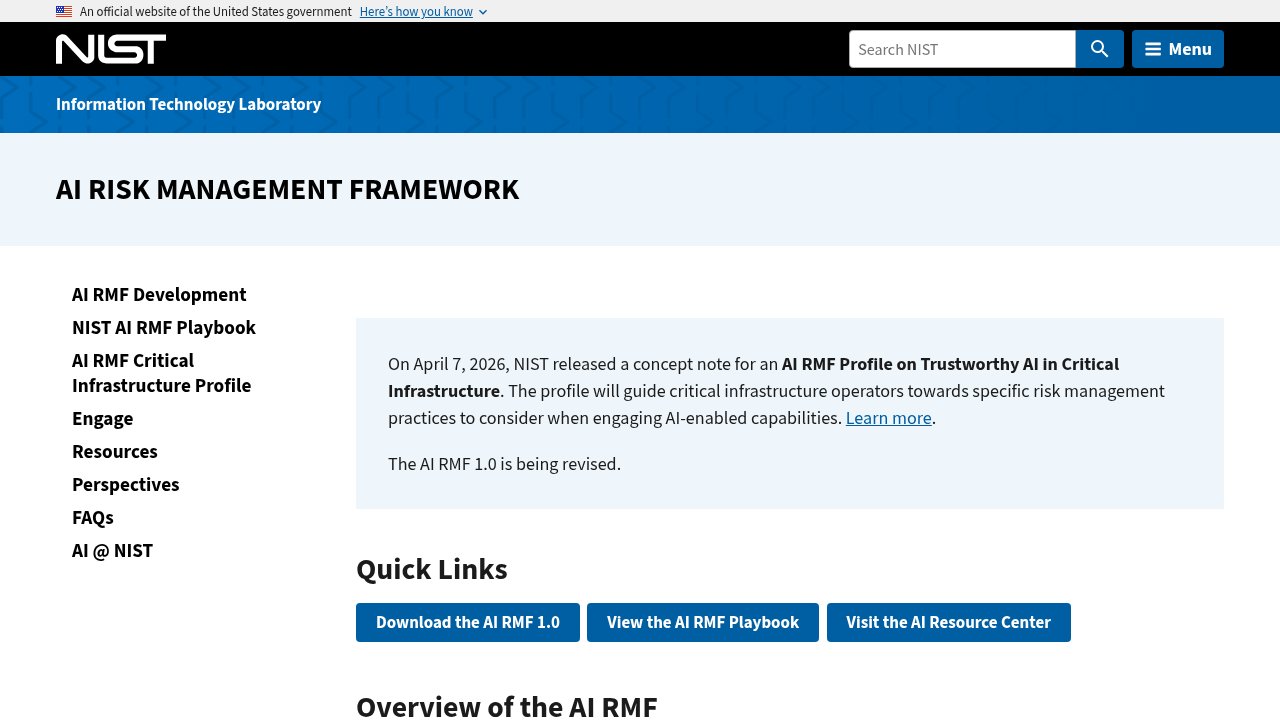
The NIST AI Risk Management Framework, governing the program through govern, map, measure and manage.
Side by side
| OWASP | MITRE ATLAS | NIST AI RMF | |
|---|---|---|---|
| Answers | What to fix | How the attack happens | How to govern the risk |
| Written for | Engineers building the app | Teams defending it | Leadership and compliance |
| Reads like | A checklist | An attacker’s playbook | A management framework |
| Best moment | While building | Once the system is live | As the program scales |
| Don’t confuse with | The classic web Top 10 | MITRE ATT&CK | The older NIST cyber framework |
The order that actually works
Because each one picks up where the last stops, they stack in a natural sequence. Build safely first with OWASP: walk the checklist, scope down what your AI assistant can touch, clean up the data it draws on. That produces a system that resists the known weaknesses.
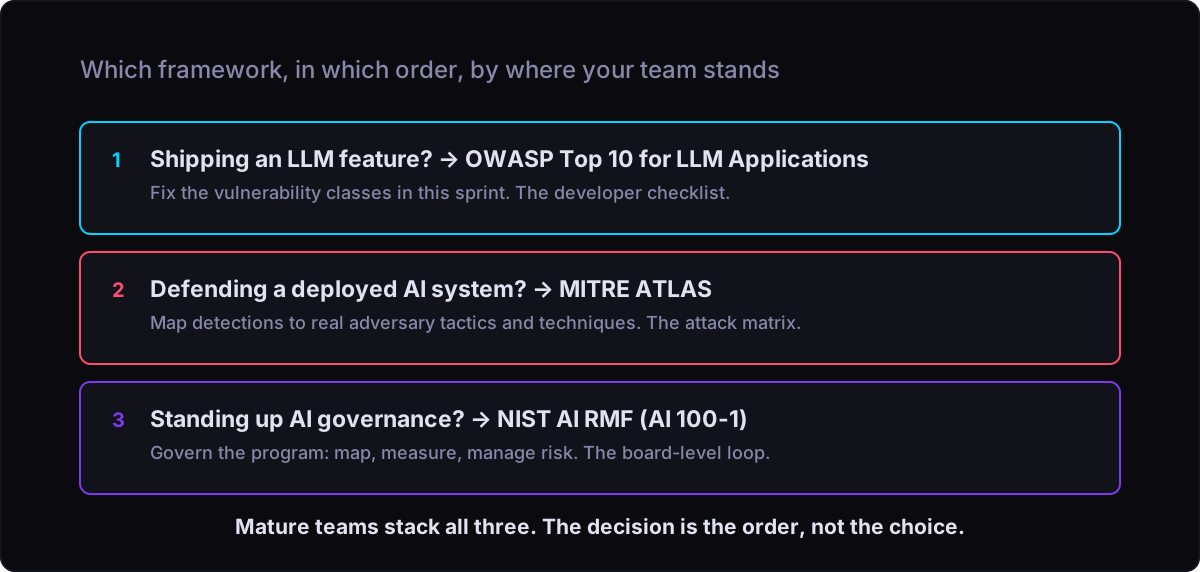
That system then becomes the thing ATLAS helps you defend. The same prompt-injection risk OWASP told you to fix shows up in ATLAS as a move an attacker makes, so your defenders can ask whether they would actually catch it in progress. The two read the same risk from opposite ends, the builder’s and the attacker’s.
NIST wraps around both. Governance decides which AI features ship at all, sets the policy that requires the OWASP review, and defines how much risk is acceptable, which in turn tells the defenders which ATLAS attacks are worth spending on. The supply-chain thread runs through all three, behaving much like the propagation risk we covered in software supply chain attacks, where one poisoned dependency reaches far past its entry point.
None of this means adopting all three at full depth on day one. A small team can live inside the OWASP checklist for a long time before the rest earns its keep. The frameworks nest instead of competing, so adopting the next one never undoes the work you did under the last. Reverse the order, start with governance and no engineering underneath, and you get policy that protects nothing. Build first, defend second, govern around both.
Frequently asked questions
Should I use OWASP or MITRE ATLAS for AI security?
Both, for different jobs. OWASP is the checklist your engineers work through while building, covering common weaknesses like prompt injection with fixes they can apply in the moment. MITRE ATLAS is what your defenders use once the system is live, helping them map real attacker moves against what they can actually detect. If you are building and have to start somewhere, start with OWASP, because it maps straight to the code. Add ATLAS when you have a running system worth defending.
Is the NIST AI framework the same as the older NIST cybersecurity one?
No. The NIST AI Risk Management Framework is a separate, newer document focused on AI-specific risk, built around four jobs: govern, map, measure and manage. The well-known NIST Cybersecurity Framework covers computer security in general and predates the AI one. They share an author and a similar shape, but they cover different ground, and any comparison that treats them as interchangeable is unreliable on its other claims too.
What is the difference between NIST AI 100-1 and AI 600-1?
AI 100-1 is the main framework, the four-job governance backbone. AI 600-1 is the Generative AI Profile, a companion published in 2024 that applies the same framework to generative AI and adds a dozen risks specific to it. The profile extends the main framework rather than replacing it. If you work with generative AI, you use both, with AI 100-1 as the spine and AI 600-1 as the generative-specific layer on top.
How big is MITRE ATLAS?
It runs to roughly a dozen and a half attacker goals and dozens of specific techniques, grounded in real-world cases, and it grows on a regular schedule as new kinds of attack appear. Recent additions have concentrated on autonomous AI agents. Because the count moves with every release, the honest answer is to check the live matrix on the MITRE ATLAS site rather than trust a fixed number in any article.
Can a small team realistically use all three frameworks?
Not at full depth on day one, and you do not need to. A small team shipping AI features can live inside the OWASP checklist for a long time and cover the risks that actually break systems. MITRE ATLAS earns its place once you have a deployed system worth defending and people to defend it. Formal NIST governance matters most when scale, regulation or audits arrive. Because the three nest, adding the next one never undoes the earlier work.