ZeroBytes: France's Tax and Education Breach Explained
ZeroBytes breached France's tax authority and Education Ministry. What each confirmed is narrow, and the claimed 346 million figure is misleading by design.
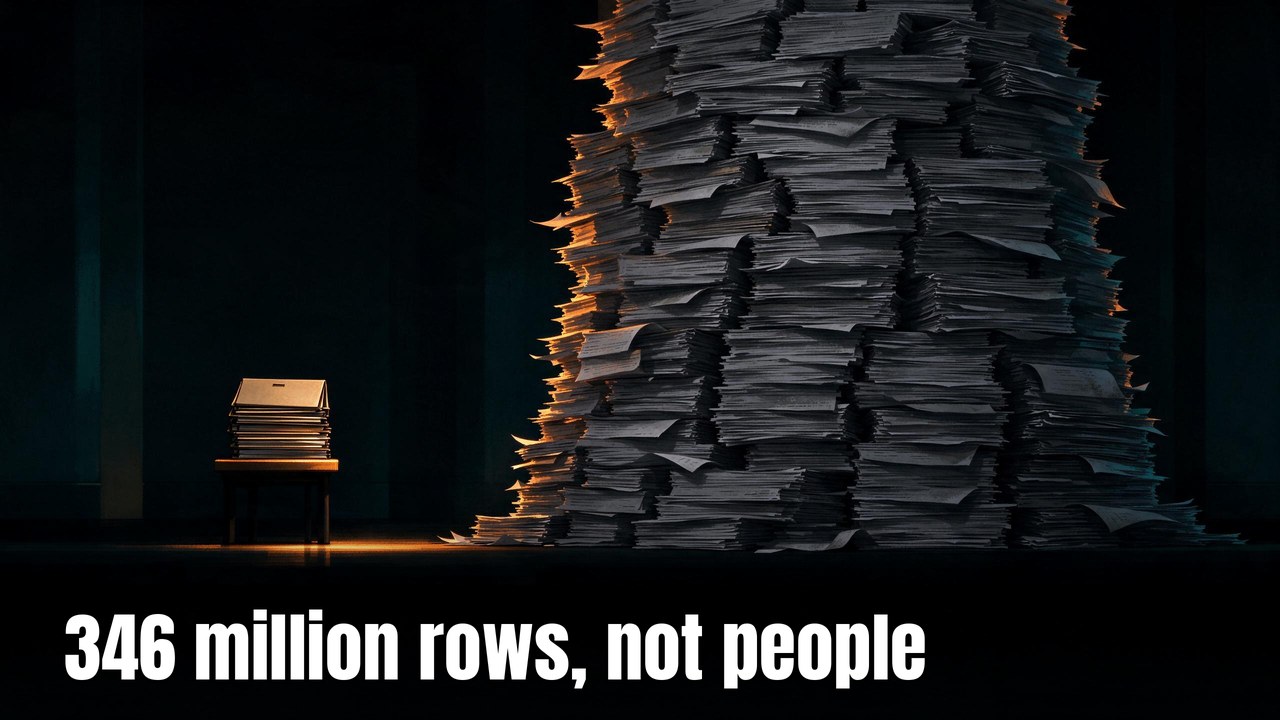
Within the space of a few weeks, two separate French government agencies confirmed they had been broken into, and both breaches trace back to an attacker using the same handle: ZeroBytes. One hit the tax authority. The other hit the Education Ministry’s staff-records system. What each agency officially admitted is fairly contained. What ZeroBytes then claimed on a criminal forum is a different story altogether, one built around a headline number, 346 million, that turns out to be far less alarming than it sounds once you ask a single question: how was it counted?
That question, more than the specifics of this one incident, is the useful thing to take away here. Breach numbers get repeated as if they were victim counts. Often they are not. They are raw data-dump metrics, and the gap between the two can be enormous.
Two agencies, one handle, ten days apart
France’s tax authority, the DGFiP (Direction Générale des Finances Publiques, the agency that manages income tax, property records and business registrations), discovered in mid-August that someone had been inside its systems since June. Around the same time, investigators traced a separate intrusion into a French Education Ministry system, this one dating back to the night of July 25. Both cases surfaced publicly within days of each other, and both were tied by security researchers to the same forum handle, ZeroBytes, after the actor listed data for sale on a cybercrime marketplace called PwnForums.
It is worth being precise about what that connection actually means. Neither the Finance Ministry nor the Education Ministry named ZeroBytes as the confirmed attacker in their own releases; the handle comes from journalists and threat trackers who monitor forums like PwnForums, not from the government’s own attribution. Both breaches also share a root cause that keeps showing up across unrelated incidents: not a broken firewall or a software flaw, but stolen login credentials reused by someone who was not their owner. It is the same weakness discussed in DecodeStack’s guide to zero-trust security, which treats every login as untrusted until proven otherwise, rather than assuming a valid password means a valid person. What the two agencies did confirm, independently, are two distinct and fairly narrow incidents. Understanding exactly where each one stops is the whole point.
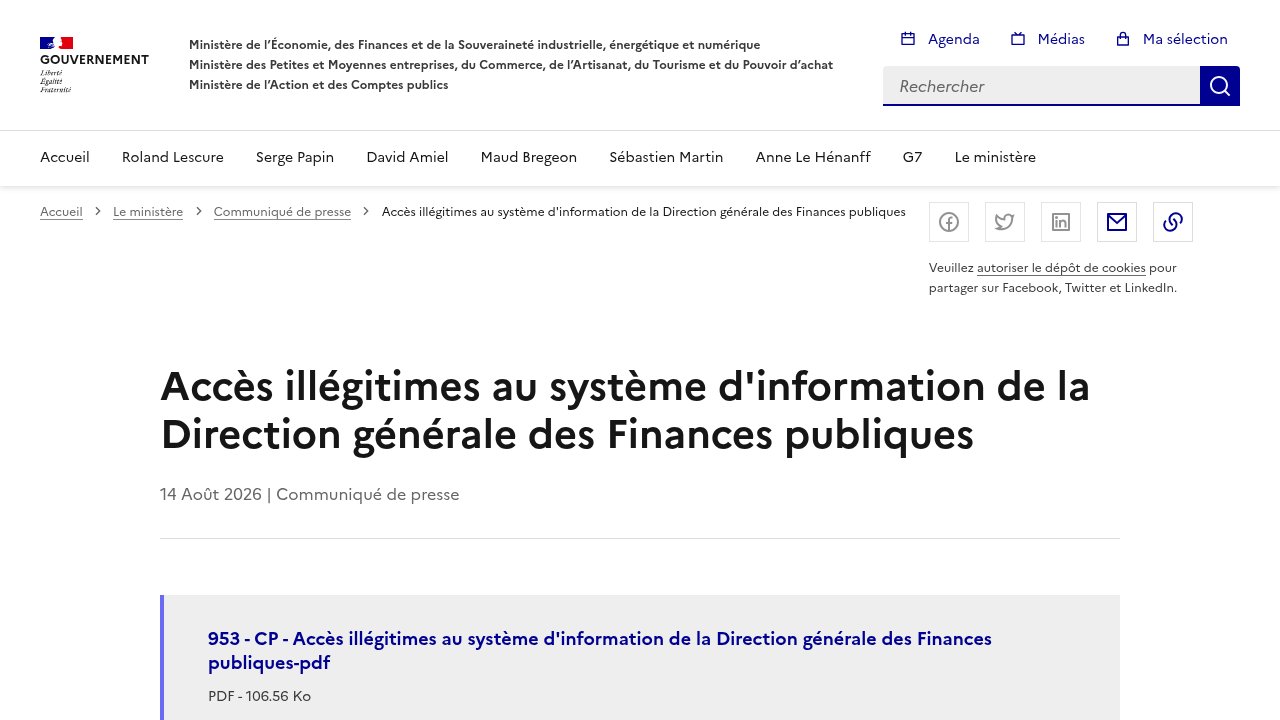
French Ministry of Economy and Finance — the official press release confirming unauthorized access to DGFiP systems.
What the tax authority actually confirmed
According to the French Ministry of Economy and Finance’s official press release (n°953), unauthorized access to DGFiP systems occurred in June and July 2026 through two stolen sets of credentials, one belonging to a DGFiP staff member, the other to an authorized third party working with the agency. That detail matters: this was not a single leaked password but two separate identities being impersonated.
The ministry states that the intrusion affected 678,000 individuals and businesses, and specifies exactly what was exposed: reference taxable income, family quotient (a French tax calculation based on household size), the individual withholding tax rate, company registration numbers for businesses, and cadastral data such as property addresses and surface areas. The release is equally explicit about what was not touched: login credentials and passwords for the online tax portal were not compromised, and the portal itself was not breached. Access was cut off as soon as the activity was detected, and the ministry says it has filed a complaint.
France’s independent data protection authority, the CNIL (Commission Nationale de l’Informatique et des Libertés, roughly the French equivalent of a national privacy regulator), corroborated the same categories of data independently in its own statement on August 18, and confirmed the same point about passwords staying untouched. The CNIL will run its own compliance checks; it says individual taxpayers do not need to file a complaint of their own, though it recommends staying alert for phishing attempts that try to exploit the exposed data.
The timeline is what turned this from a quiet intrusion into a public story: the access happened in June and July, but it was only after ZeroBytes listed a dataset for sale on PwnForums on August 12 that the ministry launched a deeper investigation, confirming the breach publicly on August 14.
What the Education Ministry confirmed, and drew a hard line around
The second incident is genuinely separate. According to Education Ministry statements published on education.gouv.fr, an intrusion occurred during the night of July 25, 2026, using a compromised professional account. The target was the ministry’s information system for staff training, not a student database, and not the general HR system for the whole ministry.
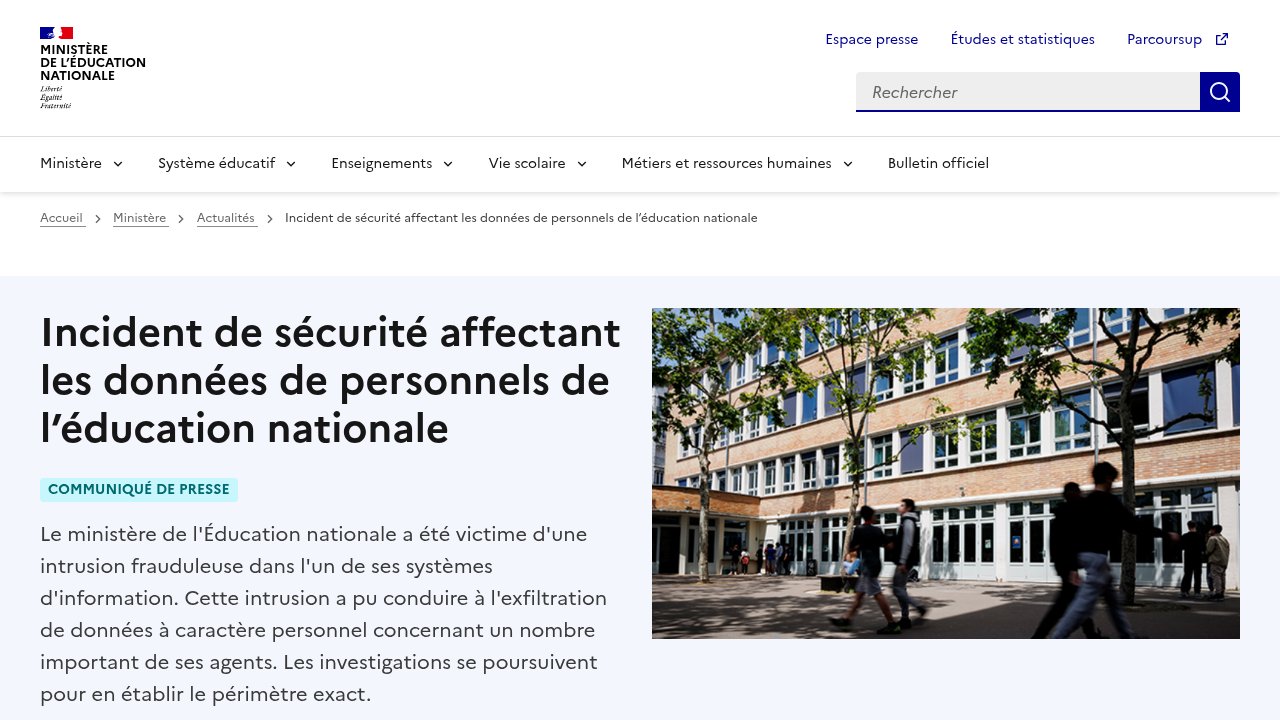
French Ministry of National Education — the official statement on the security incident affecting staff data.
The data involved is identity and professional information for academy staff (teachers and administrators) who have worked in a French school district since 2001, and for some individuals this includes home address, phone number, and social security number. The ministry’s own release is again specific about the boundary: banking data, passwords, and student data were explicitly not part of what was compromised, according to the confirmed scope.
A follow-up release on August 18, the same day ZeroBytes’s forum claim surfaced, acknowledged that data from the July 25 intrusion had subsequently been posted online. The ministry says it has filed a criminal complaint with the Paris prosecutor’s office and notified both ANSSI (France’s national cybersecurity agency) and the CNIL. It also states that the exact scope of what was taken is still being established through technical forensics, meaning the ministry itself has not yet closed the book on how far this goes.
The much bigger claim, and why it is still just a claim
This is where the story splits from what is confirmed into what is alleged. On the forum, and relayed by specialist trackers who monitor these communities, ZeroBytes described a dataset far larger than anything the ministry has acknowledged: 346,178,591 raw lines, roughly 43 gigabytes across some 2,500 files, supposedly including student records spanning all 33 academies, plus two LDAP directories (a type of system used to store and look up user account credentials across an organization) covering two specific academies, Créteil and Versailles, containing hashed passwords.
None of that wider scope, students, password hashes, 33 academies, has been confirmed by the Education Ministry. No public sample of the data has surfaced to verify the claim independently. It should be read exactly for what it is: an unverified posting on a criminal forum, made by the same actor behind a confirmed but much narrower breach. That distinction is not a technicality. It is the difference between a fact and an advertisement.
Why the biggest number in the story is also the least trustworthy
Here is the detail that makes this incident worth writing about beyond its own news cycle. ZeroBytes’s own numbers, once you dig one layer deeper into the same forum post, undercut the headline figure. According to an analysis of the actor’s own claims, after deduplication the 346 million raw lines reduce to 4,350,358 personal identifiers and 1,224,291 unique students. ZeroBytes itself noted that the larger figure spans more than 20 years of historical archives, not a current headcount.
That gap between 346 million and roughly 4.3 million is not a rounding error. It is the difference between counting every row in every export file, including duplicate entries and repeated fields across two decades of archives, and counting how many actual people the data describes. A raw line count from a stolen database dump is not the same measurement as a victim count, and treating the two as interchangeable is how a breach involving a few hundred thousand confirmed records turns into a headline about hundreds of millions.
This is not unique to ZeroBytes. It is a recurring pattern across large data leaks, similar to the way a compromised software package can multiply into thousands of downstream reports once every copy and every mirror gets counted, a dynamic covered in DecodeStack’s piece on how a single compromised dependency can cascade through thousands of downstream projects. A seller wants the biggest possible number attached to their listing, because a bigger number sells for more and draws more attention on the forum where it is posted. The incentive runs directly opposite to accuracy. The practical lesson for anyone reading about the next mega-breach headline is simple: before accepting a number in the hundreds of millions, ask whether it has been deduplicated, and ask over what time period the underlying data was collected. If neither question has an answer, treat the number as a sales pitch, not a measurement.
Don’t confuse this with April’s ÉduConnect incident
French education-sector breaches have made headlines more than once in 2026, which makes it easy to blur separate stories together. In April, the ministry disclosed a distinct issue affecting the student-account-management service attached to ÉduConnect (the portal itself, and accounts already activated on it, were explicitly not affected), caused by a flaw dating back to late 2025 that had already been patched by December of that year. That incident had no demonstrated connection to ZeroBytes and no link to the July intrusion described above. The number of students potentially affected by the April issue was never publicly quantified. It is a separate case, on a separate system, months earlier, and should not be read as an earlier chapter of the ZeroBytes story. A third, unrelated incident involving France’s FICOBA bank-account registry surfaced even earlier, in January and February 2026, through a different stolen credential entirely, and likewise has no established link to ZeroBytes.
What happens next
At a press conference in Paris on August 18, France’s minister responsible for public accounts, David Amiel, addressed the tax authority breach directly. “Yes, we apologize, because what happened is unacceptable for the French people,” he said, adding that “our information systems have weaknesses.” It is a rare instance of a government official naming the problem plainly rather than deflecting it, and it is worth noting because the rest of the official record, from both ministries, has been similarly direct about what was and was not compromised.
Senator Nathalie Goulet has been pushing for a parliamentary inquiry into the pattern of cyberattacks and data leaks affecting French public administration for months; her proposal was formally filed back in May, well before this particular case broke. She has since cited the DGFiP and Education Ministry incidents as further evidence for a fight she was already running, memorably describing the state of affairs as “France passoire,” a French phrase meaning, roughly, “France as a sieve.” It would be inaccurate to frame her push as a reaction to ZeroBytes specifically. It predates it. She is simply pointing at the newest exhibit in an argument she had already made.
For anyone whose data may have been included in the confirmed 678,000-record DGFiP breach or the Education Ministry’s staff-training system, the practical advice from the CNIL stands: no individual complaint needs to be filed, but staying alert to phishing attempts is worth doing, and the regulator is running its own compliance review of the agencies involved, which could lead to further findings or penalties later. The unresolved part is the Education Ministry’s own admission that the true extent of the July intrusion is still being determined. Until that forensic work concludes, the honest answer to “how bad is this” is: bounded by what has been confirmed, and separate from what has merely been claimed.

Frequently asked questions
Is ZeroBytes a state-sponsored hacking group?
No named authority, government or independent, has attributed this attacker to a nation-state. Press coverage describes ZeroBytes as a financially motivated actor operating on the criminal forum PwnForums; neither the DGFiP nor the Education Ministry has publicly named or attributed the intrusion to ZeroBytes in their own official releases.
Were my tax login credentials stolen in the DGFiP breach?
No. Both the Finance Ministry’s official statement and the CNIL’s independent review explicitly confirm that login credentials and passwords for the online tax portal were not part of the data accessed. The exposed categories were reference income, family quotient, withholding tax rate, business registration numbers, and cadastral data.
Was student data taken in the Education Ministry breach?
The confirmed intrusion, dated to the night of July 25, targeted a staff-training system, and the ministry explicitly states student data was not part of that confirmed scope. A separate, unverified claim by ZeroBytes on a criminal forum alleges student records were also taken, but no independent sample has been published to confirm that broader claim.
Why do breach numbers like 346 million turn out to be so much smaller?
Large claimed figures often count raw rows in a data dump, including duplicate entries and years of historical archives, rather than unique individuals. In this case, ZeroBytes’s own claimed 346 million raw lines reduce to roughly 4.3 million personal identifiers once duplicates are removed, a pattern common across major data-leak claims where sellers have an incentive to inflate the headline number.
Is this the same incident as the April ÉduConnect breach or the FICOBA banking-file leak?
No. Both are separate, earlier incidents with no demonstrated link to ZeroBytes. The ÉduConnect issue was a patched flaw disclosed in April, dating to late 2025. The FICOBA banking-file incident occurred in January and February 2026, disclosed in February, and involved a different stolen credential entirely.