NVIDIA RTX Spark: A Laptop Made to Run Big AI Models Without the Cloud
NVIDIA's RTX Spark swaps fast memory for a huge shared pool, letting a laptop run AI models too big for any graphics card. Who it's really for.
Running an AI model on your own computer, instead of renting one in the cloud, has two plain advantages: no monthly bill, and nothing you type ever leaves the machine. NVIDIA’s RTX Spark is built squarely for that idea, a new kind of Windows laptop and small desktop, made with Microsoft, designed to run AI on the device itself. Underneath the launch noise sits one decision that should drive your whole judgment, and it has nothing to do with the logo: the RTX Spark trades fast memory for a much larger pool of it. Understand that trade and you’ll know, in one read, whether the machine is for you or a waste of money.
Bigger memory, not faster
When an AI model runs, its “brain”, the billions of numbers it learned during training, has to sit in memory the graphics chip can read. There are two ways to build that memory, and they pull in opposite directions.
A normal gaming graphics card carries its own dedicated memory: small, but very fast. A high-end laptop card holds around 16 gigabytes. The RTX Spark does it the other way. It uses one large pool of memory, up to 128 gigabytes, shared between the main processor and the graphics, the same approach Apple uses in its Macs. Far more room, but each read is slower.

The speed of that memory matters more than it sounds. To write a single word of an answer, the chip reads the entire model out of memory, then reads it all again for the next word, and the next. How fast the chip can read its memory is what sets how fast the answers appear. Engineers call that reading speed bandwidth, and a card with fast dedicated memory simply produces text quicker.
So the small fast card wins on speed. The catch is that a model only runs at all if it fits entirely in memory. A large model, the kind with seventy billion internal settings, needs far more than the 16 gigabytes a laptop card offers. On that card it simply will not load. On the RTX Spark’s 128-gigabyte pool, the same model loads and answers, slowly but successfully.
That is the whole point in one line: the RTX Spark is not faster, it is bigger. Which turns the buying question into something simple and durable: match the machine to the size of the model you actually want to run. A small model that fits an ordinary card has no business on a big slow pool. A model too large for any card has nowhere else to go in a laptop. The prices and part names will date; this trade-off will not.
What NVIDIA actually announced
NVIDIA and Microsoft introduced the RTX Spark as the first Windows machines built specifically to run AI “agents” on the device. An agent here means software that doesn’t just answer questions but actually carries out tasks for you, opening apps, moving files, stringing several steps together, on your own hardware instead of a company’s servers.
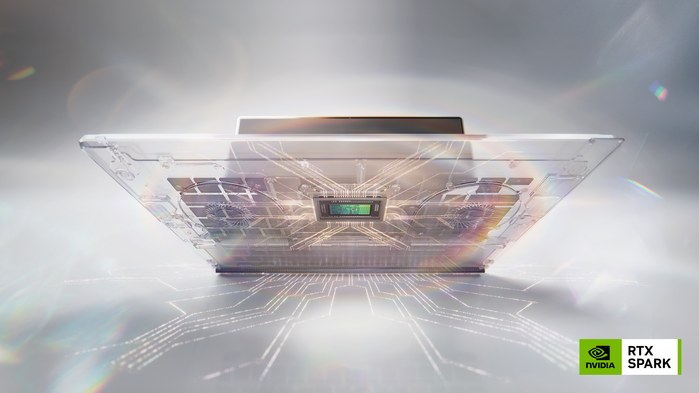
The chip inside is what NVIDIA calls a superchip, simply one piece of silicon that fuses two parts usually kept separate: the main processor (built with phone-chip specialist MediaTek to keep power draw low) and an NVIDIA graphics engine, both feeding from that single memory pool. The machines arrive in fall 2026 as thin laptops and small desktops from the usual names, Dell, HP, ASUS, Lenovo, MSI, and Microsoft’s own Surface, rather than one flagship device.
What NVIDIA has been quieter about matters just as much. It has not published how fast that shared memory actually is, the very number that decides everything above, and no independent reviewer has yet measured a shipping machine. Prices floating around put these laptops well below a developer workstation and squarely in premium-laptop territory, but those are estimates, not confirmed tags. Treat every speed claim on the launch slides as a hopeful floor until someone outside NVIDIA runs the tests.
Don’t confuse it with the DGX Spark
This is the mix-up that costs money. NVIDIA sells a second product with almost the same name, the DGX Spark, and it is a different thing built on a different chip. The DGX Spark is a small desktop box for engineers, sold as a complete appliance you leave on a desk and connect to over a network, running on a chip called the GB10. (ASUS sells its own version of that same box, the Ascent GX10.) It costs roughly twice what the consumer laptops are expected to, and it is aimed at people building AI models, not using them.
The RTX Spark is the opposite end: a Windows laptop you close and put in a bag. Same broad chip family, different chip, different buyer. If you remember one thing before shopping, make it this: the DGX Spark is a developer’s desk appliance, the RTX Spark is a personal laptop. Assuming the two share a chip, or buying one when you meant the other, is the single most common error in the early coverage. For the desk-bound box and how it compares to a top gaming card, see our DGX Spark breakdown.
NVIDIA is late to this idea, but brings one thing rivals can’t
The large shared memory pool is not NVIDIA’s invention. Apple has built its Macs this way for years, and AMD sells the same idea on Windows. They all make the same promise: one big memory pool so a large model loads where a small fast card would choke. On raw memory, the field is crowded and the ceilings overlap.
What NVIDIA brings that the others cannot is software compatibility. Most AI tools have been written, over more than a decade, for NVIDIA hardware specifically, through NVIDIA’s software layer called CUDA. A developer who has spent years building on CUDA can carry that work straight to the RTX Spark, where the same work does not simply move to an Apple or AMD machine. That existing pile of software, not the chip itself, is NVIDIA’s real advantage here, assuming the speed turns out to be competitive once it is finally measured.
Who it’s for, and who should wait
The decision sorts cleanly by what you load into memory.
If you need to run large AI models on the move, models too big for any normal laptop card, the RTX Spark’s 128-gigabyte pool is, for now, the only laptop that loads them. That is a real and narrow reason to want one, and it is worth following through the first wave of reviews.
If you mostly play games or run smaller models that already fit an ordinary graphics card, a standard high-end laptop will be faster and probably cheaper. The shared pool buys you nothing you’d actually use, and you’d be paying for capacity you never touch.
Everyone else should simply wait for the two numbers NVIDIA hasn’t given yet: how fast the shared memory really is, and how the software performs on real hardware. The machines ship in fall 2026, and there’s no cost to letting independent reviews settle whether the RTX Spark lives up to its announcement. A launch slide is a promise, not a measurement.

The takeaway
The RTX Spark is, at the same time, a genuinely new kind of personal AI machine and a familiar idea with a famous logo on it, and which one it turns out to be depends on a number NVIDIA hasn’t shared. The rule for buying it, though, is already clear and won’t expire: its one real advantage is room for models a normal card can’t hold. If what you run fits on an ordinary card, that card is the better buy. Size the machine to the model, and the choice makes itself.
Frequently asked questions
Is the RTX Spark the same as the DGX Spark?
No, and they don’t even share a chip. The DGX Spark is a desktop appliance for engineers building AI models, built on a chip called the GB10 and sold as a box you connect to over a network (ASUS sells its own version, the Ascent GX10). The RTX Spark is a consumer Windows laptop for people who want to run AI on a machine they carry. Different chip, different shape, different buyer.
Why run AI on my own machine instead of the cloud?
Two reasons: cost and privacy. A cloud AI service charges you for use, month after month, while a machine you own you pay for once. And anything you type into a model running locally stays on the device, which matters for confidential work. The trade is that your own machine will rarely match the raw speed of a data center, and you handle the setup yourself.
Can the RTX Spark really run big AI models?
Yes, that is its whole reason to exist. Its 128-gigabyte shared memory loads models a normal laptop card cannot, because a typical card tops out around 16 gigabytes. The catch is speed: big models run, but slowly, and NVIDIA hasn’t yet said exactly how slowly. If a model fits comfortably on an ordinary card, that card will answer faster.
Should I buy one now?
Probably not yet, unless you specifically need to run very large models away from a desk. The key performance numbers haven’t been measured by anyone outside NVIDIA, and the machines only ship in fall 2026. Waiting for the first independent reviews costs nothing and tells you whether the real speed matches the promise.