Nemotron Embed and the RAG Token Cost Nobody Budgets For
NVIDIA's Nemotron 3 Embed model ranks well on retrieval benchmarks. A third-party test shows why that also means fewer searches, and a smaller AI token bill.

Nemotron Embed and the RAG Token Cost Nobody Budgets For
When a company complains that its AI assistant got expensive to run, the first suspect is usually the big language model doing the talking. A less obvious cost driver sits earlier in the pipeline: the small model that decides which document snippet the assistant even gets to read. Get that step wrong, and the assistant searches again, and again, each attempt adding tokens (the billing unit AI providers charge by) to the tab. NVIDIA recently released a new version of this quieter component, called Nemotron 3 Embed, and a third-party reviewer ran a small, transparent test to see whether a better version of it actually saves money in practice, not just points on a scoreboard.
What Nemotron 3 Embed actually is (and isn’t)
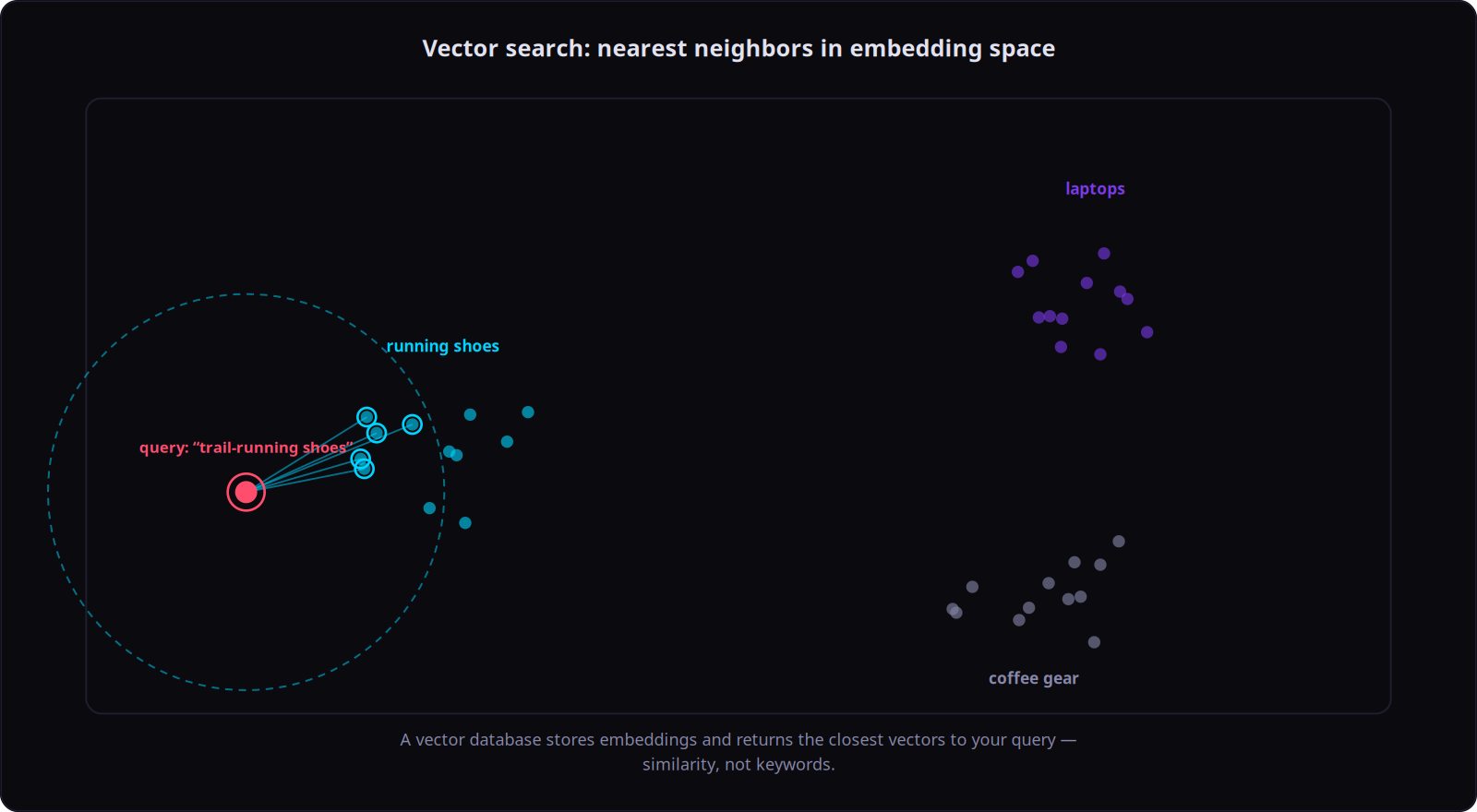
Most people who’ve heard of an AI model picture something like ChatGPT: you type a question, it writes an answer. An embedding model does something quieter and more mechanical. It reads a chunk of text, whether a paragraph, a policy document, or a support ticket, and converts it into a long list of numbers that captures what the text is about. Two chunks that mean similar things end up with similar number-lists, even if they don’t share a single word. That’s what lets a search system find the passage about renewable subsidy caps when the user typed a question about clean energy tax limits.
This matters most in retrieval-augmented generation, usually shortened to RAG: instead of a language model answering purely from what it memorized during training, it first searches a company’s own documents for relevant passages, then writes an answer grounded in what it found. The embedding model is the part doing the finding. If it hands back the wrong passage, the AI model on top either gives a bad answer or, in an autonomous agent setup, decides to search again.
Nemotron 3 Embed is NVIDIA’s newest entry in this space, and the variant getting attention is the smallest one, a 1-billion-parameter model called Nemotron-3-Embed-1B. It’s built, per NVIDIA’s own model card on Hugging Face, by starting from Mistral’s Ministral-3-3B model and running it through two rounds of pruning (trimming parts of the network that contribute least) and distillation from NVIDIA’s own larger Nemotron-3-Embed-8B model (training a smaller model to mimic a larger one’s behavior). NVIDIA didn’t build this from a blank sheet; it’s a smaller, specialized descendant of an existing open model.
Worth a moment of disambiguation, because NVIDIA reuses the Nemotron name across very different products: this is not Nemotron 3 Nano, a separate backbone NVIDIA uses elsewhere for on-device tasks, and it’s not Nemotron 2-Tower 30B, a full generation model with a hybrid architecture unrelated to search. Same family branding, different jobs entirely. If you’re evaluating one, make sure it’s actually the embedding model, not a cousin with a similar name.
On licensing, worth stating plainly since it’s easy to get wrong: Nemotron-3-Embed-1B ships under OpenMDW-1.1, an NVIDIA-authored open-weight license, not Apache or MIT as has been reported elsewhere. The underlying Ministral base model remains Apache 2.0. Commercial use is explicitly allowed either way, so the practical difference for most teams is small, but the label itself isn’t interchangeable.
On NVIDIA’s own reported numbers, the model scores 72.38% NDCG@10 (a standard retrieval accuracy metric, roughly how close to the top the right answer landed) on the RTEB benchmark, and NVIDIA describes it as achieving state-of-the-art performance among comparably sized models on RTEB (the outright top overall spot on the leaderboard belongs to the larger 8-billion-parameter Nemotron 3 Embed variant, not this one). It handles 34 languages and can process chunks up to 32,768 tokens (words and word-fragments) long in one pass. Those are NVIDIA’s claims, from its own model card, and worth treating as exactly that: a vendor’s benchmark result, useful as a starting signal, not a guarantee for any particular use case.
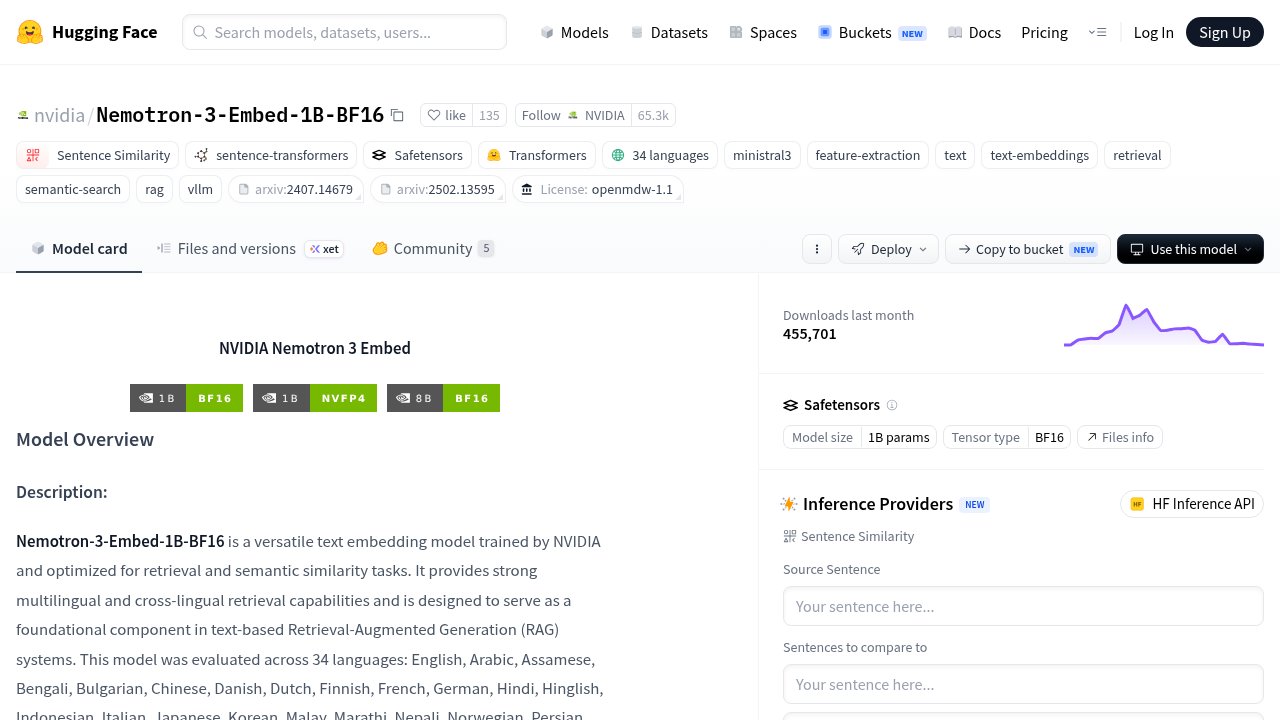
NVIDIA Nemotron-3-Embed-1B — the embedding model this article is about, shown on its official Hugging Face model card.
Why a better embedder is a cost problem, not just an accuracy one
Here’s the mechanism that connects search accuracy to a dollar figure. When an AI agent (a system that can take multiple automated steps toward a goal rather than answer once and stop) searches a document store and doesn’t find a good enough passage, it doesn’t just fail quietly. It usually tries again: rephrases the query, searches a different angle, or breaks the question into sub-parts and searches each one. Every one of those extra search cycles feeds more text back into the language model’s context window, and every word in that context window counts toward the token bill, since most AI providers charge per token processed.
So a weak embedder doesn’t just produce a worse answer sometimes. It produces a slower, more expensive path to the same answer, because the agent compensates for bad retrieval by searching more. This is also why retrieval and fine-tuning solve different problems: no amount of retraining the language model fixes a retrieval layer that keeps handing it the wrong passage. This is easy to miss because nobody puts embedding model accuracy on a monthly invoice. What shows up on the invoice is the token count, and token count is downstream of how many searches it took to find the right passage. If a team is watching their AI agent’s running cost creep upward and hasn’t looked at the retrieval layer, choosing the right vector database for storing those embeddings and the embedding model feeding it are both worth auditing before assuming the language model itself is the expense.
The test: same corpus, same agent, only the embedder changes
Benchmark scores like NDCG@10 are useful for comparing embedding models against each other in the abstract, but they don’t tell a reader running an actual AI agent how much that ranking translates into real savings. A third-party reviewer, not NVIDIA, set out to measure that translation directly, and the method is worth walking through because it’s the kind of test anyone with a document collection and an API key could rerun on their own material.
The setup: a small corpus of 25 text chunks, drawn from ocean and whale conservation policy documents, indexed twice. Once using a baseline local embedding model, nomic-embed-text, run through Ollama (a tool for running AI models on your own machine rather than a cloud service). And once using Nemotron 3 Embed 1B, pulled from Hugging Face. Everything else in the pipeline stayed fixed: the same language model, Qwen3 8B, acted as the search agent both times, asked the identical three multi-hop questions (questions that require pulling together facts from more than one document to answer). Every search call the agent made, and every token it consumed doing so, was logged.
That single-variable design is what makes the result readable at all. If the corpus, the questions, or the agent model had changed between runs, any difference in token count could be explained by a dozen other factors. Holding everything constant except the embedder is what lets a difference in outcome be attributed to the embedder specifically.
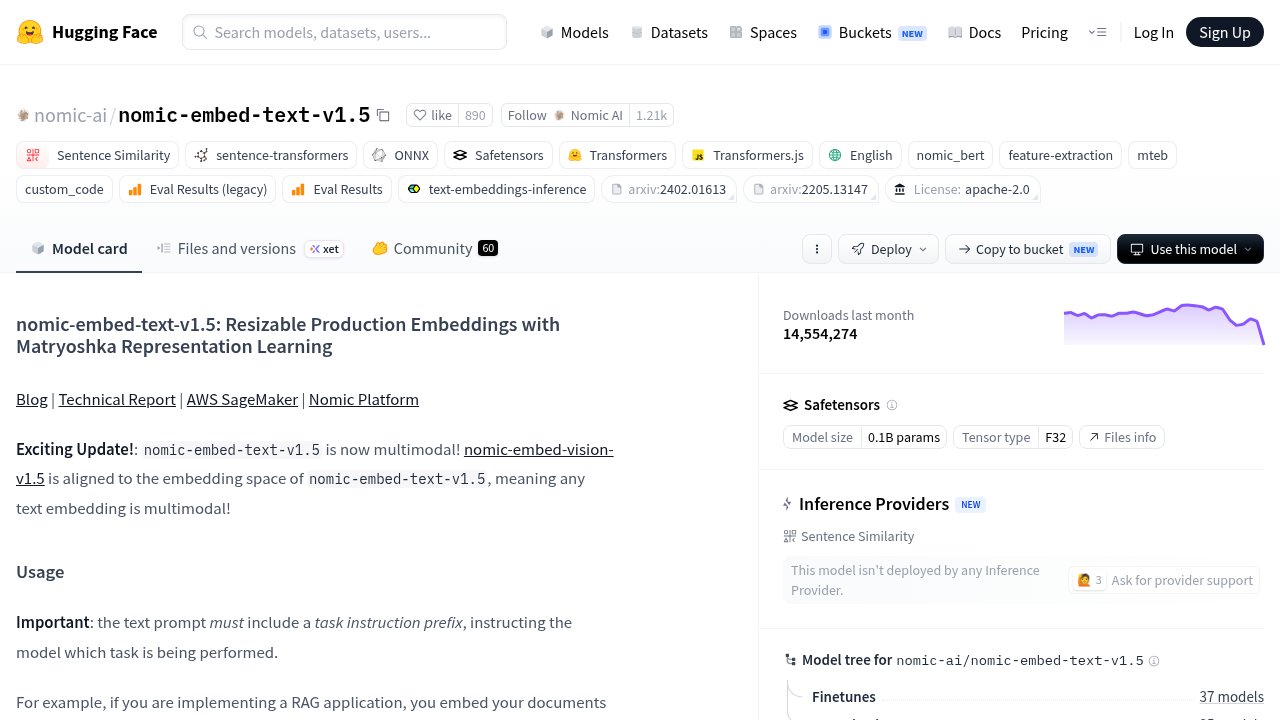
nomic-embed-text — the baseline embedding model in this test, run locally through Ollama.
What the numbers showed, and what they didn’t
Across the three multi-hop questions, the baseline embedder (nomic-embed-text) drove the agent to make 15 separate searches, consuming roughly 12,688 tokens in the process. With Nemotron 3 Embed 1B swapped in and nothing else changed, the same agent needed 11 searches and about 8,734 tokens, a 31% drop in tokens and four fewer search calls on this specific corpus, these specific questions, and this specific agent. On one isolated question the gap was even starker: 5 searches, 3 conversational turns, and 4,231 tokens with the baseline embedder, versus 3 searches, 2 turns, and 2,110 tokens with Nemotron, roughly half the cost, for an answer the reviewer judged equivalent or better organized.
That’s a real, mechanically clean result on this test run. It is not a statistically robust study, and treating -31% as a number that transfers to a different corpus, a different agent, or a different question style would be a mistake. Three questions and one 25-chunk corpus is a small sample by any standard; it demonstrates that the mechanism works (better retrieval does reduce search iterations, which does reduce tokens) without proving a specific magnitude that any other RAG deployment should expect to see. NVIDIA’s 72.38% NDCG@10 figure and this reviewer’s 31% token reduction are two different kinds of evidence: one is a vendor’s own benchmark claim about ranking quality, the other is one independent person’s measured, reproducible protocol on one small dataset. Neither substitutes for the other, and neither should be quoted as if it applies universally.
What this means for a RAG system already in production
The durable takeaway isn’t the percentage. It’s the shape of the test. Anyone running a production RAG system who suspects the token bill is creeping up has a reproducible way to check whether the embedding layer is the cause: take a representative slice of their own document set, index it with their current embedding model and with a candidate replacement, point the same agent and the same test questions at both, and log the search counts and token totals. That comparison, run on a company’s actual documents and actual query patterns, tells them something a public leaderboard cannot: whether swapping the embedder would meaningfully cut their specific bill.
This also reframes where to look first when an open-weight LLM choice or an agent’s running cost feels off. The instinct is to blame the language model doing the writing, since that’s the visible, talkative part of the system. But in a RAG pipeline, the language model spends tokens reacting to what the embedder handed it. A retrieval layer that returns the right passage on the first try gives the language model less reason to loop back and search again, and that discipline compounds every time the agent runs.

Frequently asked questions
What is an embedding model, in plain terms?
An embedding model converts a piece of text into a list of numbers that represents its meaning, so a search system can find related content even when the wording doesn’t match exactly. It’s the component that does the finding in a retrieval-augmented generation, or RAG, system, before a language model writes the actual answer.
Is Nemotron 3 Embed the same as Nemotron 3 Nano or Nemotron 2-Tower?
No. Nemotron 3 Embed 1B is a dedicated retrieval and search model, while Nemotron 3 Nano is a separate NVIDIA backbone used in other products, and Nemotron 2-Tower 30B is an unrelated text-generation model with a different, hybrid architecture. They share a brand prefix, not a purpose.
Does a 31% token reduction mean every RAG system will save 31% by switching?
No, and this figure shouldn’t be read that way. It came from one reviewer’s test: a single 25-chunk corpus, three multi-hop questions, and one agent model, changing only the embedder. It’s a clean demonstration that better retrieval lowers token spend, not a universal percentage any other deployment should expect.
What license does Nemotron 3 Embed use?
Nemotron-3-Embed-1B is released under OpenMDW-1.1, an NVIDIA open-weight license, not Apache or MIT. The base model it was distilled from, Ministral-3-3B, remains under Apache 2.0. Commercial use is permitted under either.
How would I test this on my own documents?
Index a representative sample of your own document set twice, once with your current embedding model and once with a candidate replacement, then run the same AI agent against both using identical test questions while logging every search call and token consumed. The side-by-side token totals, not a published benchmark score, tell you whether switching would actually lower your bill.
The takeaway
A retrieval benchmark score is a starting signal, not a purchase decision. What actually shows up on an AI agent’s bill is how many times it had to search before it found the right passage, and that number is set by the embedding model, not the language model getting the credit or the blame. The way to know whether a better embedder is worth adopting isn’t to trust a headline percentage from anyone’s test, including this one. It’s to run the same comparative protocol, one corpus, one agent, only the embedder changed, on the documents and questions that actually make up the workload in question.