The Nvidia CUDA Moat: Why AMD's Chips Can't Close the Gap
Nvidia's real advantage over AMD isn't its chips, it's two decades of software nobody wants to rewrite. Here's how CUDA built that gap.
Nvidia’s market value has stayed above $5 trillion since late 2025. Every headline about it mentions the latest chip: Blackwell, H100, whatever comes next. Almost none of them mention the real reason a company that sells hardware is this hard to compete with: a piece of software from 2006 called CUDA, short for Compute Unified Device Architecture. It is not a chip and not an AI model. It is the programming layer that lets a graphics card do math it was never originally built for, and it is the reason Nvidia’s closest hardware rival, AMD, keeps losing a race it is no longer losing on hardware.
The stake here is not abstract. Every AI lab, every cloud provider, every startup buying GPUs is making a bet on which company’s software they will depend on for years. Understanding why that bet keeps landing on Nvidia tells you something durable about how technology monopolies actually form, long after the initial hype fades.
A chip built to do many small things at once
For anyone who has weighed buying a GPU for running AI models at home, the distinction between a CPU and a GPU is worth settling first. A regular computer processor, the CPU (central processing unit), is built to do one complex task very fast, then the next, then the next, in careful sequence. A graphics processor, the GPU, takes the opposite approach: it does thousands of simple tasks at the same time. That design exists because rendering a video game screen means calculating the color of millions of pixels simultaneously, not one after another.
It turns out that this same trick of doing many small things at once is exactly what training and running AI models requires. Both involve enormous grids of numbers being multiplied together, over and over. A CPU chews through that one calculation at a time. A GPU splits it across thousands of tiny cores and finishes in a fraction of the time.
But here is the part most explanations skip: for a lot of AI work today, especially running a trained model to generate answers (what’s called inference), the bottleneck is not the math at all. It is moving data. To produce a single word of a chatbot’s reply, the chip has to pull the model’s entire set of learned values, its weights, out of memory and into the calculating cores. The arithmetic itself takes almost no time; shuttling billions of numbers across the chip does. This is why a GPU’s memory bandwidth, how fast it can move data internally, matters as much as its raw calculating speed. On Nvidia’s H100 chip, that bandwidth runs about 3.35 terabytes per second (SXM version). It’s also why the size of a model you can actually run depends on how much memory, or VRAM, a card has: a 7-billion-parameter model needs roughly 14 gigabytes to simply hold its weights, a 70-billion one needs more than most single cards offer, and anything larger forces labs to chain dozens of GPUs together just to fit the model in memory at all.
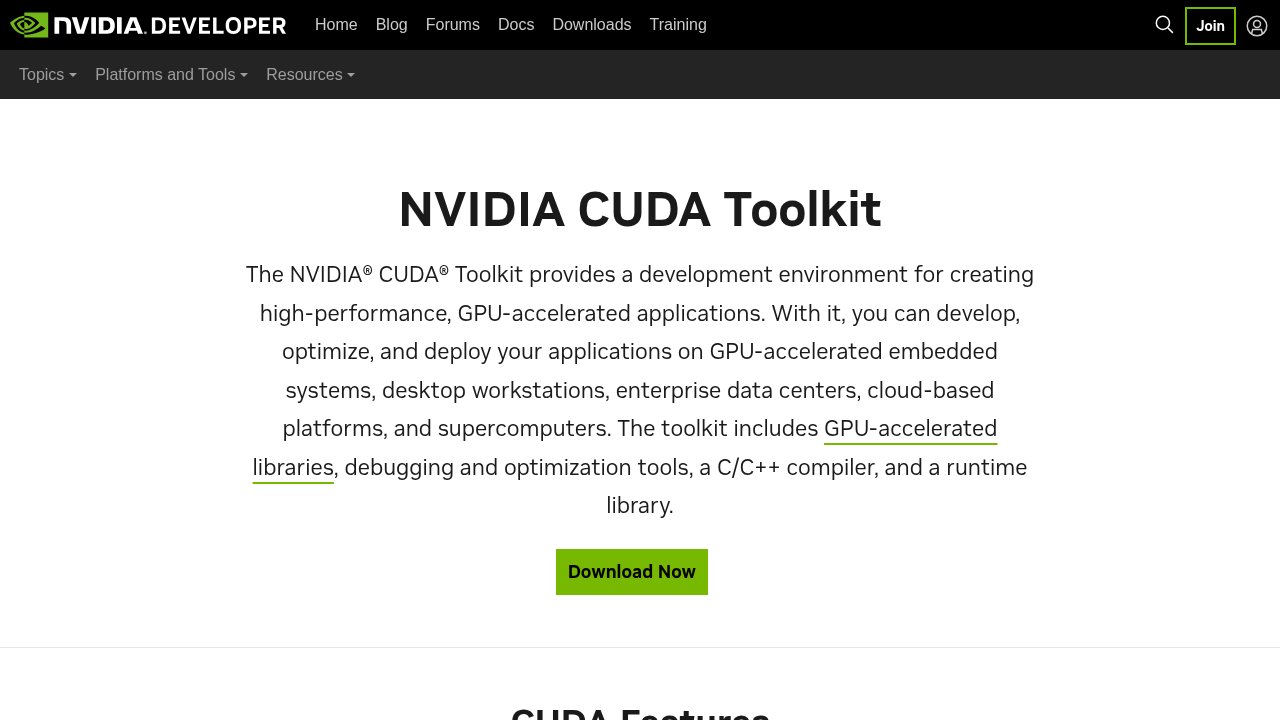
NVIDIA CUDA Toolkit — the official developer page for the platform this article is about.
A graduate student’s side project
CUDA’s origin is not a boardroom decision. In the early 2000s, a Stanford graduate student named Ian Buck was experimenting with using ordinary graphics cards, built for games, to run general scientific calculations that had nothing to do with rendering images. He built a research language called Brook to make that possible on the GeForce cards of the time. It was a workaround, not a product: graphics chips weren’t designed for this, and coaxing them into it required tricking the hardware into treating scientific data like it was pixels on a screen.
Nvidia noticed. The company hired Buck and, in November 2006, unveiled CUDA alongside its GeForce 8800 graphics card, with the SDK reaching the public in early 2007. Where Brook was an academic hack, CUDA was a real toolkit: a way for any programmer, not just a handful of researchers who understood graphics internals, to write code that ran on a GPU’s parallel cores without pretending it was a graphics problem. At the time, there was no market for this. AI as a mainstream industry didn’t exist yet. Nvidia built and funded the groundwork for a use case that hadn’t been invented.
The platform, not the chip, is the product
This distinction matters more than almost anything else in this story: CUDA is software, not silicon. It is a programming platform, a set of tools and a language extension that lets developers write instructions for Nvidia GPUs. A chip is a one-time purchase. A platform is something thousands of engineers build careers, code libraries, and entire companies on top of.
Once researchers started writing their training code in CUDA, switching away meant more than buying a different brand of card. It meant rewriting software, retraining staff, and abandoning a decade of accumulated tools built specifically for Nvidia’s platform. cuDNN, Nvidia’s deep-learning library, and most major AI frameworks like PyTorch and TensorFlow, were built with CUDA as their foundation first and everything else as an afterthought. The chip is replaceable. The platform underneath it, and everyone’s familiarity with it, is not.
The moment the whole field switched
The turning point came in 2012. Three researchers at the University of Toronto, Alex Krizhevsky, Ilya Sutskever, and their advisor Geoffrey Hinton, entered an image-recognition competition called ImageNet with a deep learning model later known as AlexNet. It won by a staggering margin: a top-5 error rate of 15.3% against 26.2% for the second-best entry. The detail that mattered for Nvidia: Krizhevsky trained the model using CUDA, with training for five to six days on two GTX 580 GPUs.
That single result is widely credited as the spark that pulled deep learning out of academic obscurity and into the industry-defining field it became. Every lab studying the result saw the same conclusion: GPUs, running CUDA, were the path forward. Within a few years, CUDA wasn’t one option among several for AI researchers. It was the default, taught in university courses, baked into every major framework, assumed by every new graduate entering the field.
Why AMD’s comparable chips still can’t close the gap
This is where the AMD comparison becomes useful, not as a scoreboard but as proof of the actual thesis. AMD has shipped GPUs that are genuinely competitive with Nvidia’s on raw specifications. Its answer to CUDA is ROCm, an open-source platform that does, on paper, much of what CUDA does. There is also OpenCL, an open industry standard meant to work across any vendor’s hardware. Neither has gained meaningful traction in AI workloads: Nvidia still holds roughly 80% of data-center AI accelerator revenue, according to analyst estimates, with AMD in the mid-to-high single digits.
The reason isn’t a missing feature. It’s two decades of accumulated dependency. Every tutorial, every pretrained model checkpoint, every open-source library optimization, every engineer’s muscle memory assumes CUDA underneath. Switching platforms isn’t like switching phone brands, it’s closer to an entire industry agreeing to leave the App Store at once. No single company or lab wants to be the first to bet its product on a less-tested platform, so almost none do, even when the hardware underneath is comparable. AMD has to not just match Nvidia’s chip, it has to convince an entire ecosystem of developers to rewrite work that already runs. The same dependency shows up further down the stack too: when picking open-weight AI models to run locally, nearly every toolchain still assumes CUDA by default, which is part of why Nvidia hardware remains the path of least resistance even for hobbyists.
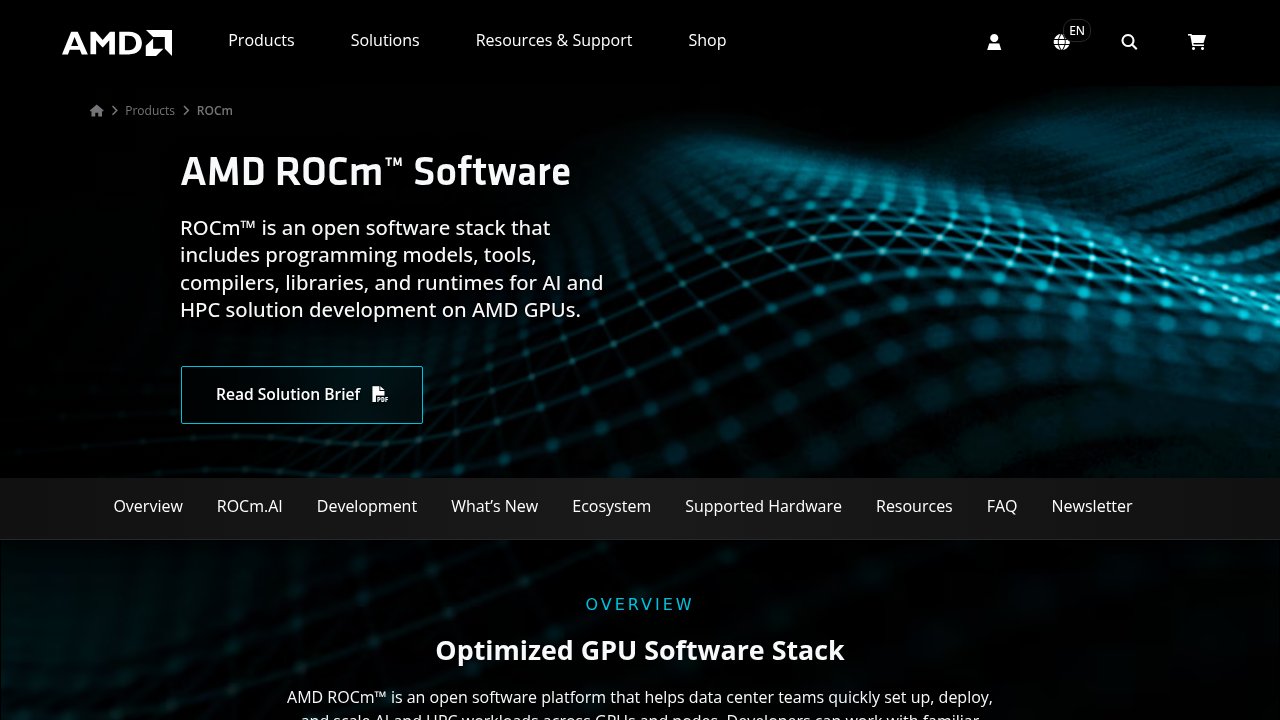
AMD ROCm — AMD’s open-source answer to CUDA, built for its Instinct, Radeon, and Ryzen AI hardware.
The moat that compounds
CUDA explains the technical lock-in. What keeps the gap widening is what Nvidia has done with the resulting market position. Nvidia’s fiscal 2026 results show Data Center revenue, the segment that covers AI chips and the servers built around them, at $193.7 billion, close to 90% of the company’s total $215.9 billion in revenue for the year. Those are Nvidia’s own reported figures, not press estimates.
Nvidia used some of that position to buy Mellanox, a networking hardware company, in a roughly $7 billion all-cash deal ($125 per share) that closed on April 27, 2020. Mellanox’s InfiniBand networking became the backbone that links entire racks of GPUs together at data-center scale, complementing NVLink, Nvidia’s own high-speed connector, built years earlier, for linking GPUs within a single server, so thousands of chips behave, for large AI workloads, like a single giant chip. That’s the real competitive layer above CUDA: it’s not enough to build one fast GPU anymore. Training today’s largest models requires thousands of GPUs working in concert, and the company that controls both the software layer and the interconnect that ties the hardware together controls the entire stack a customer has to buy into.
In late October 2026, Nvidia’s market value stood around $5.2 trillion. That number will be outdated within months; markets move. What won’t move nearly as fast is the two-decade head start CUDA has on any alternative, built one research paper, one framework, one trained engineer at a time.

FAQ
What exactly is CUDA, in plain terms?
CUDA is a software platform built by Nvidia and unveiled in November 2006, with the public SDK following in February 2007, that lets programmers run general calculations on a graphics card, not just graphics rendering. It turned GPUs, originally built for video games, into general-purpose computing tools, which later made them ideal for training AI models.
Is CUDA the same thing as a GPU?
No. A GPU, graphics processing unit, is the physical chip. CUDA is the software layer that runs on top of Nvidia’s GPUs, letting developers write code for them. You need both: an Nvidia GPU as the hardware, and CUDA as the toolkit to program it.
Why can’t AMD just build its own version of CUDA?
AMD has built one, called ROCm, and it works technically. The obstacle isn’t engineering, it’s adoption: nearly every AI framework, tutorial, and pretrained tool was built and tested on CUDA first, so switching costs labs and companies far more in rewritten code and retraining than most are willing to spend.
Why does memory speed matter as much as raw processing power for AI chips?
Running a trained AI model to generate a response is largely a data-movement problem, not a math problem. The chip has to pull billions of stored values from memory before it can calculate anything, so a GPU’s memory bandwidth, how fast it moves data internally, often determines real-world speed more than its peak calculation rate does.
Did Stanford invent CUDA?
No, and this is a common mix-up. Ian Buck, then a Stanford graduate student, built an earlier research language called Brook in the early 2000s that inspired CUDA, but CUDA itself was built and unveiled by Nvidia in 2006. The 2012 AlexNet breakthrough that made CUDA the AI industry’s default was developed at the University of Toronto, not Stanford.